Clodagh Finn: What it was like meeting my birth father for the first time, aged 26
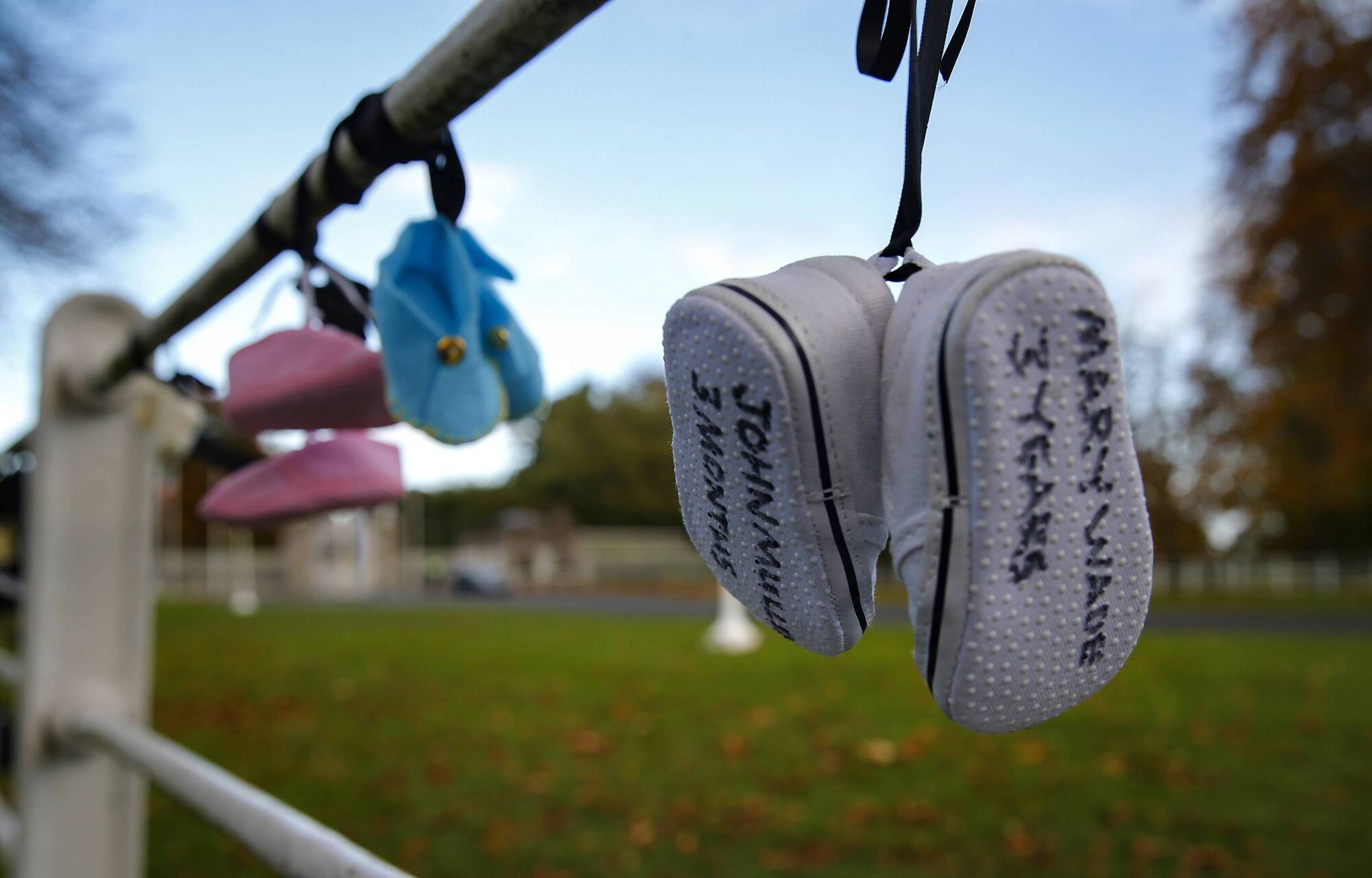
Protesters hang baby shoes by Áras an Uachtaráin to highlight their opposition to the sealing of records into the Tuam mother and baby home scandal.

Oh, the wonderful, messy humanity of it. That’s what I remember most about meeting my birth father for the first time, aged 26. There was gushing conversation followed by misty-eyed silence and then the really awkward goodbye. He swept me right off the ground and gave me a big sloppy kiss.
When I stepped into a taxi afterwards, the driver swung his big brass neck around and, with comic exaggeration, asked: “And who was that?”. I couldn’t but admire the cheek, so I gave him a straight answer: “That was my father — and it’s the first time we met.”
“Ah, go on, pull the other one,” he said, but I could see he was doubting himself as his big, astonished eyebrows shot due north.
Many years ago, I wrote a paragraph describing that encounter for a competition for a place on a memoir-writing course. It was read out on the radio among the runners-up. At the time, I was incredibly relieved not to win because I would not have been able to write any more.
Until now.
For many, 2020 will be remembered as the year Covid-19 upended life as we know it, but I will remember it as the year the Mother and Baby Homes Bill passed through the Dáil.
That day in late October, when an undebated bill was rushed through the Houses of the Oireachtas with indecent haste, was the very worst of days. It felt like a punch in the gut — not just to me, but the many thousands like me who passed through the institutions under investigation by the Mother and Baby Homes Commission.
It seemed, at first, as if the Government was going to do what officialdom had done so many times before and seal information that hundreds of thousands of people have spent a lifetime trying to find. “A lost generation muted by bureaucracy,” as a fellow adopted friend put it.
But then, something extraordinary happened. The Government bowed to a groundswell of public opinion and did a perfect U-turn, promising that survivors, birth mothers, and adoptees would be granted access to their personal information.
The culture of silence and secrecy that has caused incalculable damage stops now. That was the message coming loud and clear from the general public. Or so it seemed to me. That was the very best of days.
In the months since then, the issue of mother and baby institutions and what needs to happen so that we, as a country, can at last make restitution has never been far from the headlines.
The tone has changed too. There seems to be a new — and very welcome — understanding of the depth of the hurt and, perhaps, a sense that the publication of the final report of the Commission of Investigation into Mother and Baby Homes in January will only be the start of it.
Last week, Minister for Children Roderic O’Gorman talked of ongoing consultation and the need to put counselling services in place.
Taoiseach Micheál Martin has also given us reason to hope. He has spoken of the need for a dedicated archive where the story of the dark chapters of our past would be told, and has questioned the wisdom of developing land at Bessborough where the remains of hundreds of children are believed to be buried.
He also seems committed to letting the truth come out at last: “I’ve no interest in any records being put into some vault and left there for a long time that no one has access to.”
As a person who waited seven years for a reply to a letter asking for details of my birth, this feels like a very important moment. It should be said, however, that there is still no mechanism for the estimated 100,000 children adopted from Ireland between 1922 to 1998 to access their personal information.
That means adopted children, like me, are obliged to write to child agency Tusla which, up to now, has over-zealously interpreted data-protection laws, blacking out the very information sought — the name of the woman who brought them into the world.
So many fellow adopted friends have tried, without success, to find details of their own beginnings. Their documents come back criss-crossed with black or white lines, deleting any mention of anything that might tell them who they are.
Little wonder, then, that one of the things I felt when I first met my birth father was shame. Not his shame, or indeed mine, but the shame that Irish society has, in the past, laid like a mantle on the shoulders of those who fall outside its norms. Secrecy and the withholding of information can have that effect on a person.
There was also the matter of State-sponsored name-calling. The term ‘illegitimate’ was not abolished in Ireland until 1987, too late for many of my generation who suffered under its insidious tarring brush.
Perhaps that sense of being outside the norm has kept many people affected by mother and baby homes silent for so long. But those voices need to be listened to now, a point made eloquently this week by two former mother and baby home residents Francis Timmons and Terri Harrison, who have set up a helpline for survivors.
It will be needed. There will be very hard moments ahead if, as is hoped, the Commission reveals more about the allegations of detention, cruelty, neglect, forced adoption and vaccine trials that went on inside some of the institutions.
In all of that, I am one of the very lucky ones. I was legally adopted into a loving home and when I went looking for my birth information, I found it — albeit after a seven-year wait. And that brings me back to my birth father and the incomplete story of our first meeting.
I never got beyond that first paragraph because, up to now, it didn’t feel as if there was a space to tell the stories of the people who, for one reason or another, don’t quite fit the template.
That might explain why the strangeness of that first encounter never quite wore off. We had a few more meetings and exchanged cards and heartfelt good wishes. A few years after that, I read of his death in the paper and felt the urge to go the funeral but felt, again, that there wasn’t a space for me. I didn’t know if his other family — there was another family — even knew of my existence. I didn’t want to intrude, but I didn’t want to be absent either.
Stuck between a rock and a hard place, I rang the priest who was to say his funeral Mass and I will be forever grateful for his offer to represent me, so to speak, on the day of the service by lighting a special candle.
It’s a story with a less than satisfactory ending, but it’s one I’m no longer reluctant to tell.
Now it’s time to hear all those voices that have been silent for so long. It’s time for truth and reconciliation.

CONNECT WITH US TODAY



Be the first to know the latest news and updates