Kerry lawyer due in court on people smuggling charges after trying to rescue refugees from sea
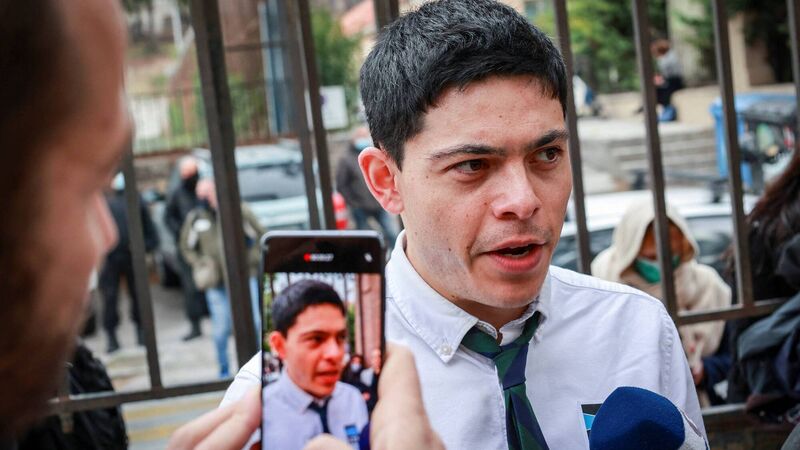
Seán Binderanswers journalists' questions outside the court of Mytilene in the island of Lesbos on November 18, 2021. File picture: Manolis Lagoutaris/AFP via Getty Images
A Kerry humanitarian and lawyer is due in court on Thursday on people smuggling and other criminal charges after trying to rescue refugees from drowning in the sea.
Seán Binder is one of 24 defendants charged in connection with efforts to save refugees from drowning off the Greek island of Lesvos in 2018.
They face charges of participation in a criminal organisation, people smuggling, and money laundering.
Mr Binder could face up to 20 years in prison if convicted.
“I'm expecting to be acquitted because we've done absolutely nothing wrong,” Mr Binder, age 31, said ahead of the trial.
“But you don’t know what will happen.”
Mr Binder began volunteering for the search and rescue NGO ERCI on Lesvos in 2017, a lethal year for crossing the Mediterranean with more than 3,000 people reported dead or missing.
In 2018, the Greek authorities arrested Mr Binder, then age 24, and detained him for more than 100 days before releasing him on bail.
Mr Binder has been trapped in limbo for the seven years since, with limitations on his career, unable to start a family, and having to save to potentially pay for an apartment in Greece so that his mother and partner could visit if he is jailed.
But Mr Binder is confident that he will ultimately be acquitted.
“If we were really the heinous criminals that the police accuse us of being, then wouldn't they want us in prison as quickly as possible?"
A major problem has been the delay in getting to trial, with multiple adjournments mostly due to procedural errors by the prosecution, Mr Binder said.
Miring humanitarians in seven years of probable lawfare has had a chilling effect on others keen to help vulnerable people arriving in Europe.
And the charges were almost certainly brought to provide this powerful deterrent.
“The uncertainty has scared people away from doing search and rescue,” Mr Binder said.
The search and rescue organisation he volunteered for ceased to exist as everyone involved was arrested.
And targeting humanitarians for helping refugees was not isolated to the 24 defendants in Lesvos.
Mr Binder knows of 143 people in similar situations across the EU, including a Swiss pastor who was to be prosecuted for allowing asylum seekers sleep in his church.
"But people still have a right to seek asylum. That's still the law. There's still a right not to drown," Mr Binder said.
"We still have the UN Convention on the Law of the Sea, which says we have an obligation to assist people in distress.
"The Maritime Convention specifically states we have an obligation to assist people regardless of what their passport, their visa says."
Mr Binder was born in Germany but moved to Castlegregory, Co Kerry, at the age of 5.
He studied in Trinity College Dublin and at the London School of Economics before training as a barrister.
When released from a Greek prison, he spent time with his mother in Togher, Cork. He is now practicing criminal law in London.
“It’s been horrifying to confront the hypocrisy of European border policy," Mr Binder said.
“On the one hand, we lecture the rest of the world about the European Convention on Human Rights and how strong Europe is in upholding fundamental rights.
“And yet, as soon as the responsibility comes to implement those in our own waters, they evaporate, meaningless. People are abandoned to drown.
“The Mediterranean Sea is the deadliest sea crossing in the world. At least 33,000 people, according to the UNHCR, drowned in the Mediterranean since 2015 as of September.
"But two weeks ago there was a drowning off the coast of Lesvos so that number has increased.
“Those aren't an act of God or a freak of nature. The reason people are drowning in the Mediterranean is because we are letting them drown.
“The European Union is one of the wealthiest economic groups in the world. If we wanted to stop people from drowning, we could easily do so. We choose not to do so.
“People are dying because of the policies we put into place.”
Coast guard officers are due to give evidence on Thursday in the first day of the trial before the Mytilene Court of Appeals in Lesvos, Greece.
Their testimony is key to the defence.

It is being alleged that Mr Binder and his fellow humanitarians refused to co-operate with the authorities when helping people at the Greek shore.
But they have proof — through telephone records and coastguard accounts — that they communicated with the coast guard in relation to any rescues from the beaches of Lesvos.
Mr Binder's lawyer, Zac Kesses, said that they are ready to start the trial.
The humanitarians face three “extremely serious” charges, Mr Kesses said — forming and participating in a criminal organisation; migrant smuggling; and money laundering.
The last charge stems from the police assertion that ERCI was not a humanitarian organisation but criminal, so all funds it held were criminal.
In Greece, anyone convicted of membership of a criminal gang or people smuggling must be imprisoned until any appeal.
So if anything goes wrong, the defendants will end up in prison pending appeal, Mr Zesses said.
Migrant smuggling carries a 10-year sentence per person smuggled.
In Greece’s case against the humanitarians, more than 100 people were allegedly smuggled, potentially bringing jail terms of more than 100 years.
But practically in Greece the maximum sentence a person can serve is 20 years, Mr Kesses said.
He expects the humanitarians to be acquitted.
But the cases were brought with the goal of pushing humanitarians off Lesvos, he said.
“Back in 2018 there was a perception that the humanitarian agents were a pull factor in migrant smuggling,” Mr Kesses said.
Multiple criminal cases were brought against humanitarians to discourage volunteers from coming to provide humanitarian assistance, he said.
A doctor from the US, a banker from the Netherlands, and a police officer from the Netherlands are also among the 24 facing trial this week.
Those charged range in ages from their 20s to 78, Mr Kesses said.