Getting jobs for disabled people shouldn’t be such hard work
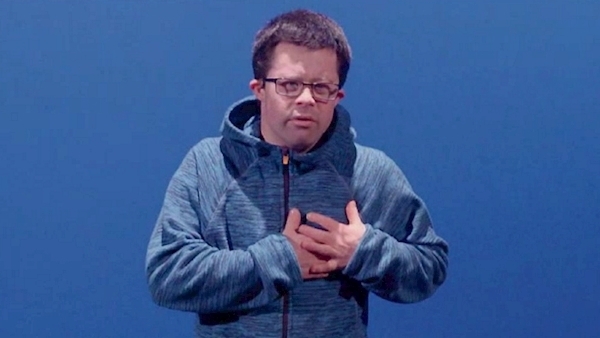
‘So, Samuel arrived in. We knew he had always wanted to be a pizza-maker, so I said, ‘Hey, Samuel, do you want to try your hand in the pizza kitchen?’ His eyes lit up and he said, ‘are you serious?’
Within a couple of hours, he was up to his elbows in flour, and, very quickly, he had learned how to knead the dough and twirl it. He turned out to be a fantastic pizza baker.
“Only trouble was, after a fortnight, he got bored doing the same thing every day and asked for something different. That surprised us, because we thought the repetitive tasks might suit him, but not a bit of it. Now, there’s no aspect of the kitchen that he hasn’t worked in. And every day he brings the same enthusiasm — and the same smile — to brighten everyone’s day.”
That was Lisa Mullaney talking. She’s from a giant catering company called Compass (if you were unfortunate enough to be in the Aviva last Saturday, you might have drowned your sorrow in their wares). Samuel was introduced to her by WALK. Samuel has an intellectual disability, and an awful lot of people had told him that when he was finished school, there might be a day service waiting for him.
He didn’t want a day service. He wanted a job, and ultimately a career.
I’m sure you’ve heard of Compass or seen them in action. I wonder, have you heard of WALK? Or Airfield for that matter, or Blue Diamond?
They’re different entities, but they all have something in common. (And there are many other organisations I could include.) They’re leading the way, or helping to lead the way, in cracking one of the oldest and most intractable employment issues: the hiring of people with disabilities, or, in this case, people with intellectual disabilities.
We’re a rapidly growing economy. The economists and statisticians will tell you that we’re as close as dammit to full employment. But people with disabilities remain locked outside this “miracle”, and spend their time looking in. Their unemployment rate remains intractably and unacceptaby high.
There’s a lot of slow, painstaking work at national level to try to break down the barriers between people with disabilities and the world of work. It’s not exciting stuff, but those of us involved with it hope it will make a difference over time.
But the real excitement is in the initiatives happening on the ground. That’s where Airfield and WALK come in.
Airfield is a national treasure. It’s a 38-acre estate, right beside the Dundrum Shopping Centre, that was left in trust to the Irish people by the Overend family. It’s a working organic farm and estate, open to visitors all year round, and dedicated to re-educating us about food and where it comes from.
You can happily spend a day there with your children, and you’ll come away with a new awareness of the joy of growing and planting and cooking.
But it’s also a place with a very inclusive ethos. That’s why they gave the place over the other day for the launch of the WALK Real programme, and why they have partnered with WALK to employ several of their graduates in the restaurant and on the grounds of Airfield.
But what is WALK? WALK is a service provider for people with intellectual disabilities (I’m guessing the name comes from Walkinstown, where they started up). But they believe in a few strange things. Like self-determination. Like the building of supportive relationships. Like challenging the community around them to work with them in ensuring that their people can get to where they want to go.
They talk to employers constantly. But they’re not interested in asking employers to be charitable, or nice.
They’re interested in making the business case to employers, that a well-trained, properly supported, hard-working and loyal employee is an asset. Having an intellectual disability becomes a non-issue once the initial barriers are broken.
That’s where WALK REAL comes in. WALK REAL is what they call an Ability project, part of a €16m programme aimed at enabling people with disabilities to break into the world of work, if they want to. And they do. The “day services” that thousands of them are offered as an alternative to work are a poor and expensive substitute for people who relish the challenge of a job. There are nearly 30 Ability programmes in different parts of the country now.
WALK REAL is one of them. It aims to support 75 young people who are preparing to leave school to find work and careers. They are creating social enterprises of their own and working with private sector employers to achieve challenging targets.
And what is Blue Diamond, and where does it fit into this? Well, it does, and it doesn’t. It’s a theatre company, and its members are people with an intellectual disability. And, my goodness, the work they do is simply stunning.
It has come out of the Blue Diamond Drama Academy, a venture started by Dr Anthony Walsh and his wife, Susan, in Churchtown, in Dublin. They started the academy because they got to know talented and passionate young people with an intellectual disability — young people with a passion for drama, and no hope of ever being accepted onto the professional stage.
The academy offered them a two-year degree programme — the first of its kind in Ireland (or perhaps anywhere.)
The first graduates of the academy are the founders of the Blue Diamond Theatre Company. Last Friday, we went to see them in Dublin’s Smock Alley Theatre, the oldest theatre in Ireland and one of its most prestigious.
The play was One Love. I won’t spoil the story, because they’re going to do a nationwide tour of schools and venues and I really hope you get to see it. They wrote it themselves, and an ensemble cast of about ten acted every scene in front of a packed house.
It was breathtaking. You’d be laughing one minute, a lump in your throat the next. Not for the first time, I realised the depth of emotional intelligence that many of these young people have in spades. We may all too often write off their cognitive abilities, but their capacity to get under your skin is real and deep.
I hope you’ll meet some people with intellectual disabilities in Airfield, and other places, over the year. I hope you’ll get to meet them on stage, as Blue Diamond hits the road. And I hope it prompts a couple of questions.
Like, how come it has taken so long to see the potential of people with disabilities — the ability, and not just the disability?
And how come it’s so easy to put our barriers and attitudes in their way?
There’s nothing they can’t do with the right support. And if only we could learn to stop knowing best what’s good for other people.
People with disabilities remain locked out... their unemployment rate is intractably and unacceptably high