Time to give serious consideration to cancelling Christmas in future
Turning a blind eye to homelessness and drug addiction is not Christian behaviour, says
CHRISTMAS only began yesterday, but regrettably the intensity of the lead-in means that for many it is already over today.
One short piece on social media caught my attention recently. The author mentioned that she doesn’t believe in Christmas, doesn’t celebrate it, and was rather tired of having to explain herself.
Admirably frank in my opinion, it’s likely to be an increasingly common point of view.
Why should you invest your time and money on a palaver you think is made-up nonsense?
Still, 11 of the 12 days remain, an increasingly faint trace of a thought-world that is much diminished. It is overlain by commercial, cultural and social frenzy which bears ever less relevance to the original miraculous event.
There are seven Irish public holidays, and three at least — Christmas Day, St Stephen’s Day, and Saint Patrick’s Day — are religious in origin. Easter Monday, as a day in lieu for Easter itself, may be considered a fourth.
I am surprised there isn’t a campaign to abolish these public festivals as superstition and have them renamed and reassigned. We could have winter solstice day and summer solstice day.
Rather like the spire in Dublin’s O’Connell St, there could be a public competition for suggested new national commemorations. It seems an ideal area of interest for the defunct Citizens’ Assembly. There would ideally be referenda, to give the thing a patina of considered change.
Randomly chosen people picking new cultural milestones would suit us, because we are shiftless and unsettled.
It would be a logical move-on for our society. It would remove the withering fig leaf of Christianity, and show us again naked. It is strange that, long after the substance has gone, outward forms are continued. It would remove the crutch of an excuse organised religion has become for much of what is wrong. It would move on responsibility to where it currently lies, which if not wholly, is now largely out of religious hands. It would turn the blame game on its head, which would be interesting.
There is an inconvenient truth, which is that organised religion only had power which was freely given by us, the people.
This Christmas, doorways on the main shopping streets in Dublin have the homeless, shrouded in sleeping bags, lying outside as sentries. Two bodies were asleep or at least huddled inside those bags a few days ago, while one of our infamously aggressive seagulls pulled apart the content of a plastic bag of food beside them. It’s movie- making stuff, except it’s real life.
This is the society that has the self-regard to make memorials out of former Magdalene Laundries hardly half a mile away. There is a memorial. It’s an open air theme park. It is free to tour, but like a zoo you need to pick the best time to see the most grotesque spectacle.
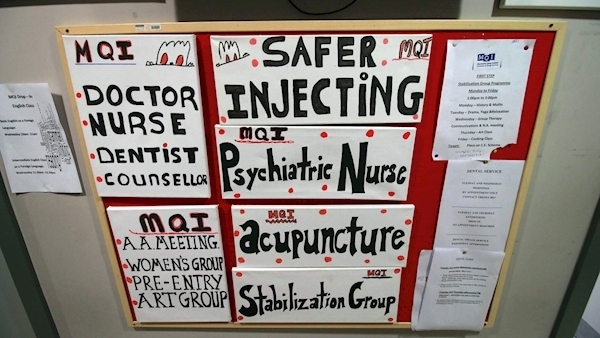
There is the stretch of the Dublin quays opposite the Four Courts, beside the Franciscan Church of Adam and Eve, where Merchants Quay Ireland provides services to those on drugs. I am not completely convinced about the arguments for supervised injecting, but I think now we have to try and see. It is not simply that the sale of drugs is open and continual in the vicinity. So is injecting. That facility, a mainstay for drug-users and rooted in the Franciscan community next door, is due to be the first supervised drug-injecting centre. Regrettably it hasn’t happened yet.

Across the Liffey from Adam and Eve’s, turn around behind the courts opposite, and walk on for 10 minutes to Smithfield, then a few minutes more up Grangegorman. The sky is teeming with cranes. Hipsters in IT companies, coffee of every hue, eateries for any taste and a sense of a thriving place.
A few derelict houses remain in Grangegorman, while around those boarded-up shells the new Dublin Institute of Technology campus rises across 72 acres. A new Luas line links it from Cabra to the north and Cherrywood to the south; new student accommodation abounds. If you pay attention you will know that the homeless are hunkering in the boarded-up houses just yards away. Once grim institutional buildings, including Grangegorman itself, are decanted. The laundries, mother and baby homes, industrial schools are empty, derelict or on their way to other use. The religious orders that ran most of them are now pale imitations of their former selves.
They mainly serve now as shorthand for a narrative that is out of date but still generally satisfying.
The lines are so rehearsed, we can finish them off for each other. So it seems a shame to bother rewriting them. The furore over the new maternity hospital at St Vincent’s is a case in point.
The nuns are off the pitch, but they are still in the script. The real moral issue, however, can’t be spoken of. The State will spend at least €300m and probably much more on a hospital, where although they haven’t paid for any of the capital cost, doctors will profit outrageously from private practice. Paragons of that corrupt regime are entertained on-air to talk about nuns. Seriously, think it through. The irony of an Irish hospital consultant talking about morals to nuns. You need a heart of stone to listen without laughing.
Blaming nuns is now usually accompanied by impugning government. Unlike elderly religious, the political class is in rude good heath, and the scope of the State has significantly expanded. If there is relatively little deference left for any authority, Government is institutionally, if not informally, more in command of a larger public space than before. Regrettably, this leads to an all-purpose whinge that ‘they’ should do something. Institutions were full of the detritus of society once, because we removed the unchaste, the unruly, and the disturbed from our own homes. So other homes were built for them, with high walls around them, and nuns and brothers to police them. It suited everyone except the inmates. But they weren’t just incarcerated, they were othered.
Now we continue that, but more efficiently. The shelter we wouldn’t give once to immediate family we refuse as a society to the homeless and addicted. Now as then, there is no question of having anyone of that sort about the place. Big buildings where they were all together, or open doorways on the streets are flexible extensions in principle of the same moral edifice. We have other priorities, and we are clear about that. In our very efficient democracy, we get exactly what we want. We are unforgiving of any politician who refuses to pander. It is too late for this year, but it is time to seriously consider cancelling Christmas in future. The few who believe can hymn-sing on their own time. If we really want to throw off guilt, what better way to start than by casting off responsibility?
There is an inconvenient truth which is that organised religion only had power which was freely given by us, the people











