The intricacies of birdsong

‘Then nightly sings the staring owl,
Tu-whit, tu-who, a merry note,
While greasy Joan doth keel the pot’.
But the Bard of Avon got it slightly wrong; there are two ‘staring owl’ vocalists, not just one. The female leads a duet with ‘tu-whit’; her mate adds ‘tu-who-oo’. Female birds are not supposed to sing but hen tawny owls do. Only one of our native small birds ignores this gender rule; robins perform throughout the winter and half of the vocalists are female. At other times of the year, only the males sing but, come the autumn, each hen robin starts doing her own thing; deserting her mate, she grows a new set of feathers and stakes out a winter territory of her own, singing to defend it. Few other songbirds, male or female, bother with winter territories. They don’t need to sing.

German foresters used take bullfinch chicks from nests and teach them to mimic tunes played on tin whistles. Half of the youngsters, the males, became excellent performers, fetching high prices at bird markets. The youngsters not learning to sing always turned out to be female. Are all female songbirds equally incapable?
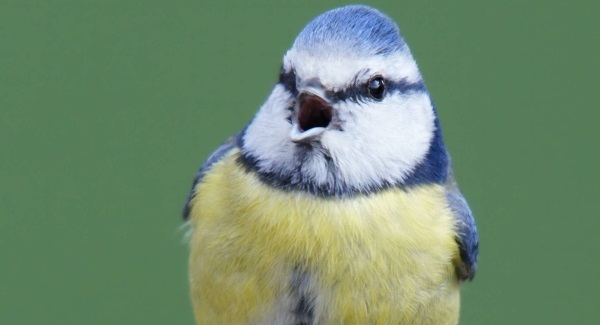
According to a paper appearing in the Journal of Ornithology, female blue-tits sing. Nor is their doing so just freak behaviour. Katharina Mahr and colleagues at the Konrad Lorenz Institute in Vienna studied tit behaviour in an aviary. When a stuffed sparrow-hawk was brought close to their nest, the parent birds began singing.

Individuals of several species have been recorded bursting into song when encountering a predator; male skylarks, for example, will sing if a hawk or falcon appears on the scene. But why would birds do this? Singing attracts attention to the singer, rendering him vulnerable to attack. Wouldn’t it be safer to lie low?
Song is normally a ‘trespassers will be prosecuted’ warning to other males of the singer’s species and a courtship invitation to unpaired females. When a raptor approaches, however, the song is directed differently. Sparrow-hawks are stealth and ambush predators; surprise is essential to their hunting success. By singing, the blue-tit is telling the would-be attacker that it has been spotted and that a successful ambush can’t be mounted.
Similar behaviour is found among mammals. A hare, for example, can outrun a fox and both hunter and hunted know this. The hare, spotting an approaching fox, will show itself conspicuously to the enemy, letting it know that stalking is futile; an ambush won’t succeed. Both species benefit; engaging in a futile chase would waste valuable energy for both of them. Even an injured or elderly hare, no longer able out-run a fox, will put on the display, bluffing its way out of danger.

But, extraordinarily, it’s not just the male blue-tits that sing at stuffed sparrow-hawks, the females do so as well. The song produced by the hens, say the researchers, ‘very much resembles that of males’. So why don’t females sing along with their mates to defend their territories during the breeding season? The answer may be that, in courtship and territory-holding situations, female singing would cause confusion; prospecting birds couldn’t distinguish males from females. But when a predator threatens, the situation is ‘gender neutral’; both sexes must be able to warn off the enemy.
In a refinement of the experiment, the researchers brought a dummy snake close to a blue-tit nest. The birds didn’t sing in response. Why? Snakes take eggs and nestlings but, unlike sparrow-hawks, they are not a significant threat to adult blue-tits. Nor are they ambush predators, so singing to inform a snake that its presence has been detected is futile. In any case, snakes are deaf.
- ‘Katharina Mahr et al. Female and male blue tits sing in response to experimental predator exposition’. Journal of Ornithology. 2016.
CONNECT WITH US TODAY



Be the first to know the latest news and updates