Dear Sir... Readers' Views (04/01/17)
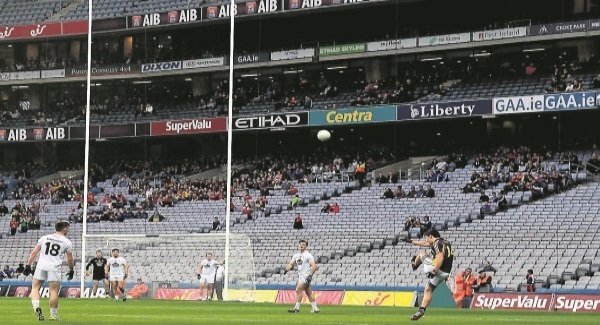
Potential GAA football changes
Having read articles by Sean Kelly and Andy McAntee on the GAA inter-county football championship (Irish Examiner December 2016) I wish to make the following suggestions.
I agree with both writers that the championship needs a radical revamp. However, tampering with the provincial system will not make any great improvement. I would suggest a new system based on the final positions in the league.
Teams in division one and division two will comprise tier one.These teams are then seeded into four groups with the top four teams in division one as top seeds and the bottom four teams in division two as fourth seeds. Each team will have three games, one home, one away, with the third game where the top two teams meet either home or away. The team with the better record in the first two games will have home venue.
The same system will apply in tier two comprising the division three and four teams. The top two teams in each group in tier one will qualify for the knockout stage. The top team in each group in tier two will qualify for the knockout stage. In the knockout stage these four teams from tier two will be drawn against the four runners up in tier one.The winning teams from this round will be through to the quarter finals where they will meet the four group winners from tier one.
The semi-finals and final will complete the championship.This system has many advantages. It provides a level playing field with each team playing the same number of games — three in the early rounds. It gives each team at least one home game. The best of the teams in tier two are given a real chance of qualifying for the knockout stage and meeting a tier one team. This championship can be played between the first Sunday in June and the final on the last Sunday in August or the first Sunday in September.
Many face being unable to pay rent
2017 will certainly bring, as the Government keeps assuring us, rent certainty: Many poor souls in rental accommodation can now be quite certain that, due to the measures being introduced by those in power, they will no longer be able to pay rent.
They will face the crushing and scandalous prospect of homelessness in the midst of alleged recovery and restoration in this sadly mismanaged little country.
Questions over Irish Rail figures
Have Irish Rail now extended the free travel scheme to cover all users of the Nenagh line?
We travelled on Thursday 29 with a group of 42, none of whom holds a free travel pass. We boarded at Cloughjordan, expecting to get our tickets from the guard on the train. That is the usual procedure in the case of an unstaffed station with no ticket machine. However, we were given no opportunity to pay at any stage of our journey.
On arrival at Limerick, we found the ticket barrier unstaffed — and wide open. We could easily have availed of a free trip. Instead, we took care to buy return tickets on our way home. However, we have to wonder how many of our fellow passengers bothered to do so. And the train was full too.
Other passengers advised us that failure to issue tickets is common on this service — and that the barrier at Platforms 3-4 at Limerick is never staffed. It follows that any passenger counts issued by IR can only be guesswork — and that IR are throwing away potential revenue on a daily basis.
Most national media seem all too ready to believe press releases reporting low usage of rail services and low fare income, and to conclude that there is little demand. However, an investigative reporter might find it fruitful to look into the accuracy of the figures — and the dozens of ways in which reported user numbers are driven down on Ireland’s more neglected railway lines. Our experience is merely one example.
Boyle’s simplicity still insightful
Now that 2016 has drawn to a close, one has to think of the well-burnished vernacular observation of Captain Boyle in Juno & the Paycock:
“Th’ whole worl’s in a terrible state o’ chassis. ...”
Plus ca change, il semble.
The ‘fluxable’ worldwide electoral shifts, retrograde posturing and malevolent machismo abounding, bode ill for any decent shoots of ‘entente cordiale’. The perennial addictive tendencies towards manipulative machination for self-aggrandisement rather than collective harmony and global generosities of spirit, would seem to be smothering the calls for peace, restraint and mutual accommodation.
The persistence of unfettered neoliberal free-marketeering pursuits all geared to sustain a totally unrealistic relentless economic growth, is surely doomed to fail and derail any potential authentic equilibrium. Plundering the planet, while pretending to care for the global family of broad-spectrum/ethno-cultural tapestry, is surely the antithesis of civilisation in any thereof.
From the crassly immature, deathly and dangerous political superpower pettiness to the festering foment of so many local rivalries across the world-scape, one has to reckon that Captain Boyle’s profound simplicity still retains an ultra-valid currency of insight.
Chassis breeds apace, apparently, despite the core human yearning for peace of self in loving, sharing and caring for and with others.
Entropic contradiction or what? .....maybe just the essence of ‘chassis’.
An evening of remembrance
A darkened, hushed hall with only the stage lights revealing a solitary forlorn figure awaiting death by firing squad, provided the backdrop to the final showing of the 1916 commemorative drama Ó Pheann an Phiarsaigh by Noel Ó Gallchoir in Halla na Paróiste Gort a’ Choirce on the evening of the December 28, 2016.
This was an honourable and selfless achievement by a man who to all intent and purposes shuns the spotlight, apart from when it shines directly on him as he re-enacted Pádraig Anrí Mac Piarais life, from the cradle to the grave. Pádraig was an Irish teacher, barrister, poet, writer, nationalist and political activist, and one of the leaders of the 1916 Easter Rising. Noel exemplified his life on the same stage where Pádraig Mic Piarais may have stood on the second of his two visits, when he last came to the Parish in 1912, the first was in 1906.
Noel’s brother, Sagart an Pharóiste, an tAthar Sean (Johnny Shean) Ó Gallchoir acted as Fear an Tí for the evening, which began with haunting Gaelic music and the words, ‘Mise Éire’ opening the one-man play.
The sound of a pin dropping would have echoed like thunder, had it happened as Noel narrated his way through an hour and a half of memorised script containing in the region of 10,000 words that pieced together this entire dramatic accomplishment.
His only pause was to take a few sips of water to revitalise the vocal chords.
A truly captivated audience listened intently as they took in every word that flowed effortlessly in a beguiling narrative of an Phiarsaigh’s life in the Teanga Duchás from Noel Ó Gallchoir.
Noel accompanied by his wife Olive (who only missed two showings) criss-crossed all 32 counties accruing a tally of 60 showings in the process, which included one in Glasgow.
Noel’s interest in Piarais’s life was shaped through a lifetime of teaching history and Gaelic, where one of his tasks was to aid students researching Irish history for their Leaving Cert exams.
He spent the last 17 years of his career as principal of Pobal Scoil Gaoth Dobhair.
This was an evening of culture, tradition, and remembrance in every sense of the word that brought to an end the many important historical events that were held throughout the parish to commemorate the 1916 Easter Rising.
It has revitalised interest in a very much unexpressed, but important history that had far reaching connotations of liberty and independence on a world stage. There has been a recording done of this historic drama and is available to the public, I would expect that a play of such historical significance would be shown on RTÉ or TG4 in the not too distant future.
Fond words of acknowledgement were paid to deceased, and former regional manager of Raidio na Gaeltachta na Dhoire Beaga, Séamus McGéidigh, whose contribution to the language, his membership of various Coiste and coverage of na cluiche peil were praised in appreciation of what he had achieved in a life that was cut shockingly short.
It was left to the cream of talented sean nós singers and musicians born and raised in the Donegal Gaeltacht to bring the evening to a close. In a list that contained the musically gifted Mairéad Ni Mhoanaigh, Connie Mhary Mhicí, Diane Cannon, Connor Ó Gallchóir, and Clíona Ní Ghallchóir. They had the crowd in awe as they sang one of Piarais’s songs ‘Oró Sé do Bheatha ‘Bhaile’ plus other songs that had people swaying and tapping their feet in perfect unison to the melodic tunes.
Tea, coffee, home-made mince pies, and scones were among the refreshments that were enjoyed afterwards.
every cent of money raised on the night was donated to a well deserving cause, the Donegal Hospice.
CONNECT WITH US TODAY



Be the first to know the latest news and updates