Devil-may-care flight of the swift
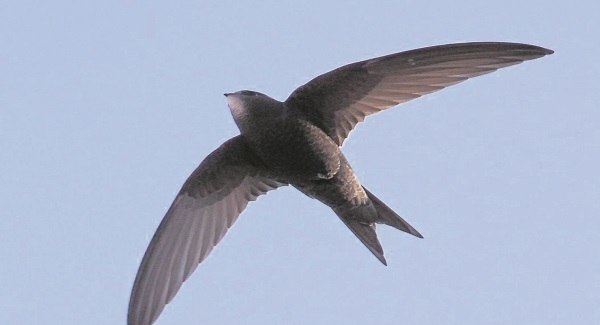
There are 92 kinds of them worldwide but only one species breeds here. Cool damp Ireland is not an ideal place to raise young swifts.
You might think global warming would help but, according to the Bird Atlas, the species’ range here has shrunk by 26% since 1970 and the number of birds fell by around 46% between 1998 and 2010. In Britain, the breeding range didn’t shrink significantly but numbers dropped by about 38% between 1995 and 2010.
No other bird would dream of doing the things the ‘devil bird’ gets up to. A true creature of the air, it lives almost entirely on the wing. Living off flying insects, it doesn’t need to land. Partners are chosen on the wing and the lovers mate in flight. Swifts pair for life but the spouses seem to go their separate ways in winter.
A bird must be light and streamlined for such a lifestyle, so the swift’s legs and feet are tiny; what Aristotle called ‘the footless one’ can’t even stand, let alone walk. This has security implications; without strong legs, a bird can’t change position or get airborne quickly in an emergency.
Roosting in trees or on cliffs, such a bird would be easy prey to hawks owls or falcons. During the 1st World War, a French airman cut his engine to glide over enemy territory at night. Some 10,000 feet up, he encountered birds ‘which seemed to be motionless’ near his plane. Although nesting pairs sometimes take in a ‘lodger’ for the night, most swifts go aloft and sleep on the wing.
However, even swifts can’t incubate eggs and raise chicks in the clouds. They nested on cliffs long ago but holes in buildings are used almost exclusively nowadays. During cold damp periods there are few flying insects about, but the enterprising swift has a trick up its sleeve; the chicks become torpid, reducing their energy and food demands while waiting for conditions to improve.
The swift’s life when it leaves our shores is something of a mystery. What route does it take to Africa? Has it a ‘home range’ in its winter quarters, an area where it hunts, or is location irrelevant, the bird wandering wherever the supply of insects leads it? Do its feet not touch ground again until it returns here in spring? Using cutting-edge technology, bird-ringers in Britain and Ireland hope to answer some of these questions.
Wings magazine reports that Michael Casey fitted ‘geo-locators’ to seven swifts in nest-boxes at his home in Tubbercurry, Co Sligo, and in Co Antrim. Each device has a light-detecting sensor, a memory chip and a clock. Powered by a tiny battery, the waterproof tags weigh just over half a gram, not too heavy for a swift weighing 40gm to carry. The bird wears a harness to which the unit is attached. The geo-locator logs the times of sunrise and sunset, allowing the bird’s latitude and longitude to be calculated.
Such tiny devices can’t transmit data. Doing so would soon exhaust the battery’s power. The bird must be recaptured and the tag removed to retrieve the data. Swifts are faithful to their nest sites and return each year; recapturing them should not be a problem. The information on the chips can then be downloaded.
Given the decline in swift numbers, the project is timely. We know the problems the birds face here; there are fewer insects on the wing and modern buildings don’t have suitable nest holes. We need to identify the difficulties swifts encounter in Africa or on their migrations to and from there.
By now, the wanderers should be back in their nest boxes here and in the UK. Hopefully, their geo-locators will have interesting things to tell us.

CONNECT WITH US TODAY



Be the first to know the latest news and updates