Power of protest brings its own sense of reward and virtue
YOU can be born into a Fianna Fáil family, a Fine Gael family or a Labour family. You can be born into a criminal family. Or a rich family. Or a protesting family.
Of the whole lot — no insult to the political parties — should you be given a choice, you should go for the rich family, if only because your life expectancy tends to be longer, starting from familial riches, than if you come from a criminal family and win the transient riches at the point of a gun or knife.
Generally speaking, however, one doesn’t have a choice in the family in which one lands. I discovered early that I had been born into a protesting family. In our house, we were up there with Ruth Coppinger in our instinctive opposition to almost everything. We always had a set of laws that should exist and a matching number of laws we wanted repealed.

My parents went from wanting governments brought down to vocally changing newspapers, as if the absence of their expenditure would make the newspaper owners smack the back of their hands to their foreheads and make them see the error of their ways.
Even though, as a family, we had little provable impact on anything within the country, that never constricted our ambitions. The world was our oyster and we perceived ourselves to be even stronger on the international front.
My mother and father had a largely unevidenced conviction that our veto would, sooner or later, change the world, starting with Apartheid and oranges. We had to turn around every orange we considered purchasing in order to see if it bore the Outspan stamp indicative of South African origin, and, if we found that stamp, we had to put that orange back in a marked manner.
When a few supermarket chains stopped carrying the Outspan brand, we moved to those supermarkets, making the move with an enormous sense of virtue and efficacy: see the effect of our individual protest.
It didn’t stop there. We also weren’t allowed to buy Spring Books. Their title related, not to the season of the year, but to the publishing imprint. My mother, when we went to the bookshop, would wait for me or my sister to come to her with a brightly illustrated book we really, really wanted bought, and go to the inside back cover. Our sibling hearts would sink.
Spring Books always had a line on that page, down at the bottom, saying ‘Printed in Czechoslovakia’. That meant, it would be explained, that they were printed by brainwashed priests, so we couldn’t buy them. I always resented this on the basis that what would the brainwashed priests be doing, otherwise? Printing wouldn’t be the worst job for them. I knew better, however, than to get in the way of parental principles. Get in the way of parental principles in a protesting family is neither safe nor profitable.
The great thing about the protesting gene is that it takes credit for even the most tenuous apparent victories. When the Berlin Wall came down and Czechoslovakia ceased to exist, I had fantasy moments where brainwashed priests freed by events with which I was unconnected, nevertheless travelled to Clontarf to thank me for my bookish sacrifice.
The sheer mass of today’s brands has seemed to make impotent even the best-organised protests in recent years, so when, at the start of this year, in this newspaper, I wrote a column about SeaWorld’s horrific use of Orca whales, I had no expectation that it would have any effect. Nor did it. I still know my place, which is underfoot. But, in this particular instance, protest and resistance, as of this week, have had a profound and important effect.
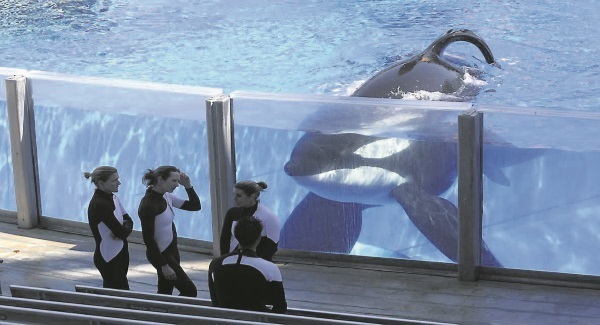
On January 4, I wrote a protest column about SeaWorld first capturing Orca whale calves, which normally stay beside their mothers for the bulk of their lives, winching them out of the sea, and transporting huge wild animals thousands of miles to dump them in what for them is the equivalent of a back garden paddling pool where the highlight of their day was being bribed by wetsuited swimmers into playacting for an audience.

The column came about because I had seen a televisual kick in the heart entitled Blackfish. This attack on SeaWorld, one of the most popular tourist attractions in America, advanced the thesis that a killer whale subjected to decades of mistreatment may be so damaged that, while bouncing a trainer on its nose or obediently “bowing” for a thrown dead fish, it is filled with a rage that requires only the coming together of a few factors to find lethal expression.
As happened in 2012, when Tilikum, an Orca captured off Iceland in 1983, was first subjected to such bullying by two bigger female whales that he had to be moved to a smaller pool and kept in isolation there.
Eventually, Tilikum was taken out of isolation to “play” in front of thousands of holidaymakers. Bribed with dead fish by a human trainer, he did his tricks, all day, everyday. Until the day trainer Dawn Brancheau got on the wrong side of him.
She was used to balancing on his nose, being thrown off into a graceful dive. On this day, however, the whale grabbed her arm, dragged her under, beating her and drowning her. In this country, a dog which killed or mauled someone would be put down. Tilikum’s killing of Dawn Brancheau brought his score to three dead people, but SeaWorld kept him alive and performing. And presumably would have continued to do the profitable same on the Orca front, were it not for Blackfish.
From the day the documentary was screened at the Sundance festival, the share value of SeaWorld tanked, if you’ll pardon the expression.

AVING fought the book which first drew attention to the case of the orca whales and Blackfish with equal argued vigour, SeaWorld, last week, saw the light. They will no longer either capture wild whales or breed orcas in captivity, as they have been doing for decades. They won’t release to the wild the 29 orcas they hold, including Tilikum, because they believe with some justification that they would not be able to survive in the wild. Tilikum certainly wouldn’t, since he’s already dying from a progressive whale disease.
It took the loss of millions of dollars before SeaWorld saw the light. As recently as October of last year, it was fighting the California Coastal Commission on the captive breeding issue. Now, it’s gone all born-again, promising to “introduce new, inspiring, natural Orca encounters, rather than theatrical shows”. Furthermore, it’s entering a five-year partnership with the Humane Society of the United States to produce educational material and educate their customers about animal welfare and conservation.
Lots of Irish holidaymakers will this summer visit one of the SeaWorld emporia. They can do so with an easier conscience, now that protest has taught that company the substantial error of its ways.