Europe’s long age of optimism has come to a bloody end in Paris
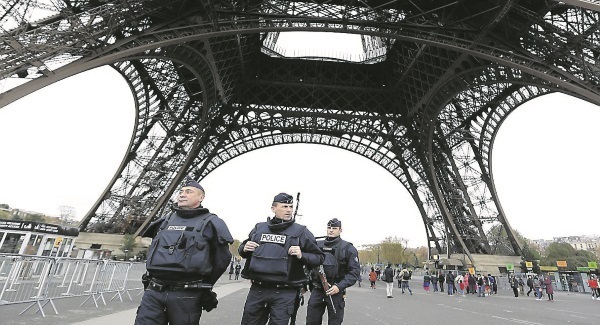
MAJOR European capitals are imperial cities. London, Paris, Rome, and Berlin have grand boulevards, triumphal arches, palaces and unrivalled treasures. But the power underpinning them is diminished.
The scale of the stage on which government is performed in European capitals is now several sizes larger than the substance.
The substance forgone is not just lost empire, it is increasingly the population and economic base which, over time, is the source of all power.
It was the Industrial Revolution, and a near monopoly in technological advantage that founded the empires of the 19th century and sustained a long afterlife of influence in the 20th century.
Europe in caricature, is the theme park home of an aging population, who have lost their capacity to naturally repopulate and will not forgo the state supports their economies can no longer afford.
In an objective sense our continent and civilisation are easy pickings.
Paris last Friday night is now a new normal. If shocking, as violence is, this has multiple causes but no quick fixes.
The seeming inexorable expansion of Western values that characterised the long haul since World War II is ruptured.
That rupture need not be irreversible.
It is several decades too soon to say.
But whatever the future brings, a long age of easy optimism is over, at least in Europe.

The events of Friday night, likely only part of a series of similar ones which have yet to unfold, are symptoms of interrelated crises which coincide with other issues.
Before the problems of the Middle East exploded on European streets, global warming, an aging population and an increasingly rapid shift of relative power and influence eastwards towards Asia was underway.
Economic crisis and the problems of the eurozone accentuated everything.
If there is cause for concern we should reflect too on the pulling power of Europe.
Though our life of relative ease is fundamentally unaffordable, and our public conversation around the welfare we enjoy is delusional, we have values, and civic structures which much of the rest of the world wish to emulate.
Globalisation, and its consequent shift in power is a backhanded compliment to postmodern Western society, as well as the most effective remedy for global poverty.
People wish to come to Europe in their millions for a reason.
It is a better place to live.
To that extent, what happened on Friday night was a clash of civilisations.
To say that the clash is between ‘them’ and ‘us’ is too simple, however.
Most of ‘them’ are ‘us’ — European citizens. Many of ‘us’ have values rooted in prejudice.

Over the 21st century, Europe will either succeed or fail in assimilating a large Muslim population, which itself is ethnically and ideologically diverse.
In hindsight this will be seen as the great crisis issue.
Paradoxically, illiberal economics, protectionist state supported cartels which act as barriers to newcomers are key inhibitors to economic participation in Western Europe.
It is an unhappy coincidence but, no accident, that France has both the largest, least assimilated cohort of population and the densest network of protectionist barriers against economic participation.
Assimilating people, giving them opportunities, requires economic as well as cultural insight.
It is all a far bigger picture of course, but ultimately that is one part of the jigsaw that will have to be found.
The bigger picture is global.
It is centuries old. Colonisation, decolonisation, immigration, assimilation and the lack of it, all abut immediate events.
Arguably the ill-prepared, Bush-Blair invasion of Iraq was the moment the pin was removed from the grenade.
Another underlying force is Saudi Arabia, its money and its brand of Wahhabi Sunni Islam.
A theocracy and kleptocracy in one, it was a main funder of Saddam’s war against Shiite Iran, a key funder of Al-Qaeda in Afghanistan, and a source of aggressive proselytization of Muslim populations in Africa and globally.
Isis is both a spinoff from a disintegrating Iraq and a centuries-old ferment within iconoclastic, puritanical Wahhabism.

Over decades the Saudi kingdom sought to channel religious fervour it neither could, nor ultimately perhaps wished to control, abroad.
Acting through proxies, using its religion as cultural diplomacy, it used oil money to become the quartermasters of the Sunni world.
In Isis a form of Wahhabism has mutated — and that is a deadly threat to the Saudi regime. Unlike Al-Qaeda which was a lose network, Isis pretensions to be a state are absolutely core to its identity and credibility.
To be the ‘caliphate’ it claims to be, it must be a state. Unlike Al-Qaeda, without territory Isis cannot sustain its foundational claims among its followers.
This may prove to be its ultimate weakness but, for now it is a deadly threat not only to Europe but to Saudi Arabia and regimes across the Middle East.
Our secularisation, our democracy, the civil rights inherent in our society make it almost impossible for us to grasp the mindset not only of Isis but of wider, deeper traditions.
Yet, in gloom, we should remember that this is what people are fleeing in their millions and they are fleeing to Europe.
The mutation of irrational hatred take many forms.
In Europe one form is a partial replacement of anti-Semitism with Islamophobia, and the subsequent refuelling of the latter in a coincidental coalition between radical Islamists and swathes of otherwise liberal European opinion.
In a sense the re-bourgeoning of European anti-Semitism is the most poisonous fruit of this decades old ferment.

It is astonishing that after last Friday night, after Charlie Hebdo, after the kosher supermarket in Paris, that there is no pause for thought about what Israelis see when they look out from their small state.
Twice the object of mass invasion by surrounding Arab states, it was the last invasion in 1967 that prompted occupation of the West Bank.
It faces a Shia Hezbollah army on its northern border in Lebanon, In Sunni Hamas it has an organisation committed to its destruction.
Look at the Assad regime and what has followed and it is understandable why it believes its needs to hold the Golan Heights.
There are limits and, more clearly consequences to the security agenda that dominates Israeli politics.
It may not be a long term solution to anything, but it is policy because it has a mandate.
It is how Israeli’s see their immediately surrounding world. Make peace?
Who exactly do they make peace with? Withdraw?
Who exactly will fill the vacuum? Take the chance and who will take the consequences?

In a Europe of reason, of rationality, it is disturbing that even to pause to think of the Israeli perspective is beyond the Pale of political correctness.
If there are European values, it is to think the unthinkable and to remain unmolested.
That is why they are coming in their millions.
Ironically they arrive to find a cultural boycott of Israel, embroidered with razor wire to keep out Muslim immigrants.