Taxonomy of mangoes puts taste buds to the test
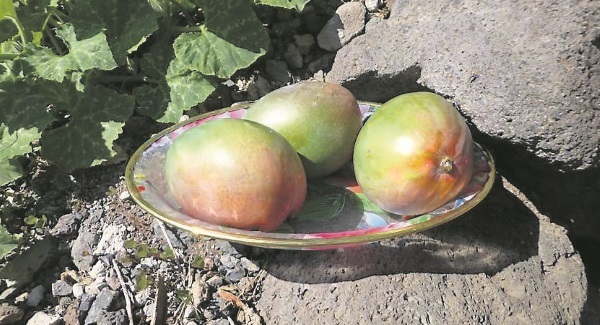
It is the autumn mango season and our neighbours bring us plastic bags full, golden or reddish green, and so large that a half dozen fill a supermarket plastic bag. The local mangoes are refreshingly juicy and sweet. They are not fibrous and they do not stick in one’s teeth. We could eat mangoes four times a day, but do so twice only.
Sliced, they go extremely well with porridge, moistened with La Irlandesa milk. The La Irlandesa tetra-pack no longer carries a picture of a mawkish Irish cailín with dimpled smile and foxy hair, but the picture of a hard-working, black-and-white friesian cow contentedly grazing a lush green field.
Mangoes are also delicious as an after-dinner dessert, ‘drizzled’ with lemon juice. I note that I am absorbing ‘foodie’ vocabulary by osmosis; I am not always listening when recipes are being discussed. As I have mentioned before, while friends dining together in the early 2000s talked of nothing but house prices, they now talk of food and exotic dishes —can it be called ‘comfort food’? The subject of property values invites gloom, while novel application of comestibles elicits pleasant expectation.
I am not culinary skilled; one accomplished cook in the house is enough. However, I notice my sons seem to have inherited that woman’s talents. And, not only my sons, daughters and grand-daughters, but grandsons, too, show a proclivity for talented food-preparation. Can it be a generational thing?
I could, in fact, knock up an edible dinner, but it would take me years to reach the apogee of our consummate family caterer. Cooking is not the same as bagpipe playing which, as Wilde insisted, any gentleman can do, but doesn’t. Gentlemen, unless dedicated, are not natural-born spatula-and-spice wielders. Meals produced by your average male, if forced by circumstances to do so, would likely put function before succulence, and opt for simplicity, such as boiled spuds and sausages, or scrambled eggs.
In spite of my culinary limitations, I greatly enjoy good food of all ethnic and cultural traditions. Recently, I enjoyed a cookery programme, Rick Stein’s Mediterranean Food Journey, on TV. Interlarded (is that the right word?) with Italian, Greek or Turkish food-sampling, were visits to places I once visited but didn’t then have the nous or the knowledge to explore their culinary finesse. I regret it now. I ate what I came across in roadside stalls or cheap cafes — cheap was the guiding principle in those days — but, to my untutored tastes, found delicious anyway. Hunger is the best appetiser of all.
But back to the mangoes. There are two types — actually dozens, but I differentiate only between the stringy kind, that get stuck in the teeth, and the un-stringy, which melt in the mouth. How can one tell the difference? Reportedly, the highly-productive, good-looking, uniform-size Tommy Atkins mango — the one sold in supermarkets worldwide — is fibrous and dull. This is perhaps so.
On this island, we don’t see Tommy Atkins, as far as I know, but there seems to be a simple distinction made between ‘mangoes’ and ‘mangas’, the latter being the toothsome, but non tooth-filling, variety. Whichever, in general, mango-fruits that would cost €2 each at an Irish greengrocer, here lie rotting beneath the trees. The same will be the case with apples in Ireland. With fruit, it is ever thus: a glut or a famine. Our two small trees burgeoned with fine apples this year, more than we could use.
It is tragic that people are starving in so many places worldwide while life-sustaining nutrition goes to waste. I once met a girl who lived entirely on fruit, and she looked very well on it, and was very energetic. Lengthy sea transport is problematic, as fruit quickly spoils, but this, I believe, could be remedied. Shipping cost is cited as the insurmountable problem.
Yet, water is shipped across the globe, at huge cost in carbon pollution and plastic waste. Here, on La Gomera, a local brand, Fonteide, is available from the slopes of Mount Teide, Tenerife, only 20 nautical miles distant, but the water sold in most shops comes ready-bottled from Lanjaron in mainland Spain, 800 nautical miles away. America imports bottled water from Fiji.
Could not apples, pears, mangoes and other perishable fruit be processed — cooked and preserved — for shipping to hungry people? Or would that interfere with free-market economy, and be a non-starter? Would Fruit Aid never, so to speak, get off the ground?

CONNECT WITH US TODAY



Be the first to know the latest news and updates