Change your diet, polar bear
This year and last, they predict, will be the warmest on record. The effects of global warming are most pronounced close to the poles; conditions there are changing rapidly. Areas ice-bound a few years ago are now clear, cruise-ships are negotiating the notorious Northwest Passage while, in Alaska, houses are sinking as the permafrost thaws beneath them. If humans are affected by climate change, how much more so are plants and animals?
Scientists at the University of Santa Barbara modelled the likely effects of ocean warming on 13,000 species. Many plants and animals, their research shows, will relocate towards the poles. But how will those already living in the far north cope? Some mammals seem to be changing their lifestyles. Perhaps Arctic creatures are more adaptable than we think.
Walruses haul out onto the ice shelf overhanging their favourite feeding areas, shallow waters rich in marine creatures. They forage for crabs shrimp and molluscs on the sea bottom and then return to the ice to rest. Now the shelf is disappearing. Reports from the Bering Sea say that, in the absence of the ice, walruses are turning up on beaches along the coasts of Alaska and Russia.
Up to 5,000 animals have been recorded at one location. They can access their feeding grounds from the land but the lumbering giants are very awkward when out of the water. Relatively safe from their enemies on the ice shelf, they are far more vulnerable on land. This insecurity leads them to stampede back into the sea at the slightest sign of danger. When animals or people approach them too closely, walruses panic, trampling their youngsters to death in the ensuing scramble.
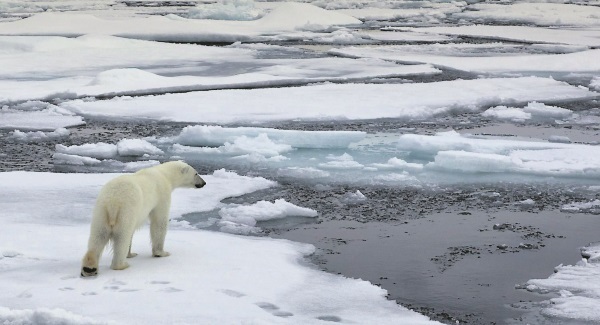
The Arctic’s most celebrated creature, the polar bear, also depends on the ice shelf. The largest meat-eater on the planet lies in wait at holes where seals surface for air. When the ice melts in the autumn, hunting ceases. Now the shelf is forming later and the thaw is occurring earlier. With the shorter period in which to hunt, it’s harder for bears to build up the fat reserves needed to get them through the long, dark winter.
As the Arctic night begins to lengthen, a female bear seeks out a den where she will sleep, fasting, until the spring. Her cubs are born in the depths of winter. When the light returns in spring, she and her babies emerge and head for the ice shelf to hunt. But the hunting grounds are now increasingly farther away each year and mothers and cubs face longer journeys.
With more open water to negotiate, they may have to swim rather than walk. Of 50 swims undertaken by 20 bears monitored over a six-year period, the average distance travelled was 155km. One bear covered 350km. Journeys took an average of three to four days. One ran to 10 days.
There is a glimmer of hope, nonetheless. Like the black and brown cousins, from which they evolved comparatively recently, polar bears are opportunists. Robert Rockwell of the American Museum of Natural History examined bear droppings along the shores of Hudson Bay. Young polar bears and females, he found, have taken to eating plants, caribou and the eggs of ground-nesting birds such as snow geese. Even adult males are beginning to do so.
Rockwell’s colleague, Linda Gormezano, computed the energy values of these foods and compared them with the amounts bears expend in hunting for them. She believes that there are enough food resources on land, in the western bay area at least, to sustain bears.
It’s just possible that the iconic polar giant will be able to sustain itself in an ice-depleted Arctic by changing its diet.
- J Molinos, R Rockwell et al. Climate impacts on marine biodiversity. Nature Climate Change. 2015.

CONNECT WITH US TODAY



Be the first to know the latest news and updates