Following in the footsteps of the butter makers in West Cork
It was on July 5 at about 2.20pm that the sun came out in our part of West Cork, and it stayed out until evening. Nights — and days — of deluge followed this short respite. Meantime, when you’re reading this, may the blessed eye of heaven be splitting the stones as it did in the midlands during the week. Down here, where the sea mist comes between us and the sun, there wasn’t a glimmer in the sky above us.
My heart bleeds for the holidaymakers who have invested their money and their fortnight of liberation from the workplace for a holiday in the deep and beautiful southwest. It is beautiful, I assure them — they’ll see it when this damn mist clears!
I would recommend any perambulating visitor to west Cork — or any resident who doesn’t already know it — the Butter Road Walk from Ballydehob to Schull. Mapped and described in the brochure for the newly opened Fastnet Trails, it is, for half its length, a grassy track once used by farmers to transport salted butter in oak barrels to the Butter Exchange in Cork, founded in 1769. Two firkins, each holding 56lbs of butter, were secured on the back of a pony with hay-rope sugáns. The journey to Cork took a week.
The Skibbereen to Crookhaven area sent 6,000 firkins per year to Cork, where, by the 1800s, the butter market was the biggest in the world, exporting to Spain, Holland, the West Indies and Australia.
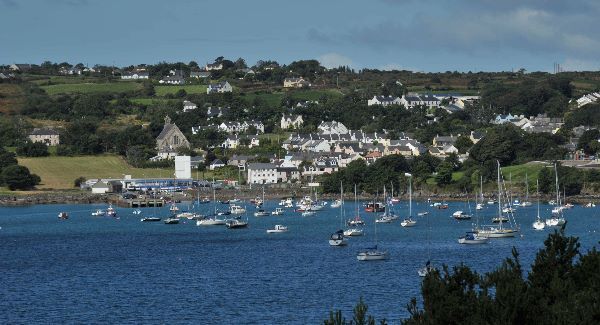
The green section of the Butter Road Walk, from Cappaghnacallee townland to Schull (see brochure) can be walked as a there-and-back outing far from road traffic, passing between fields and breaks of gorse and heather with fine views over Schull Harbour and with Mount Gabriel to the north.
The complete Butter Road route joins Ballydehob to Schull, a distance of 10km, outlined in the Fastnet Trail brochure, available free at shops and filling stations in either town or outlets between them.
Ballydehob and Schull are character-full and pretty settlements. Ballydehob, the smaller, has its strong West Cork ‘feel’, its imposing 12-arched bridge — last and finest remnant of the West Cork Tramway — its pubs and eating places. Schull has its pier which serves the islands its holiday cottages, restaurants, bookshops and boutiques. Ballydehob has, for some years, been home to a colony of native and expatriate artists, poets and literati, while Schull is a holiday venue for Dublin glitterati, media persons, yachtsmen who launch and ladies who lunch.
For walkers, The Fastnet Trail, with its excellent information plaques, maps easy routes into a wild and unspoiled world. In a pocket guide I wrote years ago, I remarked that west of Skibbereen, the green sward of agri-biz stops at Kilcoe Bridge, on the Roaringwater River, a few kilometres short of Ballydehob. Beyond, and from there on, bedrock breaks the fields and there is more gorse than grazing. Fence-to-fence nitrate grass bedspreads are replaced by patchwork fields, small, rock-rent and bockety.
Here, the land is ‘free’, even if owned, undomesticated, even if farmed. It’s a skipping land, up and down and lively as a fiddle air, jigging and reeling as it goes. Much is not worth ‘developing’, for you can’t grow grass on rocks or spuds in bogs It offers little sustenance, and that little is hard won.
Of food for the spirit, there is a feast; like the sea or sky, the land here is nature’s domain and humans have only scratched the edges. Beyond the roadside fields, the bog stretches away like a brown mantle to the hills or sea. Drab as sackcloth in winter, it is softened with heather and bright with gorse in summer.
The views are of uplands and islands. Beyond the low, brown hills, the mountains of Caha and Kerry rise, the wide Atlantic is below us, with the small and big islands of Roaring Water Bay. Three thousand years ago, paths crossed these local bogs to reach the copper (some say, the gold) workings on Mount Gabriel. They are long since subsumed beneath the brown blanket but, without doubt, the back roads often follow these routes.
Nowadays, there are farmhouses and holiday homes but, off the bohreens, few feet have walked the rough ‘undeveloped’ land. We may make small marks on the surface, but the spirit of place abides.
CONNECT WITH US TODAY



Be the first to know the latest news and updates