How Tom Murphy’s great play speaks to the stages of my life

It’s among the handful of sentences from literature to which I’ve clung for guidance and it’s been stuck in my mind since I first saw Tom Murphy’s play, The Gigli Concert, in the Abbey Theatre in 1983.
I had just started studying English at college, but I never had the money for the theatre. I don’t know why I went to that show and I don’t remember being with anyone. I don’t remember anything except the play.
To say it blew me away is an understatement. It blew me right through the Milky Way.
READ MORE: The Gigli Concert - Review
The story of an Irish developer who goes to an English quack psychologist, called JPW King, wanting to sing like the Italian tenor, Gigli, made me understand that magic can happen in the theatre. Far more than that, it made me understand that magic can happen in life. That self-expression matters. That love matters.
I was floored by the builder’s black depression, particularly his rejection, with the words ‘fuck you,’ of his wife’s offer of love. I was elated by JPW King’s discovery of his own voice, as he metamorphosed into a singer. I was in floods of tears as he left the Gigli record playing, and the window open to the street, with the words “That’s it… sing on forever… that’s it…” The Gigli Concert was one of the reasons I began writing about the theatre and that’s how, almost by accident, I became a journalist. One of my first editors at the now-defunct Theatre Ireland magazine shared my love of The Gigli Concert. She told me that she and her partner had driven from Coleraine to Dublin to see it, had driven home, and had then driven back the next night to see it again.
I didn’t know why the play had such power over me. I was young. I didn’t know anything about opera. I didn’t know what depression was. I didn’t know what a failed life was. I didn’t know anyone who, like JPW’s lover, had tried and failed to have a baby. I didn’t know anyone with cancer. I responded to the feelings in the play without really knowing what they were.
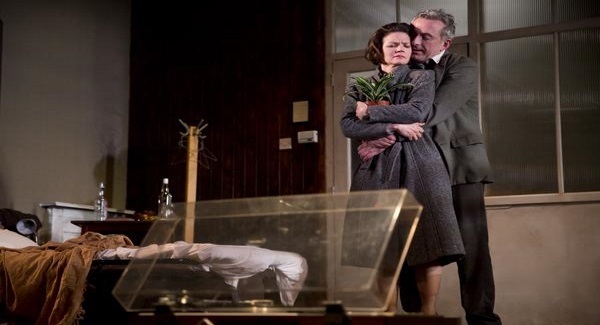
Coming back to the play as a middle-aged woman — it is running in the Gate Theatre, Dublin, as an 80th birthday tribute to Murphy — was strangely moving. I know the script backwards. I still have my much-thumbed Gallery Press edition, from 1984. I even get mildly annoyed that the play has been whittled down again and changed in little ways.
But, still, the colours are brighter now that I am nearly the same age as the protagonists and that I am in the heart of all the sorrows, disappointments and crises of middle age. I have seen friends struck down by depression, I have seen friends lose siblings to suicide. I have had children and I feel the desperation of JPW’s lover, Mona, to have them in my gut. The friend who was sitting beside me in the theatre has cancer.
The first production, directed by Patrick Mason, and starring Godfrey Quigley and Tom Hickey, was masterful. As Quigley said to Hickey: “We have climbed the mountain, dear heart.” But it’s as if it prefigured my life, while this latest, superb production, in which Daniel Grindley directs Declan Conlon and Denis Conway, describes it. Conway also played the developer in the Druid production of the play, in 2009.
Now, from the distance of 30 years, I can see the play as a period piece. Jonathan Fensom’s naturalistic set, the dingy flat cut out of a grand house with a mottled glass partition, is familiar to anyone who rented flats in Dublin in the 1980s. Unemployment was not just epidemic, it was pandemic. There were thousands of people like JPW, living as fictional characters, the same semi-employed people who wander in and out of the fiction of Joyce.
Money finally changed a city that had remained unchanged, in essential ways, from the time of Joyce, as Nuala O’Faolain once observed. But the seeds of the transformation of Ireland were well in evidence by the time of The Gigli Concert, and recognising them is one of the joys of returning to it. It’s not just there in the ‘gombeen’ builder who has friends in high places; it’s also there in the relaxed and relaxing social mores.
Without making Ireland his subject, Murphy evokes it better than those who do. I rely on Murphy to explain the past for me, so I can read the present. His play, Conversations on a Homecoming, evokes the failure of an economic model that stopped generations of Irish people growing up. You couldn’t marry until you had the job or the farm, and you couldn’t get either of them until you were middle-aged. Who can forget the words with which the frustrated teacher puts down his long-term fiancée, telling her to run along home on her “fat little legs.” Murphy has written many other brilliant plays, including A Whistle in the Dark and Famine and Bailegangaire, and they have deeply marked many of the people in their audiences, including me.
But The Gigli Concert is Murphy’s masterpiece and it is a masterpiece of world theatre. So why is Murphy’s name not up there internationally, not even with Brian Friel’s?
Friel’s Dancing at Lughnasa has had the international success that Murphy’s masterpiece has never had, including a Tony Award for its Broadway production. It was also first directed by Mason at the Abbey Theatre. It is also a play about transformation in the midst of economic devastation.
But, for all its savagery, it offers access to Ireland through the familiar cottage door. The entrance to Murphy’s work is more difficult for an international audience to find, precisely because they are looking for an Irish experience. It makes you wonder how Samuel Beckett would have fared if he had stayed in Dublin, writing in English, instead of going to France. His international reputation might still be languishing with other Irish writers who do not obviously make Ireland their subject.
I hope that, in this, Murphy’s 80th year, The Gigli Concert finally travels as far as it should, not so that we in Ireland get a chance to bask in its glory, but to let as many people as possible in on the secret of life: “That’s it… Sing on forever… That’s it…”
READ MORE VICTORIA WHITE
VISIT THE VIEWPOINTS HOME PAGE
CONNECT WITH US TODAY



Be the first to know the latest news and updates