When the rain stops and we find a world transformed
The recurrent showers of recent weeks has had us crouching under bushes for shelter.

When the rain stops and we find a world transformed

Sweeping in from the Atlantic, they catch us on cliff tops where there’s often no more than a wind-bent sceac for protection. “Carry an umbrella!” I hear my reader say.

But an umbrella is somehow incompatible with cliff-walking. It’s also impractical, turned inside out by the wind as soon as it’s opened or snatched from the hand by a gust. As for a walking aid, a piece of a sceac itself is more appropriate.

Both blackthorn and whitethorn is hard and light, which is, I believe, the reason they were employed as shillelaghs.

The blackthorns’ flowers have now transformed into small, marginally serrated, oval leaves, and afford some shelter. In blackthorns, the flowers precede the leaves; in hawthorn, the deeply lobed leaves come before the flowers.

Hereabouts, both trees are referred to as sceacs. I come to the conclusion that the blackthorn may be a plain ‘sceac’, while the whitethorn is the ‘sceac gheal’, the bright sceac. The floral display of the whitethorn is brighter on the landscape, in that it is Ireland’s most common native bush and hedges of Mayblossom (it blooms in May) run for hundreds of metres across lowland meadows or stagger valiantly across mountain pastures. Both species are as tough and rough as their Irish name implies.

The blackthorn delivers sloes, which are essentially small, sour plums — the Linnaean name is Prunus spinosa, prickly prune — while the whitethorn delivers haws.

When the rain stops and we walk again through “intermittent patches of bright sunlight“, we find a world transformed. Earlier, as the mist became rain, the view darkened. As the rain fell, the field and the hills became a universal dark green, the “intermittent patches” of bright gorse, quickly losing their glow behind the curtains of the deluge, and the sea below us becoming gunmetal grey.

But then, the rain stops and we emerge into a world of almost blinding light and colour, the sun mirroring on the rain-slicked fields. The sea sparkles again, the sky is blue, and the wildflowers are never more beautiful that when they shine in the sunlight. Droplets of rain twinkle like jewels on the small blue flowers and red stems of toadflax laid across old stone walls. At the butts of ditches in West Cork, Kerry and Connemara, the tiny pink flowers of St Patrick’s Cabbage lift their faces to the sky.

Saxifraga spathularis grows in carpets, and the flowers, on their tall, pink stems, seem like a small pink cloud. Their Irish name is Cabáiste an mhadra rua — Fox cabbage? Whatever its name, it is one of our loveliest wildflowers. Its range is confined to Portugal, Spain and Ireland; it does not grow wild in Britain or France. A member of the small collection of Lusitanian species found in Ireland, how it arrived here is still debated. Possibly, it came via a land bridge between Ireland and northern Spain and could not travel onward to Britain because an ice sheet covered this country but for its western margins, and ice filled the Irish Sea.

The serrated leaves, forming a ground-hugging rosette, are like spoons (thus spathularis), fat and fleshy with toothed edges. They thrive on acidic rocks, with little soil. They grow on a wall in my garden; and survived the freezing weather of January 2010, when the leaves, hunkering the wall, looked as lovely frosted over with ice as do the flowers when they are sprinkled with rain.

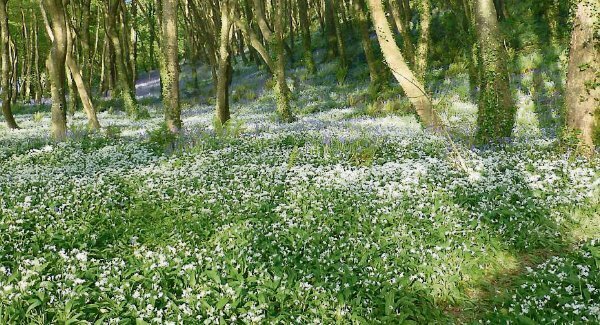
The woods in Courtmacsherry, and elsewhere in Ireland, are carpeted with a million (a trillion?) bluebells and broad swathes of ramsons with their white, star-burst flower heads, broad basal leaves and garlic smell. Earlier, it was delicate wood anemones; now the bluebells.

Over the last weeks, foxglove flower spikes have shot up from their beds of big, deep-veined leaves, and flowers were already opening in mid-May. They are poisonous, of course, but are the source of many life-saving drugs to treat heart conditions, digitalis being the best known. Digitalis, fingers, foxgloves.

And, sometimes, we find white foxgloves in the wild.

In more open woodland, Red Campion stands tall and elegant, forming dense mats in clearings. Lords and Ladies, also called Arum Lilies, are opening, the purple- brown spadix standing erect within the cowl-shaped outer leaf.

In rain, give me the woods where there is much to see as I shelter under towering beeches, rather than crouching under a lonely, wind-sculpted sceac.

DISCOVER MORE CONTENT LIKE THIS

More in this section

Revoiced

Newsletter

Sign up to the best reads of the week from irishexaminer.com selected just for you.

Cookie Policy Privacy Policy Brand Safety FAQ Help Contact Us Terms and Conditions

© Examiner Echo Group Limited









