There’s no decency in prioritising votes
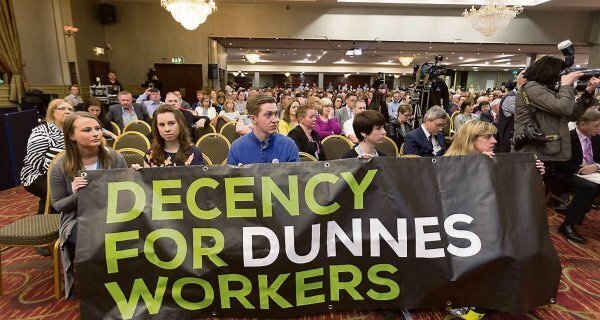

EASTER week presented a view of the march of a nation towards its destiny and it wasn’t a pretty sight. Dunnes Stores workers who were on strike on Holy Thursday have been singled out, intimidated, had their hours reduced and rosters rescheduled.
That’s according to the union for retail workers, Mandate. We don’t know Dunnes’ response, because the retailer doesn’t engage on these matters, believing, presumably, that they are insulated from the society that supports them.
Have we come to this? As the smoke clears from a deep recession, is society accepting that workers in low-skilled sectors can, once more, be treated like serfs, as was the case a century ago? Government figures, like Ged Nash, have been issuing warnings on foot of these reports. The time for that is past. Action is required yesterday on this issue.
DISCOVER MORE CONTENT LIKE THIS
Dispatches from Paris, during the week, came from a conference in which governor of the Central Bank, Patrick Honohan, opined that Ireland, where the biggest banking collapse in history occurred, needed laws to rein in bankers.
“The Irish legislative framework deserves to be strengthened to take account of the egregious recklessness in risk-taking by those who were in charge of failed financial firms,” he said. “Recently, the UK enacted legislation of this type, which I believe could be usefully mirrored in Ireland.”
After all the country has been through, the Government has still not brought in laws to incentivise bankers not to take a punt on the welfare of the nation. Do they expect the bankers to self-regulate for the common good? Eight years down the line, and it’s ‘as you were, lads’.
Elsewhere, the teachers’ conferences provided some pointers, both to the future and the past. All of the three unions want pay restored to 2008 levels. The demand implicitly suggests that public-sector pay levels in 2008 were sustainable, if only those goddamn banks and developers had behaved themselves. There is absolutely no recognition that pay levels and services were based on a bubble economy.
Other priorities at the teachers’ conference merit immediate attention, such as the lower pay scale imposed on younger teachers.
Similarly, the casualisation of teaching needs to be reversed. And the stripping of resources, particularly in the most disadvantaged corners of education, must be halted as a priority. Any parent who has a child with a psychological condition knows the importance of time in getting a diagnosis, and having it acted on.
Educational disadvantage and special needs were savaged during the years of austerity. In any self-respecting nation, priority should be given to relieving the burden imposed on the most vulnerable.
This matter was touched on by one speaker at the INTO conference. Tom Healy, director of the Nevin Economic Research Institute (NERI), said that children needed to be protected “from the ravages of tax-cutting mania.
Let me be abundantly clear about this. How can we, as keepers of the democratic revolution, tolerate a situation where 3,000 children…are waiting more than a year for urgent speech-and-language therapy, where there is talk of cutting income tax? This is immoral, economically irrational, and fiscally irresponsible.”
It surely is all of those things, and it is also the priority of the Government. Instead of standing back and viewing the damage that was wrought in particular sectors of society, and resolving to prioritise those, the Government is looking to where votes can be harvested.
According to the spin put out by vested interests, this remains a ‘high-tax’ country. Of course it is, compared to the bubble years, but, once again, there is no acknowledgement that the tax rates of those years were built on sand.
Income tax is the priority of the current Government, but the alternative ‘government’ is also obsessed with rooting around for votes on the back of tax cuts. Sinn Féin announced during the week that it was again reversing its policy on Irish Water.
The first thing a new Sinn Féin government would do, according to Pearse Doherty, is abolish Irish Water.
Of all the things that are wrong in the country, of all the suffering that has been inflicted on some, the hardship on others, and the worry and stress on the many, the first priority for Sinn Fein would be to abolish Irish Water, and head back to the future on water charges. At this stage, one gets the impression that the Shinners send a man down from West Belfast monthly to climb the Spire in O’Connell Street, to check which way the wind is blowing on the water-charge issue, and formulate policy for the month on that basis.
One of the few chinks of light during the week was the publication of the annual socio-economic review from Social Justice Ireland. The organisation, led by Fr Sean Healy, does what it says on the tin, prioritising social justice. Like Mr Healy from NERI, Fr Healy’s organisation conducts extensive research on which to base its positions.
This is in stark contrast to the policy-making that is formulated by surfing the latest populist wave, or by buying the next election. On health, SJI believes that the rollout of primary-care networks should be prioritised, “if it (the Government) is serious about providing a viable healthcare system across the whole country.”
Fr Healy says: “These networks are a very good example of what should be prioritised, as resources become available from Ireland’s economic recovery. These networks would benefit the entire community and, in particular, older people, children, and people with disability. This would go some way towards mitigating the income and service losses endured by Ireland’s most vulnerable since the crash of 2008.”
And what’s the Government’s priority? On Thursday, the Government announced that it had struck a deal with GPs over free access for children under six. For those who can afford to visit the doctor, and who are, for the most part, more likely to vote, this is effectively a tax rebate.
The priority here is to hoover up votes, rather than ensure that those most in need of medical care, whatever their age, are taken care of. The deal is sweet for doctors, who will be paid an annual capitation grant of €125 per child, 82% more than the existing rate.
And why wouldn’t it be sweet, as they had the Government over a political barrel, just as was the case back in 2002, when another government was scooping up votes with the medical card for over-70s? At least some vested interests are managing to get back on the horse, now that there’s a few bob around again.
That’s the week that was. The glorious Republic is on the march, towards an election, back to the future, any which way that doesn’t involve pausing for a sconce in the mirror.
DISCOVER MORE CONTENT LIKE THIS
CONNECT WITH US TODAY



Be the first to know the latest news and updates