Caught in a spider’s web
The cleaning involved removing cobwebs. Spiders love my greenhouse and I encourage them, because they provide biological pest control.
Then, a truly enormous one appeared and ran across the back of my hand.
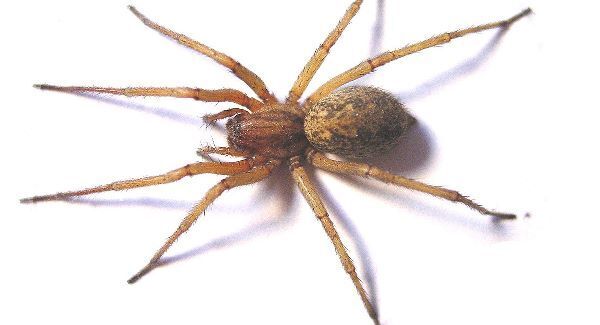
My first reaction was terror. I’m not an arachnophobe; I’m an amateur naturalist with an interest in spiders, and I was ashamed of my terror. So I immediately overruled my reflexes, identified the species as Eratigena atrica, the giant house spider, and told myself that all Irish spiders are harmless to humans.
Arachnophobia is an extreme psychological condition that is relatively uncommon. But the majority of people, at least in the western world, have a nervousness around spiders and snakes.
It’s been demonstrated that other primates, such as chimpanzees, share this nervousness. It seems probable that it is hard-wired into our genetic make-up, a left-over from some point in our distant, evolutionary past when spiders and snakes really did pose a threat to us.
In my defence, this really was a big spider — it had a leg span of over 50mm and a finger-nail-sized body in various shades of brown. It was also extremely fast — over short distances, the giant house variety is probably the fastest spider in the world, having been clocked at 0.55 metres a second, which is about 1.18 miles an hour — it doesn’t sound like much, but it’s impressive when you see it.
A further point in the case for the defence is that it is a white lie to say that all Irish spiders are harmless to humans, and it is propagated to make us all feel better. Of the 370 species recorded in this country, several can bite people and have done so. The giant house spider is one of these.
The fact that it doesn’t bite often is because it is very non-aggressive, not because its mandibles are unable to penetrate human skin and inject venom.
In Ireland, I’ve never been bitten by a spider, but I know several people who have. And I have been stung by Irish centipedes, which are also supposed to be harmless. It’s happened to me twice and the first time the extremely painful swelling on my hand took a fortnight to disappear. As the saying goes, once bitten, twice shy.
The giant house spider is a funnel-web spider that is native to Britain and probably to Ireland, as well.
It is not as widespread as the common house spider, but is not rare. It actually prefers to live in undisturbed out-buildings, rather than in dwelling houses.
Nature Table - Waxwing
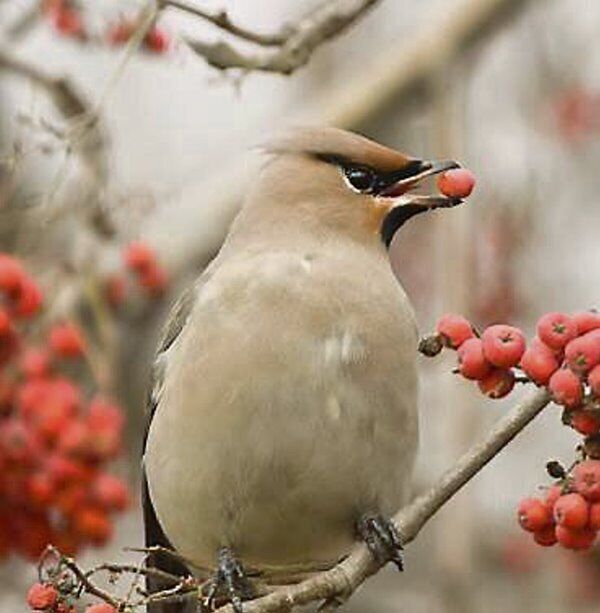
With their crested heads and gaudy plumage, waxwings look like tropical birds. In fact they’re the opposite, spending most of their lives in forests fringing the arctic tundra.
They’re slightly larger than bullfinches and live on insects during the summer and berries in winter. When the berry supplies in the northern forests are exhausted they range far and wide looking for food and some reach Ireland.
There are sightings every year, mostly in the east and north of the country, and there have been several recent reports.
In some years there is a massive irruption of birds (an ‘irruption’ is when a large number of birds arrive; an ‘eruption’ is when they leave).
The last big waxwing irruption in Ireland was in the winter of 2012. They often visit towns and cities where berry-bearing trees and shrubs, such as rowan, pyracantha or cotoneaster have been planted in gardens and parks.
Although individual birds are sometimes spotted they typically form flocks of a few dozen to several hundred.
CONNECT WITH US TODAY



Be the first to know the latest news and updates