Scotland will never be the same no matter what the result of poll
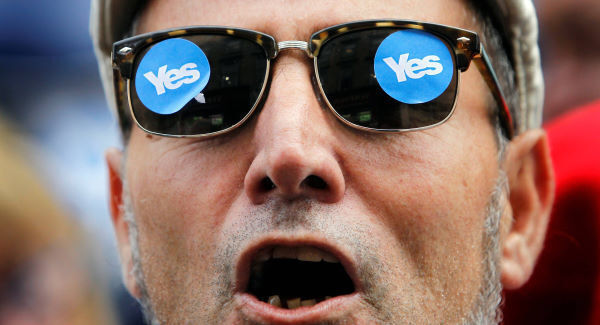
Nationhood doesn’t matter anymore, does it? Tell that to a Scot standing in George’s Square. And put a sock in it the next time Ireland plays a rugby match against England. Of course nationhood matters. Nationhood matters because nationhood is identity, community and kinship.
It is clear that the “nation state” as we understood it, as an utterly sovereign entity, is over — if it ever existed. But statehood within the context of wider groupings and allegiances is not over. In fact you can argue that the small state working within a big multi-lateral confederation, such as the EU, is the way of the future.
A confederation, not an empire. Today Scotland is still the colony of an empire. While any sane person would want the constituent parts of these islands to work together on energy, defence, healthcare, migration, fishing, farming and dozens of other issues, they need to work together as equals.
Scotland will never be England’s equal as long as she stays in the UK. That has always been clear to me, coming regularly from Ireland to Scotland, where my brother married, works and lives.
You realise this the minute you arrive. Glasgow is the biggest city in Scotland but it has a provincial airport. It does not have the institutional flexibility to tailor its taxation laws and infrastructure to compete with London. There is a reason for this. London does not want Glasgow or Edinburgh to compete with London.
You can argue that an independent Scotland in a stronger EU would have to compete with other bigger powers writing the laws to suit itself, such as Germany and France. I don’t disagree. But there is far more chance of fairness in a relationship with a multi-lateral power, than in a relationship with one much bigger country, which will always feed itself first before making room at the trough.
London regards Scotland as a far-flung province. That has been made clear as crystal in the last days of this campaign, as stunned Westminster politicians dash north to make tearful speeches and the BBC gasps as at the antics of a daring child.
Yesterday, in an article so passionate it nearly burned the paper of the Glasgow Herald, the writer Ian Bell spoke of the attempts to “harry an electorate into submission.” To the question, “Why break up the United Kingdom?” he replied, “Because in the 21st century, such things must be broken up for the common good.”
His charge sheet against the UK includes, “institutionalised corruption, the self-perpetuating Oxbridge elite, the fealty to the city, the brutality towards the poor, the veneration of stolen wealth, the local military-industrial complex, the decadence of the Commons, all the media stooges and a contempt for — because they mean you — “the provinces.””
Scotland, with one Tory MP, is unrepresented by the UK Government. As one of our many taxi-drivers with Donegal roots put it, “We could have Nigel Farange running the country in two years time, taking us out of the EU, which has given workers all their protections…”
He worried it might be wrong to break faith with the English working classes but he hoped a Yes vote in Scotland might rouse them. He was no nationalist, he said, and he had always been a Labour man. Until now.
I don’t know how many times we heard those words. Opposing Scottish independence may in time be seen as one of the biggest mistakes the British Labour Party has ever made. I doubt they can ever recover in Scotland as the SNP, like Fianna Fáil in Ireland, hoovers up the left-of-centre vote.
All the more so because today’s vote is in part a delayed vote against Margaret Thatcher and her 11 years of hacking away at the British post-war welfare state and the social cohesion it reflected and nurtured.
Canvassing for a Yes vote in Scotland, I found myself renewing my vows of allegiance to my own country. I remembered a letter I wrote to a UK newspaper after they engaged in yet another bout of bashing Ireland as “feckless” and “Romish”. It said that the one concern the UK had to have about the Republic of Ireland was why they were so far behind us in the UN Human Development Index.
The biggest banking crash in recent Western history impacted on our ranking and we are down three places since last year, but we’re still three places ahead of the UK and a full six places ahead when the index is corrected for equality. My 15-year-old son brought one punter over to the Yes side just by making that comparison when we briefly hit the campaign trail in a huge multi-storey housing estate in Glasgow.
Scotland will not be Norway on Saturday if there’s a Yes as some of the campaign literature would have you believe, but it does not have too much to fear of a Yes either.
What a Yes gains Scotland is the possibility to dream of a future as a small, relatively prosperous country. It will be part of the EU soon enough and eventually it will probably use the euro. The Scots are terrified of the euro and surely cannot be denied sterling in the short term, as we were not. Sterling will mean they owe much of their government to the British Treasury, but independence must be gradual if it is not to be damaging. That’s another lesson in tolerance of my own history I’ve learned over here.
What a Yes gains Scotland is potential. The Yes campaign is full of hope, the No is full of fear.
Standing in Georges Square at a rally this week, it was clear the Yes campaign included the looniest of lefties and the hippest of hippies, all promising Utopia by the weekend. But it was impossible not to be moved by the carnival atmosphere, the babies with Yes stickers on their faces, the strains of ‘O Flower of Scotland’, the ever-changing hand-writtten placards: “Hope over fear”, “You’re better than you think you are”, “This is our time of reckoning” and my favourite, “Three sleeps until Yesmas.”
“I wish I was Scottish,” said my son as we walked away and I knew how he felt. The Yes campaign has been the most significant popular movement in my lifetime in our islands and I was grateful for the chance to briefly share in it.
This vote is happening today because the people wanted change and eventually they are going to get it. It may be one sleep away — it may be hundreds or even thousands — but some day Scotland will wake up to a new morning.
Today’s vote is in part a delayed vote against Margaret Thatcher