Fantastic fossils, feds and the FBI
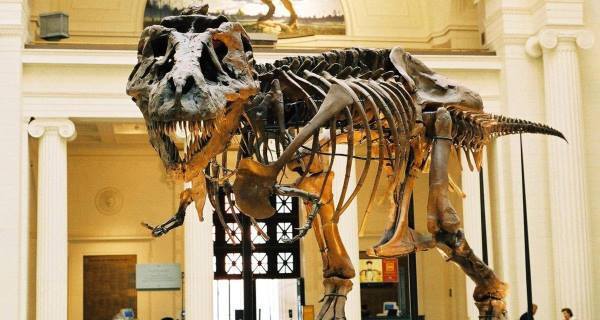
In August of that year, some fossil hunters were prospecting in the ‘badlands’ of South Dakota when a tyre on their jeep went flat. They headed for town to sort out the problem but one member, Sue Hendrickson, stayed behind in the arid wilderness. Exploring on her own, she came on fossil bones protruding from a cliff face, which team leader Peter Larson, on the jeep’s return, identified as those of a tyrannosaurus.
The specimen, nicknamed ‘Sue’ in honour of its finder, would prove to be one to the most important and controversial dinosaur finds ever made.
Tyrannosaurus rex, ‘the king tyrant lizard’ and a favourite of children everywhere, is one the world’s iconic animals. Living in a part of what is now North America, it became extinct 65 million years ago. Computer simulations suggest that these 7 tonne giants, up to 12m long and standing 4m high, walked at about 4km/hour, waddling duck-like on hind legs.
Films of the Jurassic Park genre invariably depict Tyrannosaurus as a ferocious predator gobbling up everything in its wake, but some paleontologists argue it was not a true carnivore but a scavenger, butchering carcasses with serrated ‘steak- knife’ teeth.
Only twelve Tyrannosaurus rex specimens were known prior to Sue’s discovery; hence the film’s title. Larson paid landowner Maurice Williams, a member of the Sioux tribe, $5,000 for the specimen. It was the largest amount ever paid for such a fossil.
The team meticulously extracted Sue from the surrounding rock, loading the fragments onto a truck. The work, depicted in the film, took 17 days to complete in temperatures reaching 47ºC.
In all previous tyrannosaurus finds, no more than 50% of the fossil had survived, whereas Sue was 80% intact. Forensic examination revealed she had suffered several nasty injuries during her lifetime. The right shoulder was badly damaged and three of her ribs were broken. She was 28 years old when she died, making her the longest-lived tyrannosaurus known. The meticulous reconstruction of the skeleton got underway. People came to see Sue from far and wide.
Then, almost two years into the work, there was a knock on the door. FBI agents were outside and the building was surrounded by armed National Guardsmen.
A warrant had been issued for the confiscation of the famous fossil, which the FBI claimed had been taken illegally from federally-owned land. The Hill City community resisted the confiscation of the fossil which had made their little town famous. A three- day standoff with police and troops ensued.
Not only Sue, but all the specimens on the premises were taken into custody and placed in a warehouse 50km away. The Institute’s files were seized. The deputy US attorney general became involved. Thus began a protracted legal battle, culminating in a cliff-hanging courtroom drama in which Larson and his co-defendants were charged with a total of 153 offences.
The legal shenanigans were extraordinary. What, for example, had been removed? Not bones — fossils consist of crystalline material which, over time, replaces bone. Larson’s team, therefore, had not removed animal remains, but rock.
Had Sue been found on land allocated to the Sioux? If so, Williams was not entitled to sell anything from the site without the permission of the Bureau of Indian Affairs.
I won’t reveal the bizarre outcome of the trial, and the nail-biting auction at Sotheby’s, New York, which followed it. Go and see the film.

CONNECT WITH US TODAY



Be the first to know the latest news and updates











