National day of debauchery a sign we are unable to relinquish excess

Having abased ourselves in a Sodom and Gomorrah of greed, we know we must reform. In newspapers that indebted themselves by producing full-colour supplements of property pornography — and made investments so improvident they can excuse themselves of the charge of hypocrisy — pulpits are made of opinion columns and brimstone is rained down on readers. I prefer debating chambers: anger creates public furore, but seldom any lasting, private reformation.
Yesterday, unsung heroes were at work. The sweepers of streets, the staff of A&Es, the operators of helplines, and an Garda Siochána cleaned away and mended the debris of our national holiday. The vomit, the stale beer, the human cost of a great spewing forth of overindulgence and inebriation, were removed, all the better that our view of the world might be unhindered today. A triumph as great as the global greening is a sensation best enjoyed uninterrupted.
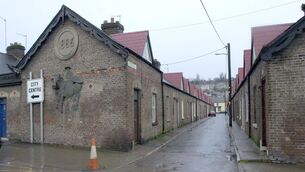
“Love-ly peop-le… Plent-ty of mon-ey…No man-ners,” as novelist John McGahern said, catching the cadence of the journalist Dick Walsh. I never knew Walsh, but I was sufficiently discomforted by his writing to dislike him by repute. So he must have been doing something right. I did, however, know McGahern, a little. When away from Leitrim, he lived in Stoneybatter. McGahern was a master of gentle cadences and good manners, though his softly spoken, wildly humorous excoriation of an obscure Irish politician I knew well is an oration I will cherish to the grave. It is truly hard to make a whole of all the pieces of St Patrick’s Day. On Monday morning, while the country was on holiday, I walked in a wide arc around Dublin City centre.
I thought it best to walk around the parade, rather than try and cross it. People waiting for hours, with children, up against crash barriers, are reluctant to stand back, lest they lose that pride of place. In a cordoned-off holding area, between Broadstone and Parnell Square, the floats and bands were waiting to go.
They were bursting with enthusiasm, colour, and fun. Onwards via Mountjoy Square, Gardiner Street and across the Liffey on the pedestrian ‘bingo bridge’ to City Quay, I then saw an instantly recognisable public man.
His once great mind and wit are now, alas, a little clouded. But he was out, as he often is on those streets, walking, smiling a lot, and on that national holiday turned out like a new pin. On Westland Row, in for a sandwich and sent downstairs because the tables upstairs were taken. I was put-out. Who wants to eat their sandwich in a charmless basement?
A man came out of the bathroom; you are always beside the bathrooms in those unattractive basements. A boy of about ten, with Down syndrome, was with him. The man, daddy I guess, was helping him on with his coat, and says to the lad “this is a nice place”. They were happy out, and off to the parade. What’s not to like, not to be proud of?
That afternoon, in Croke Park, the All-Ireland club championships were ran-after and tussled-over. St Vincent’s, from Dublin, beat Castlebar Mitchels in the football, and first-timers Leinster Rangers, from Carlow, lost to Portumna in the hurling. Off that field of dreams men had trained for months.
For many, that clash was their great moment; a perennial future point of self-reference that they had played in Croke Park on St Patrick’s Day in an All-Ireland club final. Behind those teams were larger ‘teams’, of people who chugged buckets, sold tickets, washed jerseys and cheered on wet days in small places to give fundraising a good name and their community something to be proud of.
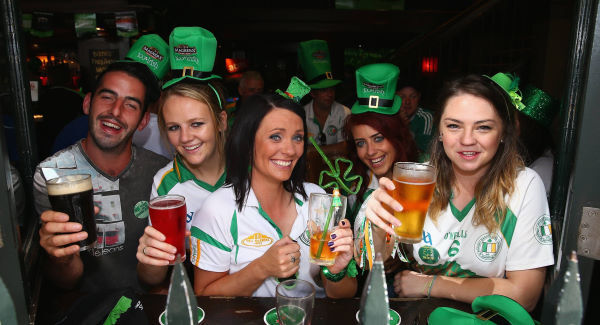
Hours later, and back home via a detour up Grafton Street, back down South William Street and through Temple Bar, the parade was long over and the streets were full of feral, drunken crowds of uninviting people. A busker on Grafton Street had his takings whipped away, probably for tins of beer. Teenagers were drunk and vomiting. Girls sozzled and groping in daylight, all acne and sparkly knickers; a line was crossed en masse from the erotic to the appalling. God knows what night was to bring, but the passing of daylight at least promised obscurity for the more outrageous.
Back home in time for the Six One News on RTÉ, all was right with the world again. On the telly, the parades around the country were rerun, all colour, enthusiasm and good cheer. The All-Ireland finals were replayed. There was a sense of a people with pride and purpose, lifting themselves up and out of the ordinary for a day. So what can really be wrong, if so much is right? What is it about excess that makes it so compelling for so many of us? We pay ourselves too much, over and over again. Some choose their coin in tins of beer, others in tens of thousands. There is a fundamental resistance to restraint, and on and on it goes.
Yesterday, on this page, Fergus Finlay regretted the lack of regulation of lobbyists and charities. He is right on both counts, and I work as a lobbyist. I am also a lover of excess, of things I don’t really need and cannot actually afford.
There is little, probably nothing, in what I regret in others that I cannot apply to myself.
The line between self-knowing and hypocrisy is thin indeed and pernicious in public pontificators.
THE All-Ireland finals were sponsored by AIB, and the drink companies sponsor many events of which we are proud. We are picking ourselves off the floor economically and already we are talking loudly about how we will spend the loot.
The lusting for a more moral economy is nearly always projected out towards ‘them’ and seldom applied to ‘us’. The restraint, the perseverance, and patriotism required for a sustained change of fortune are palpably passing already.
This is a country possibly set for recovery and probably set to repeat many of its past mistakes. The ostensible details may change, of course. But the substance is clear to be seen.
Having gotten out of hock, we are destined to run up the tab again. We didn’t have a democratic revolution, because we are not ripe for reform. We prefer being outraged about how things are than changing what we are.
In clouds are silver linings.
Small kindnesses abound. Good people go on. It is just when we get together, we tend to lose the run of ourselves entirely.
CONNECT WITH US TODAY



Be the first to know the latest news and updates