Kenny has closed the gates of ‘Janus’, but must watch his back
JANUARY, from Janus, the Roman double-faced god facing in opposite directions, is here.

Kenny has closed the gates of ‘Janus’, but must watch his back

The patron of doorways, corridors and places of transition, Janus’s temple had enormous significance in ancient Rome. At midnight last night, many of us threw open our doors to let out the old and welcome in the new. Superstition? Perhaps, but also ancient religious custom. Nothing was more symbolically potent in ancient Rome than the opening and closing of the doors of the Temple of Janus.

Only in peace were the gates of the temple shut. In war, they were opened. The great Augustus (meaning ‘revered’), formerly Octavian, closed the gates an unprecedented three times. The first time he did so was after the defeat of Anthony and Cleopatra. Rome was saved from the despotic tyranny of the former and the foreign domination of the latter.

The apparently unprepossessing Octavian, who, with guile and steel, outpaced and outlived his competitors to die in his bed as the newly minted and immortal Augustus, was a master of myth-making. By dint of serial assassinations, he came to personify peace.

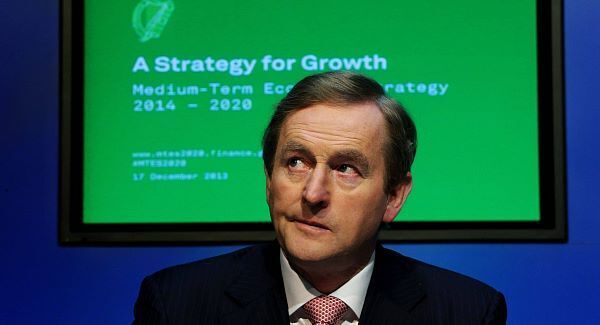
This January opens with a grateful Irish people looking up at a temple whose gates have been symbolically shut again. Our own ‘Octavian’, unprepossessing and underrated into his 50s, closed the gates of the ‘Temple of Janus’, when he addressed us as Taoiseach, veritably ‘Augustus’, on Dec 15. The shame of foreign occupation is over. The louche behaviour of a previous era, which allowed foreign rule trample our citizenship, is righted by civic austerity and sacrifice. We have not only regained our independence, we have reclaimed our virtue. We are a people not only free again, but proud once more.

The truth is a little more complicated. That wise god understood the complexity of all change and transition by facing both ways, forward and back, at once. Most change is a reclothing of continuity. Our great change, the peace we now usher in, is the renewal of an old, always present, always powerful, but seldom in-government elite, Fine Gael.

It is an unsubtle irony that Fianna Fáil, the Republican party, went to seed at exactly the moment its hereditary princelings stormed the political stage en masse. One of the most startling images of Brian Cowen’s government was its first. Looking at the ‘family photograph’ of that government, six of 15 Fianna Fáil ministers were inheritors of a familial political tradition without which their initial Dáil election was improbable. That excludes Martin Cullen, who was the scion of generations of local government in Waterford. The last government of Ireland similarly dominated by a hereditary political class was Lord Salisbury’s administration in the 1890s.

But in Ireland, class and connections are infinitely subtle, but no less real for that. Fine Gael, in this triumphant iteration, are the renewal in political power of a class who, if usually lacking office, seldom wanted for access or influence. It is, in its core DNA, the successor of the Irish Party, the nationalist middle class and strong farmers who colonised fertile plains, the higher professions, and the common rooms of the national university.

Through decades out of government, other power bases were cultivated. These gave Fine Gael many of the rewards of power, despite ostensible exclusion. Excluded but not exiled, sometimes small enough not to matter on the national stage, they were large enough to densely settle profitable tracts of the professions and economy.

They enjoyed education when it was not universal, social standing in a culture crippled with a lack of self-confidence, and a benign exclusivity on social and economic uplands. That exclusivity effortlessly transubstantiated into snobbery. Fine Gael is a party of privilege. That privilege is leavened by what it sees as its obligations. This democratic revolution, so-called, is their renaissance as the natural party of government. In this decade of commemoration, that is the centenary they are celebrating.

Success, when it came for them, was at the cost of diluting the clotted cream coursing through the veins of an old elite whose self-regard was matched only by their acuity for mutual recognition. Even in the tidal estuary of Irish social intercourse, they could always find one another. Garrett FitzGerald understood that upper-class women and lower-class men were required if the base was to be broadened. A generation before, one Henry Kenny had been recruited in Mayo, on the same principle and for largely the same purpose. It was never expected, and until recently never accepted, in Fine Gael, that his son, another múinteoir scoile, would, like Octavian, be raised to the purple. Less still was it ever imagined that an apparently unprepossessing, unintellectual primary school teacher could do what had eluded generations of patrician consuls: close the gates of the Temple of Janus.

The tide is with Fine Gael and its imitators. Ireland is a minority that enjoys the substance of being middle class, and a majority that is determined to join them. The political left is either fractured, irrelevant and in opposition, or, like Labour in government and delivering on the most substantive advancement of William Martin Murphy’s agenda since the 1913 Lockout.

The Abbey, our national theatre, marked the Lockout with a new production of James Plunkett’s The Risen People. It captured the misery and the dilemma of the slums.

But that dilemma was long since answered by the decision of generations of working-class people; if you can’t beat them, join them. What is left over in that production is a finger-pointing and a hectoring that is a caricature of the abusive authority it purports to challenge.

Less the pointlessness be lost, onto the post-show stage on opening night arrived a supremely elegant Lelia Doolan, theatre-maker and former director of the Abbey. She demanded, resplendent in cerise and pearls, to know if there were any bishops or capitalists in the audience. The capitalists were seated wall-to-wall and any bishops present were in mufti. The evening was a last harangue from an exhausted left that had nothing to do except dress up for a night of pretended revolution, put on for the entertainment of its triumphant adversaries.

Kenny, like Octavian, has captured the moment. He has remade himself and made servants of his masters. If the continuation of that comparison can only be successfully completed in caricature, there is enough truth to allow us to see, Janus-like, backwards and forwards, the reclothing of continuity as change. Octavian lived to die in his bed, because he never allowed his enemies escape. Anthony and Cleopatra are testimony to that. Kenny, however, has. It is not necessary that his foes in the Reform Alliance succeed, only that they survive. Should they survive without him having escaped to even greater glory in Brussels, then, like Charlie Haughey after enforced coalition with a reduced but necessary Progressive Democrat Party in 1989, he may find that a peaceful end is ultimately elusive.

More in this section

Revoiced

Newsletter

Sign up to the best reads of the week from irishexaminer.com selected just for you.

Cookie Policy Privacy Policy Brand Safety FAQ Help Contact Us Terms and Conditions

© Examiner Echo Group Limited