Divine intervention for leopard
Nor does the thought that wild creatures are our blood relatives sit easily with aspirations to an eternal destiny. ‘I’m no kin to the monkey and the monkey is no kin to me’ the American fundamentalists chant.
Eastern religions have a different perspective. Their doctrine of re-birth sees connections between all living things. Now papers have appeared claiming Buddhist monks are protecting one of the world’s iconic animals and that sacred forests offer safe havens to birds.
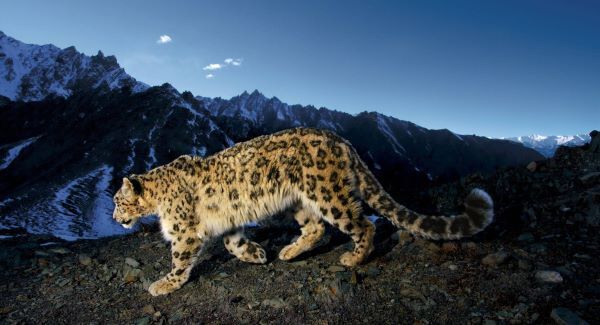
The snow leopard, whose closest relative is the tiger, lives a solitary life in the mountains of Central Asia, at altitudes of 3,500 to 6,500 metres. The smallest of the ‘big cats’, it’s beautifully adapted to the cold austere places where it lives. The coat is especially thick, grey ‘rosettes’ on a white fur background making it very difficult to spot in snowy rocky terrain.
Unusually for a cat, the thickly-covered tail is longer than the body. It helps the leopard balance on treacherous slopes and doubles as a blanket to cover the face during blizzards. With its snow-shoe paws, this sure-footed predator crosses drifts where other large animals would sink. The ears are small, reducing heat loss. Snow leopards can’t purr, nor can they roar. All they can manage is moans, whines and grunts.
Small mammals and birds are the main prey, but a leopard can tackle creatures much heavier than itself. Only the adult male yak is safe from it. As far as humans are concerned, it’s the least aggressive of the big cats; it never attacks people.
Classified as ‘globally endangered’ by the International Union for the Conservation of Nature, the leopard hunts mainly at dawn and dusk. Censusing is difficult because sightings are rare. However, it tends to use trails made by other animals, leaving tell-tale pug-marks and droppings. Estimates of the world population vary from 3,100 to 7,300.
It’s a familiar animal here — Dublin Zoo has kept snow leopards since 1900 and raises kittens for the international breeding programme. It has given financial support to the Snow Leopard Trust, working with communities in Central Asia.
But snow leopards have their dark side; they take sheep and goats. To protect their stock, Tibetan herders shoot them.
Now a more ominous threat has appeared; leopard skins fetch large sums and big-cat body parts are being sold to the Chinese medicine trade. The leopards have, however, recruited unlikely allies; according to a report in Conservation Biology monks have become their protectors. A region of the Tibetan plateau was surveyed.
Of its 336 Buddhist monasteries, 90% were within 5km of a snow leopard territory. Conservationists have begun training the monks in survey techniques and encouraging them to patrol the lands adjoining their monasteries. Deeply respected in their communities, the monks preach non-violence and tolerance of all life, helping to convince the locals that killing wild creatures is wrong.
There are many more monks than wildlife rangers. The scientists believe leopards are better protected on the lands around monasteries than in the officially designated nature reserves.
“This report illuminates how science and the spiritual values of Tibetan Buddhism can combine their vision and wisdom to help protect China’s environment”, declared the well-known conservationist George Shaller, one of the report’s co-authors.
Leopards are not the only creatures being protected by religious attitudes in Tibet. Jody Brandt and a team of researchers carried out bird censuses in six of Tibet’s sacred forests. According to their report in Biological Conservation’s =October edition, these pristine forests have a greater range of species than those of surrounding areas.
The forests with the largest trees support the greatest diversity. During severe weather, such as the extreme drought of 2010, they provide a vital haven for birds.
Cardinal Jorge Bergoglio chose to be called after Francis of Assisi who, according to legend, made peace with a wolf. Will Western religions follow the spiritual East?
CONNECT WITH US TODAY



Be the first to know the latest news and updates