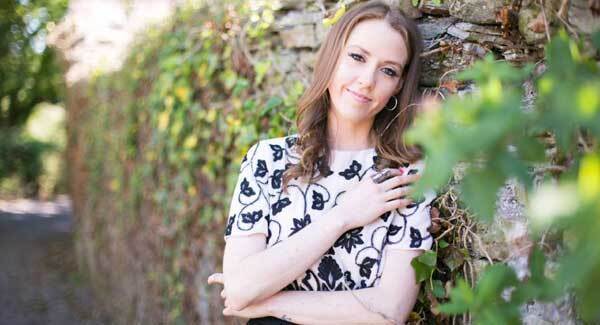
Louise O'Neill: It was as if I was learning to ride a bike for the first time, I needed the stabiliser wheels still attached before I was ready to let go
As a child, I had certain ideas about what life would be like as an adult and most of those were derived from movies.
Not films like Big or Home Alone, I knew enough from watching my own parents that it seemed unlikely adulthood would consist of staying up late and eating copious amounts of junk food. But I did secretly believe I would probably move to New York, go to work every day on the subway in thick soled white runners before changing into high heels for the office, while still managing to rent a large apartment over looking Central Park. (I blame a combination of Working Girl and Dynasty for these mixed messages about what I would be able to afford.)

I imagined myself going to bed at night in a silk, lace trimmed negligée paired with furry mules (ahem, Goldie Hawn in Overboard), applying liberal amounts of hand lotion while I had serious conversations in hushed tones with my handsome, expensively-suited husband about, I don’t know, tax evasion? (Dallas, I guess.)
I’m 34 now, and most definitely an adult, and none of that has come to pass. Ireland is too cold to wear silk negligées, for one, I have an extensive collection of flannel pyjamas instead, and I have a very nice but quite strict accountant who makes sure I pay all my taxes on time. But even at that, I don’t feel like a grown-up in the way my parents must have at my age, with two small children and a mortgage to pay.
Today, the markers of adulthood are constantly shifting. People are getting married later, they’re having their children later.
Due to the housing crisis, they’re buying their first homes at a much later stage than their parents did, if they’re able to get a mortgage at all. Gail Sheehy’s book Passages, which was supposed to be a road map of adult life, showing the inevitable changes we go through at various ages, was published in 1974 but when she wrote a new introduction to a revised edition in 2006, she acknowledged that, “there are still broad, general stages of adulthood, and predictable passages between them.
“But the timetable has stretched by at least 10 years, and counting. Age norms for major life events have become highly elastic. Since there is no longer a standard life cycle, people are left to customise their own.”
I left my job in New York and moved back home with my parents when I was 26 years of age. I started writing at 27, and was first published at 29. For those first few years, until I was 31 at least, I made so little money that I couldn’t afford to move out of my childhood home. (I was lucky, of course, to have parents who allowed me to do this. I was even more lucky to have parents I felt comfortable living with; if I had grown up in a dysfunctional home where abuse or addiction was rife, I would, I’m sure, have felt very differently.)
By the time I had become more financially secure, I’d had a major relapse with my eating disorder and I stayed at home because I needed the extra support. It was as if I waslearning to ride a bike for the first time, I needed the stabiliser wheels still attached before I was ready to let go.
The funny thing about recovery is that you realise how much time is taken up by the addictive behaviours, whether that be drinking, gambling, taking drugs, binge-eating, restricting food, etc. So much of your day is taken up with thinking about the addiction, planning it, and then engaging in it — and then the cycle begins all over again. In recovery, you’re left with all of this time on your hands and you can’t help but look up and look around you, maybe for the first time in years.
You start to see things that you had ignored before, problems that you hadn’t wanted to address so you distracted yourself with the addiction.
For me, I suddenly realised that I was 34 years of age and I was still living at home with my parents. I felt ashamed and worse than that, I couldn’t help but be afraid. Had I done something wrong? Was I being left behind?
Since then, it’s been a process of trying to dig deep and figure out what it is that I want, not what I think I should want. There’s a distinction to be made between the two. I thought I was someone who didn’t care what others thought of me, that I was someone who refused to live my life according to an arbitrary timeline that dictates when you should get married, move out of home, have children. I’m realising that level of ‘not caring’ becomes more difficult with time.
What’s dismissed as youthful naiveté becomes seen as a wilful refusal to conform as you get older, and I am not immune to that pressure. I am trying to slow down, and listen to my heart.
What is it you want? I ask myself, over and over again.
And the answer is, as it always has been — I want to be free. I’m still deciding what shape that will take, what that freedom will look like. But it will be my life, whatever it is. That will have to be enough.
Louise Says
Fresh Air. I was asked recently whom I thought was the best interviewer in the world and I said it had to be Terry Gross. She makes every person she talks to sound interesting; every conversation is completely compelling. Fresh Air is the podcast I listen to most consistently.
A Woman is No Man by EtafRum explores three generations of Palestinian-American women, and the disparity between their dreams for the future and the lives their families expect them to lead.
This is a devastatingly powerful novel.