Ireland's dental care 'crisis' is hurting disadvantaged children and medical card holders
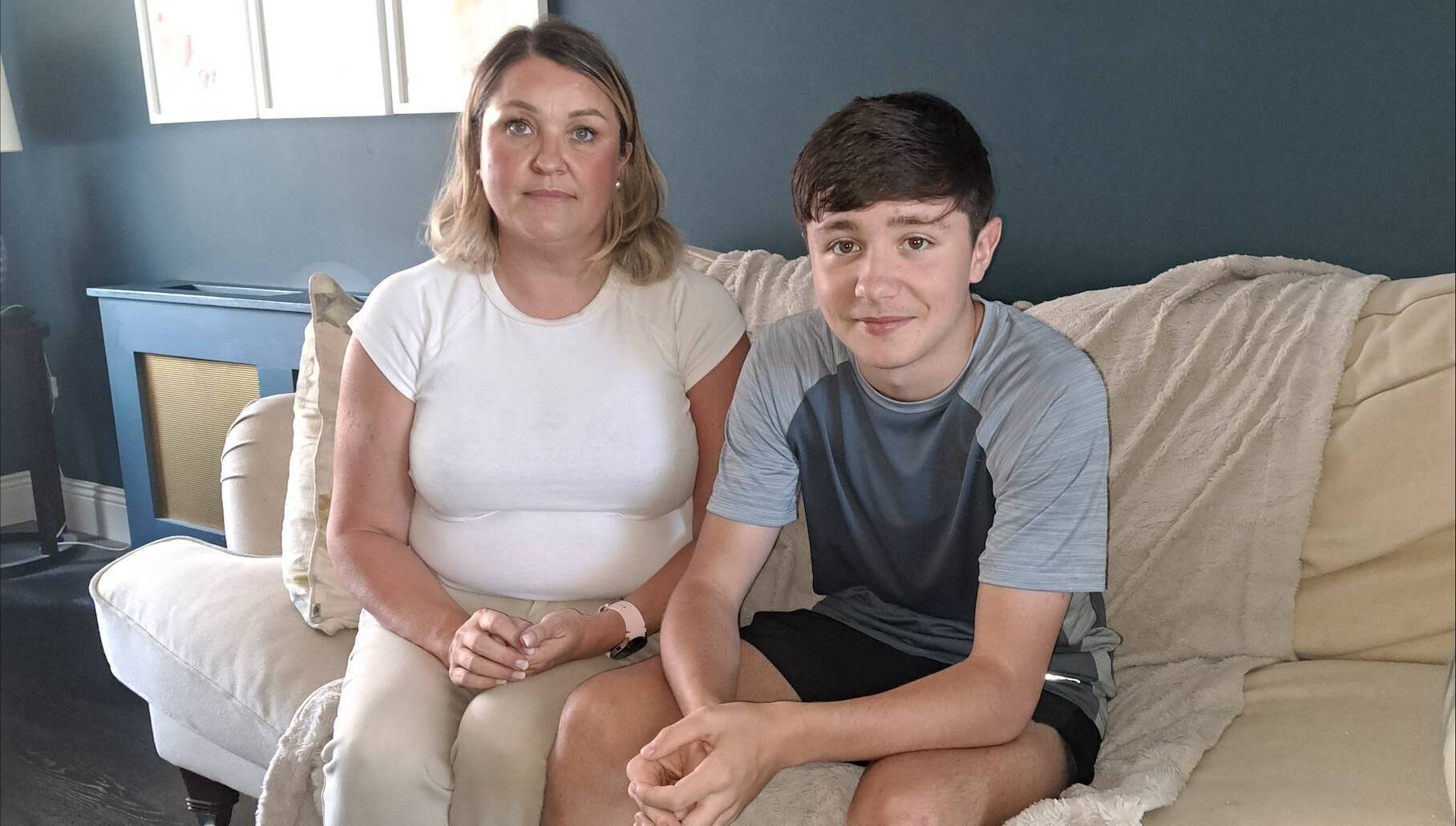
Wendy Gater and her son Michael, 14, from Kilmacthomas, Co Waterford. Private care will likely cost over €10,000.
Dental services across Ireland are in a state of "crisis", leaving large swathes of disadvantaged children and medical card holders unable to avail of free care, according to dentists, lawmakers, and impacted families.
Fracture points across the system have been building up over the years following austerity measures introduced in the wake of the 2008 financial crisis, leaving patients facing excessive backlogs for public treatment.
Figures from the HSE show there were 1.06m dental treatments carried out in 2025, a 31.73% drop from 2009 levels.
In the same window, the general population grew by more than 1m people.
Over the same time period, the number of whole-time equivalents in the HSE has dropped by 80 to 250.
The number of practitioners carrying out work for medical card holders has also nosedived from 2012 to 2024, dropping from 1,452 to 810, a 44% decrease.
Read More
There are now approximately 55,000 children eligible for primary school dental screenings who are yet to avail of the service due to backlogs.
Ireland currently ranks in the bottom quartile of OECD countries for dentist-to-population ratio.
“Gum disease or periodontal disease is at a worrying level,” said Fintan Hourihan, chief executive of the Irish Dental Association (IDA).
“For a lot of children, a lot of teeth that could be saved are not.
"A lot of preventative care and treatment that should be provided isn't being provided.
“There is a service provided by the HSE where children are supposed to be seen at three different class intervals in primary school, and the evidence shows that that's not happening. Most are lucky if they're seen once.”
Mr Hourihan said a deterioration of the screening service has meant more children are presenting to dentists in pain or requiring emergency repair work.
Helen Power said her granddaughter Hayley, 16, never got access to a dentist while in primary school.
Following an emergency visit to Cork University Hospital (CUH) to have a tooth removed, Hayley was told that braces may need to be considered, but it would likely be two or three years before she could be seen.
Ms Power said the wait was causing significant distress for the family.
“Especially with the young girls, they want their teeth to be perfect, and everything is about your appearance," she said.
“Her mum isn't in the position to be able to pay privately for them. A lot of the girls in her school are getting them done privately. So I suppose it is just the matter of waiting and waiting and seeing what will happen.”
Issues appear even more perverse in situations where children are left requiring acute specialist treatment.
Figures provided to Sinn Féin TD David Cullinane showed 804 patients were waiting over 48 months to access extreme, complex orthodontic treatments (grade 5).
More than 50% of those patients were located in the South East.
Wendy Gater, who lives in Kilmacthomas, Co Waterford, said her son Michael, 14, was also referred to CUH when his first and only dental screening in sixth class showed an impacted tooth lodged in the middle of his palate.
“At our last appointment with the orthodontist this year, they said everything is fine. The tooth is growing down. We'll see you in about five years for the braces,” she says.
“I imagine if they had picked it up in second class, he'd probably have the braces on, and his teeth would be fine by now.”
Ms Gater described the cited waiting time as “laughable” but said that the cost of a private solution, likely upwards of €10,000, was too prohibitive.
Leah Keating, a mother of three also from Waterford, said the public system for dentistry was “non-existent.”
She said she was trying to get her four-year-old child Sasha’s front teeth removed and capped after they had begun to deteriorate, and was quoted €10,000 in private clinics for the procedure.
In one instance seen by the , a child waiting five years for orthodontic treatment was referred to the Northern Ireland Planned Healthcare Scheme as a means to sidestep HSE backlogs.
Dentists working in the field said a lack of political support has hampered the profession and that public health cutbacks ushered in the wake of the financial crash have yet to be fully resolved.
“Pre-2009, there was an array of treatments that you were entitled to. Post-2009, that array of treatments was vastly restricted,” said Tom Quilter, owner of St John's Dental Clinic in Tralee and the incoming president of the IDA.
Mr Quilter said that he was once one of Kerry’s most prolific providers of dental care for medical card holders.
Decreases in remuneration and increases in bureaucratic administration meant he left the scheme alongside a swathe of other dentists.
“For me to try and satisfy a patient's needs, it just became impossible. It became impossible to work in a scheme where I felt there were so many hurdles to jump through that I just didn't feel that it was viable for me to be able to provide a level of service for patients.”
Mr Quilter claimed dentists were required to take in around €175-€200 an hour in order to turn a sustainable profit, rendering medical card treatments obsolete on a commercial basis.
He said that the practice of dentistry is now facing a demographic cliff edge.
“We now have fewer Irish and new dentists that we can actually get to work in the system.
“We also have a crisis where there are elderly practices that want to retire, give up, and we have practices who are actually closing because there is nobody to take over."
Due to long waiting times in Kerry, Mr Quilter says patients have been crossing borders and seeking dental care in Cork.
In a 2025 briefing note prepared by the IDA, the association said 65% of dentists have been unable to recruit new members of staff, with the shortages impacting quality of care and ability to deal with emergency situations.
Recent figures from the HSE showed that more than 1,600 patients in Cork and Kerry have been on waiting lists for dental care for longer than a year.
An issue continually targeted by the IDA and politicians has been the lack of pipelines into the field.
Third-level institutions that offer dentistry courses, UCC, Trinity College, and the Royal College of Surgeons Ireland, typically have half their courses made up of more lucrative foreign students who pay up to five times more for their tuition than their Irish counterparts.
Post-graduation, many trainee dentists will return to their country of origin.
The broad mass of Irish dental operations are now made up of foreign-trained specialists.
For the first time in 2025, the Irish Dental Council registered more Polish-qualified dentists than Irish-qualified dentists.
“That's a really terrible indictment of our education system… we can actually produce the people here in a registered industry, and we're not doing it,” said Fine Gael TD Colm Burke.
“The number of medical consultants in the country has drastically increased, whereas we have not increased the number of dentists who work in the public system,” said Mr Burke.
He said the Department of Education “need to get its head out of the sand” and decried a culture of disinterest within government in tackling the issue.
Both Government and opposition TDs have criticised 'Smile for Sláinte' — the 2019 action plan designed to tackle dentistry issues — as being largely ineffective.
Speaking in a June Dáil debate, junior health minister Jennifer Murnane O'Connor conceded "more must be done in the area" and said UCC and Trinity College have been engaged in creating more training places to fill backlogs in the system.


CONNECT WITH US TODAY



Be the first to know the latest news and updates