Inside Ireland’s only animal blood donation clinic
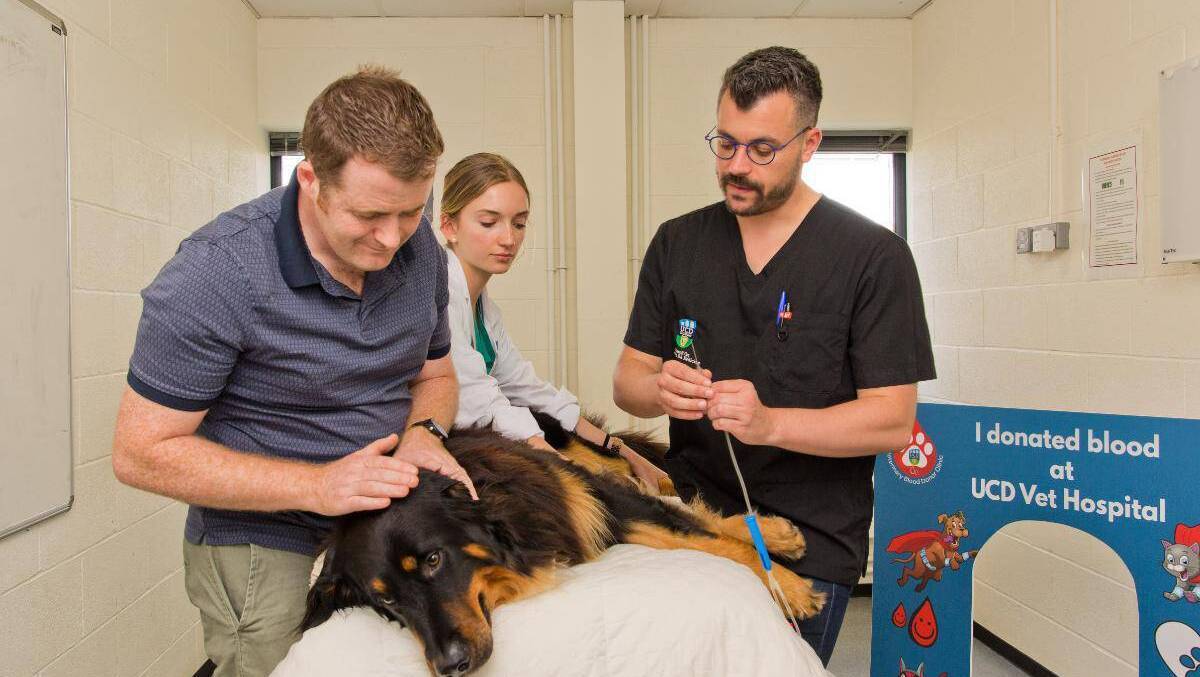
UCD Veterinary Hospital Blood Donor Clinic coordinator Michael Byrne, student Amanda Lawlor, and discipline head in small animal internal medicine Professor Benoit Cuq prepare Doyle for a donation. File picture
Michael Byrne runs a blood donor clinic like many others across the country, with just one notable difference — his patients are all animals.
The co-ordinator of the Blood Donor Clinic at UCD Veterinary Hospital faces some of the same challenges typical of mainstream services, as he battles against the clock to meet overwhelming demand.
From car accidents to severe anaemia cases, there are myriad reasons why dogs and cats might need transfusions.
Unlike veterinary teams in the UK, which has its own centralised blood bank, Mr Byrne and his colleagues are completely reliant on public donations.
He is currently appealing for help to make up the shortfall which is putting a serious strain on the service.
Read More
The clinic has welcomed many repeat donors over the years.
However, Michael stressed that even one donation in a dog’s lifetime can make a difference.
“Animals and their owners have been extremely loyal to us over the years,” he said.
“I had a lady who originally lived in Dublin that used to come in with her greyhound Penny. When they relocated to Achill Island I assumed this was the end of Penny’s donation days.
“I couldn’t have been more wrong because they still travelled this long distance to donate.
“Penny was here a couple of times and continued donating until her retirement.”
He said the amount of time and effort people go to just to try and help in some small way is incredible.
“Dogs can donate every three months safely. My donors would donate nearly as frequently as that or maybe once or twice a year,” Mr Byrne said.
“If they get up to 10 donations in their lifetime, from one to eight years, that’s amazing. Even five or six donations before they retire off means they have given enough basically.”
However, animals need to meet certain criteria to be eligible for a donation.
“They tend to refer very sick animals to places like UCD, because it’s a specialist veterinary hospital, where we can do complicated surgeries and treatments, thanks to our 24/7 ICU unit.
“This means we see a disproportionate amount of very sick animals and part of the treatment involves the transfusion of healthy blood. There is nowhere we can purchase that in Ireland.
“Legally, we can’t buy blood and it obviously can’t be made from scratch. Our only option is to get it from people with healthy dogs, who recognise the need for it and want to help.”
Unfortunately, he says not every dog can donate blood, and not every dog is suitable.
“We have a very strict entry requirement for our donors. The most important one is that the dog is between one and eight years of age. At a year old, the dog is almost fully grown. Any dog over the age of eight is deemed geriatric and it wouldn’t be appropriate to take blood from a dog that age.
“We need our donors to be over 25 kilos for a dog and 4kg for a cat. That is a safe weight but anything over that is a bonus. We take less than 5% of their total blood volume which is a very safe amount.
“It’s important that our dogs don’t have any real travel history. They need to come from Ireland because there are zoonotic diseases that we just don’t screen for in Ireland.”
Certain breeds are more suited to blood donation than others.
“Greyhounds are phenomenal for a number of reasons,” said Mr Byrne.
“Their blood is generally the universal blood type which means it can go to any dog. This is a huge advantage when treating sick animals.
“These types of dogs are athletes so they have big veins making donations very easy. They are also long and lean so there’s less fat on them and their temperament is incredible.”
Keeping blood stocks at adequate levels can prove challenging at times.
“Every Monday morning I come in I’m panicking, thinking about what happened over the weekend because it can throw up a lot of different problems,” Mr Byrne said.
"We have a little bank here and I’m able to process a transfusion of blood to make it shelf stable for 35 days.
“That’s a huge advantage. A vet in their own practice wouldn’t have the equipment or the materials to do that.
“It’s a ticking clock, so we are always replenishing our supply. Generally, it doesn’t last anywhere near the 35 days in our dedicated blood bank fridge. Instead, it tends to be gone within a few days of taking a donation.”
Cats and dogs present particular challenges for the clinic.
“We have a large veterinary hospital here so we also do donations for large animals like alpacas and calves.
“These are more straightforward because livestock come in herds, whereas we’re working with maybe a one-dog or one-cat household.
“In these cases the owner might not know their neighbour or even anyone with a dog, which presents issues when finding a donor.”
Mr Byrne said that veterinary practices in Ireland are desperately in need of a national animal blood bank.
“Veterinary practices across Ireland have called for this, but I suppose our population in Ireland is around 5m, while our nearest neighbours in the UK have closer to 70m,” he said.
“The latter obviously has more pets in need but we are also getting to the stage where a blood bank is required.
“Unfortunately, it doesn’t look like this will be a possibility in the near future.”
Ethics play an important role in the clinic.
“We wouldn’t take a transfusion from a dog that’s aggressive or overly stressed in the hospital,” he said.
“There are plenty of dogs that wouldn’t be stressed and the ethical parameters come into play when you’re doing a procedure because you don’t want to stress the dog out too much.”
He said that finding people with the time to take their dogs and cats to donate can be difficult.
“A lot of people were working from home after covid which meant they had the time to give us.
“However, when all these people went back to the office they no longer had that time.
“We struggled for a couple of years as a result. At present we have about 100 dogs on our donor list but we are really in need of donors.
“One donation can be processed in such a way that it can be split into three different parts and potentially save three lives. Even one donation is extremely valuable to us and and we would encourage anyone who meets our requirements to reach out.”
Readers wishing to put forward their pet for donation can do so by emailing vetblooddonorclinic@ucd.ie