A battle over justice: Who loses if legal aid changes go ahead?
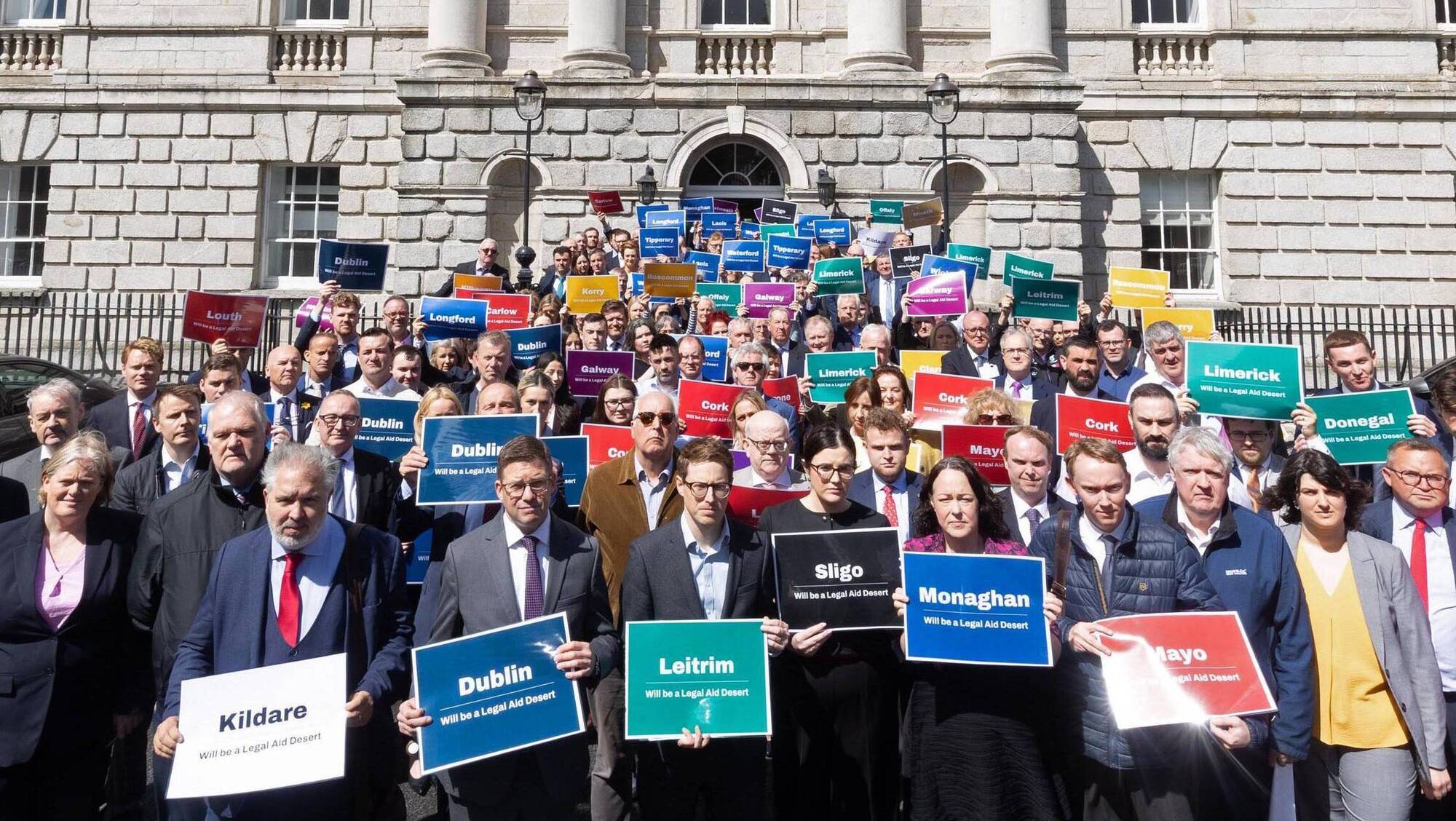
150 solicitors went to the Law Society of Ireland to highlight their concerns about planned changes on legal aid.
As the war of words between solicitors and the Government about upcoming changes to the criminal legal aid scheme continues, the wheels of justice are turning less slowly than they should.
On one side, the Department of Justice is arguing for an overhaul of the scheme by bringing in a flat fee for services instead of solicitors being paid per court appearance, while on the other side, criminal lawyers are defending their opposition to the plans and voicing concerns that there was no negotiation.
A withdrawal of services has now taken place in different forms across the country in opposition to the planned changes, due to come in on July 1.
Read More
Cork solicitor Shane McCarthy is chairman of the Law Society’s criminal law committee.
He explained: “Practitioners are concerned that their business model is gone, people are concerned that it is going to lead to an incredibly retrograde step for the people we represent.
"Generally, the people we represent on criminal legal aid very often come from the most vulnerable sections of society and they are the people who are going to bear the brunt of this.”
He added: “The cases that will require the most attention will be the ones that will be the least profitable and the least desirable to be involved because they will become a huge loss leader and it just simply will not be possible to engage with them in any positive way.”
On Wednesday, the cited a report undertaken for the Department of Justice following a review of the criminal legal aid scheme.
The report outlined that in one case, payment was sought from the Department of Justice for 63 legal aid certificates issued to a single defendant relating to charges of brothel keeping.
“The financial implications of the misuse of Regulation 7(4) cannot be understated, as a rough estimate for one appearance in respect of the above case with 63 certificates is €14,000,” states the report.
The report also referenced a case in which 30 separate payments were made in respect of legal aid certificates for a single defendant.
“These 30 separate certificates were divided amongst seven solicitors from the same firm,” states the report.

Mr McCarthy accepted there are people who are regularly appearing before the courts, but added: “Everyone is entitled to the presumption of innocence first of all but also entitled to representation.
"This system won’t change people who have 113 convictions getting 114. This change will not register with them. But the long-tailed type of one-off cases will involve too many appearances and solicitors will just not be able to take on those.”
He continued: “There are also other insidious types of changes. For example, you don’t get paid until the case is disposed.
"So that means if you are in a case where you are trying to case-manage a person, you might have to wait two years to get paid. If that person disappears, or if that person moves location and changes solicitor, you won’t get paid at all because you are not the solicitor holding the file at the end of the process.
"All that work is gone. That is very unfair.”
Recently, Sinn Féin TD for Kerry Pa Daly raised concerns that the new measures will lead to an exodus of practitioners from the scheme.
He said he had benefited from it himself as a solicitor.
He told the Dáil: “People will only be paid at the very end, when a case finishes in court. If people appear once or if they appear 20 times, they will only be paid at the very end.
"There are scenarios, particularly for vulnerable people, children, and people who do not have English as a first language, where the cases go on and on, sometimes appearing 12, 15, or 20 times, and those representing them are only paid once.”
Mr Daly said the introduction of a similar scheme in the family law arena served to reduce the number of practitioners on the panel for the scheme.
“We saw with the family law courts, in Kerry, for example, that there are only three or four solicitors left on the scheme after the introduction of a flat fee," he said.
"Will the minister review where people appear more than five or six times, because there could be a scenario where someone represents someone eight, nine, or even 10 times, then the client changes solicitor, and the new solicitor could get paid for one appearance and the person who has been there eight or nine times is not paid at all?
"There will be learnings from it. From the family law courts, just learn that the number of people representing has gone down. Just like in family law, where it is important that people receive representation and there is access to justice, it is the same with criminal law cases.”
Last month, the Irish Council for Civil Liberties also raised concerns about the changes.
In a letter to justice minister Jim O'Callaghan, former junior minister Joe O’Brien, who is now executive director of the ICCL, said: “It is understandable that the department is seeking to introduce a simplified, more efficient system that allows the courts to work through an increased number of cases.”
He added: “The proposed changes to criminal legal aid fees are based on a flawed analysis and are misguided. They risk undermining access to justice.”
He said that as noted by the Department of Justice, accused people granted criminal legal aid are “a noticeably vulnerable or disadvantaged group”.
He argued: “It is ICCL’s view that the impact of introducing a flat fee will undoubtedly lead to a reduction of legal representation for this group, thereby undermining the constitutional right to a fair trial.”
He continued: “As you will be aware, defendants in this cohort may need multiple court appearances and significant legal support for a variety of reasons. These include mental health issues, addiction, learning difficulties, language barriers, homelessness, or to facilitate engagement with services (eg Probation Service, Restorative Justice).
"The needs of children who appear before the district court are often complex and will require more than an average number of appearances.”
In response, the Department of Justice said that although criminal case volumes at district court level have decreased in recent years, expenditure on the system has increased from €19m in 2015 to €37m in 2024.
A statement from the department said the proposed changes will “speed up case resolution, reduce unnecessary adjournments, and ensure fair and sustainable remuneration for legal practitioners”.
It added: “The review that informed this change looked at more than 350,000 district court cases which took place during 2022 and 2023.”
The department refuted that it had not taken part in discussions with the legal profession on the plans, saying: “The department has been engaging extensively with legal professionals and their representative bodies on the proposed changes to the scheme.
"As well as meetings with officials, submissions from representative bodies have been received and considered, and the minister met with the Bar Council on May 27 and with the Law Society on May 29.”
It said it held a “constructive meeting with the Law Society” on Tuesday and had agreed to hold another meeting on the matter.

CONNECT WITH US TODAY



Be the first to know the latest news and updates