Children at special school in Cork need 'full-time therapists urgently'
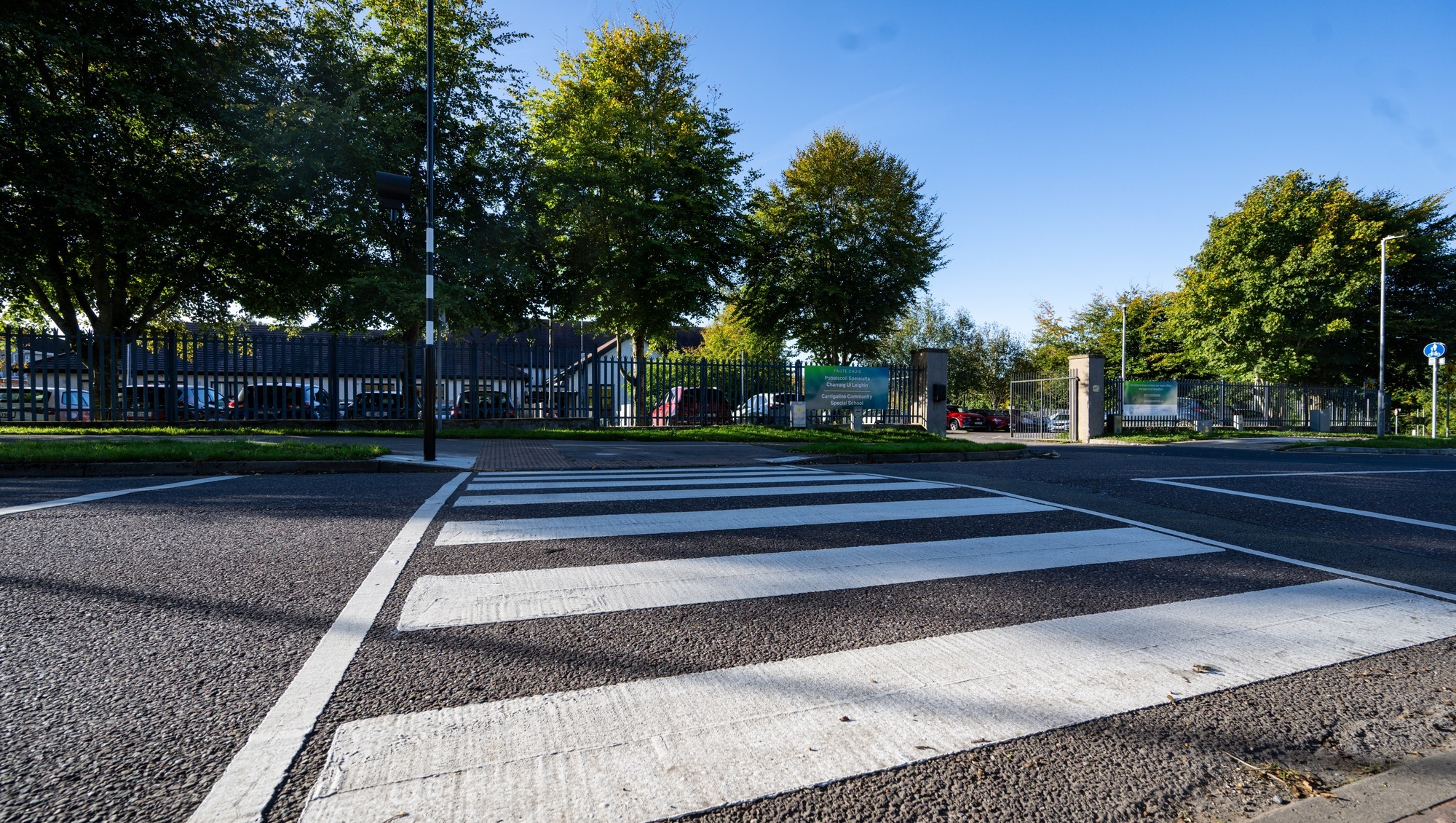
Opened in the Taoiseach’s constituency in 2021, Carrigaline Community Special School is for students between the age of four to 18 who have a diagnosis of autism and an intellectual disability. Picture: Chani Anderson
Last September, a number of parents of children at Carrigaline Community Special School came forward publicly with concerns they had spent the best part of two years attempting to raise privately with the relevant authorities.
Opened in the Taoiseach’s constituency in 2021, the school is for students between the age of four to 18 who have a diagnosis of autism and an intellectual disability.
Its students have a mix of varied and complex needs.
A recognised part of their dual diagnosis is dysregulation.
According to the National Council for Special Education (NCSE), dysregulation occurs when “a student’s stress level becomes too much to manage”.
The group of parents at the school were concerned about a lack of full-time, in-school therapies for their children, including behavioural therapies, occupational therapy, and speech and language therapy.
They were also worried about class closures and a high turnover of staff, and the subsequent loss of routine impacting on their children.
These issues combined were resulting in high levels of dysregulation and anxiety amongst the school’s students, resulting in some becoming distressed or “lashing out”.
Rather than addressing the core issues behind these behaviours, parents felt the approach instead was punitive, resulting in an “out of control” suspension rate.
In just three years, Carrigaline Community Special School had issued 17 official suspensions out of a maximum student body of just 48.
Several parents at the school had written to the Department of Education’s Inspectorate of Schools and the Taoiseach’s office, asking for urgent intervention.
Some had met with the school’s board of management and its patron, Cork Education and Training Board (Cork ETB), to raise issues, to no avail.
Having tried everything, they felt time marching on, and they were running out of options.
Students attending special schools must leave school at the end of the school year in which they turn 18.
Some spoke to the , calling for immediate intervention.
“Our children can’t wait anymore,” parent Niamh O’Grady was quoted as saying. “We want the staff supported.”
At the time, a spokesman for the Department of Education said it had actively engaged with parents and the school to address the concerns raised.
Read More
But in October, another student at the school was suspended.
In February, the school suddenly closed for more than a week to “work through a number of issues”.
In March, a new acting principal and leadership team were appointed.
Colman Motherway, formerly of Scoil Bernadette and associate of the NCSE, has taken up an acting principal role.
Speaking to the this week, several parents believe Mr Motherway has been a positive influence.
It has given parents a “glimpse at what they could have”, one said.
He brings a wealth of understanding, they added. “That’s been the true positive we have seen.”
For the first time, students have had the chance to go swimming with their school.
But the summer holidays are fast approaching, and a new school year will begin in September.
Parents say they do not know if Mr Motherway will be staying on in his acting role.
And although there have been positive changes, which they are happy to acknowledge, key concerns of theirs have not yet been fully addressed.
“The therapists are still a huge issue, because that would support staff as well as students,” Ms O’Grady said.
“We need full-time therapists working directly with the children. Given the amount of disruption and change that our children have had to endure, we need those full-time therapists urgently.”
Read More
The school closure in late February has left a mark. In Ms O'Grady's case, her child now believes school is optional due to the disruption.
“He’s school-refusing, that’s a new thing. The people who are dealing with that fallout are his brilliant teacher and SNAs. They are brilliant, they couldn’t be more supportive.”
After the school's closure, a number of additional resources were granted, including extra teaching and SNA posts for the current school year.
However, the school remains on an "enhanced" in-school therapy pilot, which sees 15 hours each of speech and language therapy and occupational therapy a week.
In March, the issue of the school closure was raised in the Dáil, with Cork North Central's Ken O'Flynn asking the Taoiseach if he accepted that "Cork ETB has stated that it cannot meet its needs when it comes to some of the children enrolled in its care, despite their statutory obligations?”
In response, Micheál Martin said that he has confidence in Cork ETB "in respect of special education".
"A number of years ago, it stepped into the breach to establish the school to provide desperately needed places in an area where children could not get places at the time. We had to take action. For the long term, the ETB has a very significant role in special education across the country. That is my view.”
He added: "If we look at how it is evolving, some of the section 39 bodies have pulled back from education, so the State has to get more involved in this particular area.”
This week, the parent at Carrigaline said: “The Taoiseach would rather defend and stand over the Government’s failure, and stand over and support the Cork ETB, in the face of unwavering evidence to the contrary, and he would rather do that than implement change for the most vulnerable in our society.
"Nothing has changed in that regard. We still have [pilot therapists], SLT and OT, and they can only advise the staff. They are not working directly with the children.”
"Our children need those supports, it's so badly needed, both behavioural and full multi-disciplinary supports, including psychology, occupational therapy and speech and language therapy, at minimum to help our children progress in their daily living skills, their education, holistically, in order to develop and progress and to reach their full potential."
In May, parents at Belmayne Community Special School, a special school for children with complex needs, established by an ETB in North Dublin last year, called on several ministers to address “serious failures” that they say placed their children in unsafe circumstances.
“It has been alarming and worrying to learn that Belmayne and Carrigaline have experienced eerily similar issues,” the parent said.
Despite the repeated advocating from families, there has still been no whole school evaluation of Carrigaline, which “sets off alarm bells”, they said.
In a statement, Cork ETB said the school has 15 hours of "in-house" occupational therapy support and 15 hours of "in-house" speech and language therapy support. "The school also has access to a behaviour support practitioner," it added.
"The process of recruiting a principal has begun and is ongoing.
From March 10, there have been no expulsions or suspensions from Carrigaline Community Special School."
In April, parents were advised that special education minister Michael Moynihan had established a dedicated working group, chaired by the department, to meet fortnightly to consider any issues as they arise for the school.
Parents were also advised that the department was working on establishing a staff supply panel for special schools in Cork.
A spokesperson for the department said as the NCSE's new Education Therapy Service expands, Carrigaline Community Special School "will be incorporated into the rollout of in-school therapy provision".
The department it also confirmed the school has now been assigned to its School Improvement Group.
The work of the group is to provide "a co-ordinated approach to the department’s engagement with schools where serious weaknesses are identified impacting on the teaching and learning in the schools," the spokesperson said.
"The planning and arrangement of any inspection work at the school remains under ongoing consideration."
The school needs full-time therapists working directly with the children, Ms O’Grady said.
“My child can’t learn when he’s dysregulated. He needs therapeutic support, direct therapy. On one hand, that will support the staff and him, for the education piece to happen.
"Instead, the burden of the dysregulation is falling on the really brilliant staff who are in my child’s class, as well as on our family.”
“My child is going into his last year. It’s crucial that it's right for him to prepare him for adult services. I’m so sad that the school didn’t reach its potential so that my child could reach his potential in these five years, despite the efforts of great teachers and great SNAs. I’m sad that didn’t happen for him.”