‘You can never understand how hard it is’: Abortion laws causing needless heartache

Advocating for changes to Irish termination laws, 15 families have written a book to share their experiences
‘You can never understand how hard it is’: Abortion laws causing needless heartache

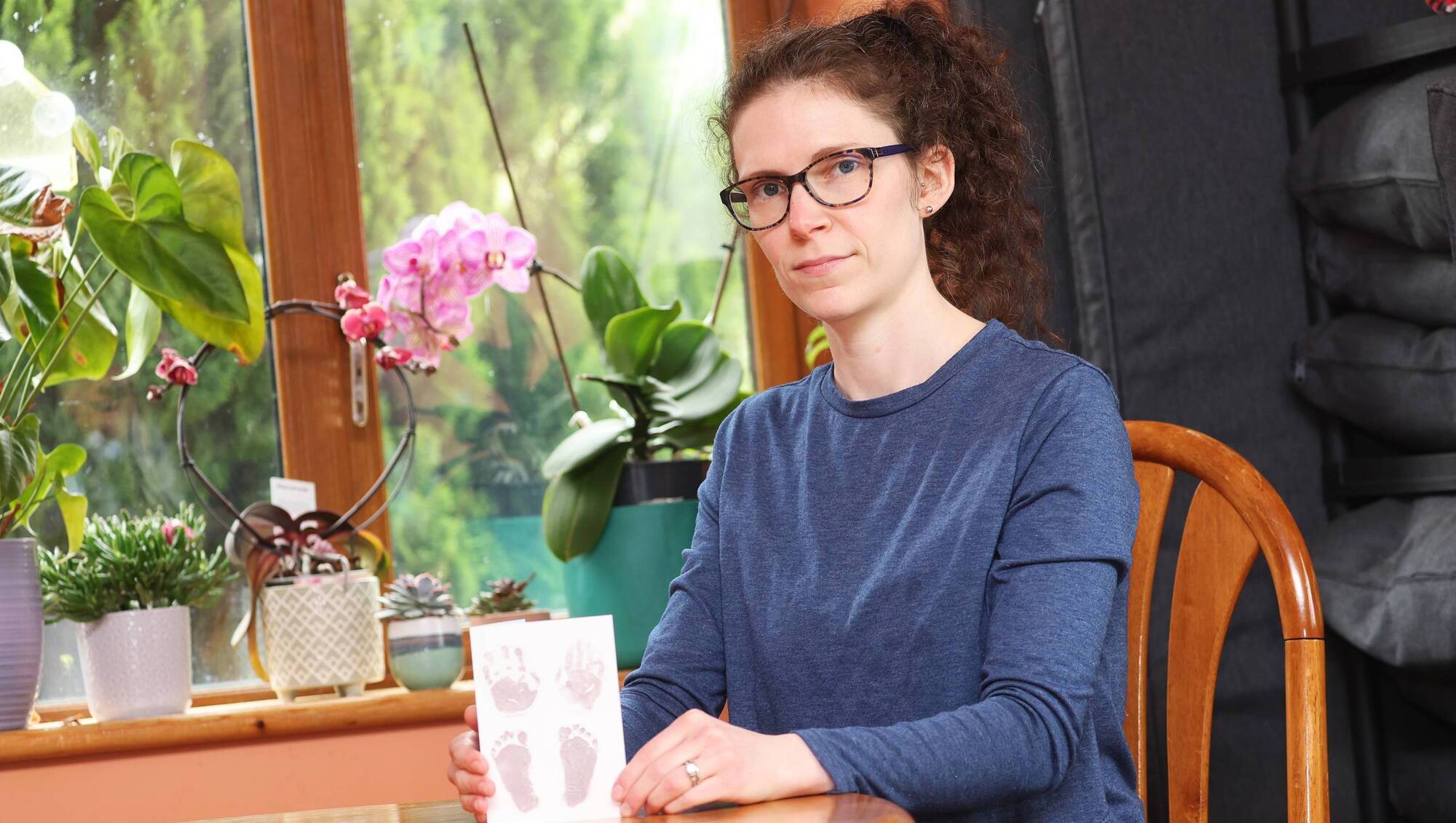
Christine Monahan, a nurse who lives in Co Cavan with a precious memory of her son Darragh’s hand and footprints. She had to travel to Liverpool to terminate her pregnancy, as her babies diagnosis of Ivemark syndrome did not meet the grounds for termination in Ireland. Picture: Lorraine Teevan

A woman who travelled to Liverpool to terminate her pregnancy because her son had a rare life-limiting condition has called for changes in Irish law to support families such as hers.


“It’s the most serious, unwanted decision that you would ever have to make,” Christine Monahan said this week.

She is one of 15 families who have worked on a book about their experiences, launching on Monday.

The book’s dedication reads: “For all the heartbroken parents who carry their babies in their hearts instead of in their arms, especially those who told their stories in the hopes of bringing comfort to others going through the same. Most of all, for our beautiful babies, may we do them proud.”

It is published through the LMC bereavement group. LMC stands for “let me choose” and the Irish phrase “leanbh mo chroí”, or “child of my heart”.

Monday also marks eight years since the Repeal the 8th Amendment vote saw an end to the ban on abortions in Ireland.

The law now allows for terminations where there is a diagnosis of a fatal foetal anomaly likely to lead to death in the womb or within 28 days after birth, an issue raised in the Dáil last week.

However, Ms Monahan and her husband Peter are calling for further changes in light of their distressing experiences.

In 2023, they found out they were pregnant with their son Darragh. “As the weeks went on, I felt a lot of movement. I felt him move every day,” she said. “At 19 weeks, I went a day without feeling anything ... the next day I didn’t feel anything all morning.”

At home in Cavan, she decided to go to a hospital emergency department. A scan left her unsettled, even though his heartbeat was found.

“There was something in her voice [the doctor]. I knew she had seen something,”Ms Monahan said.

The following week, she went alone for her scheduled anomaly scan. A nurse herself, she was devastated by what she saw on the ultrasound. “I could see a big hole in the heart; the middle septum was missing,” she said.

After another scan two days later, she was told that “he had a septal defect, and that the two arteries were on the same side”. “She [the doctor] said he would need surgery, but it could be fixed.”

The couple opted not to have an amniocentesis diagnostic test due to the risk of miscarriage linked with this, at one in 300. “I didn’t want to risk miscarrying my baby if he was going to survive with this heart problem, so I didn’t get it done,” she said.

In early November, she met with a cardiologist and a foetal medicine consultant. She recalled overhearing a short conversation around the possibility of “a health act consideration” in her case.

“I knew then for sure it was very, very bad,” she said.

Their son had Ivemark syndrome, a life-limiting condition affecting the heart and other major organs, including the possibility that he did not have a spleen.

This was later confirmed by the post-mortem.

“Based on the scan, his life expectancy was six to 15 months without medical intervention.

“She said the condition is not curable, but the palliation consists of major heart surgery to relieve symptoms,” Ms Monahan said, referring to palliative care. The first surgery would have been at four weeks old.

Their options were an abortion in England, as this condition is grounds for a termination there, or continue the pregnancy to have a controlled labour.

The options she feels reflect the book’s title: an impossible choice.

“It’s the most serious, unwanted decision that you would ever have to make.

“Nobody wants to have to make it, nobody wants to have to choose. I would rather have been told he is going to die than have had to make a decision on his life.

“Until you are in that position, you can never understand all of the complexities that go with it and how hard it is to choose.”

Flying abroad 

The couple flew to Liverpool but were sent home due to concerns around Ms Monahan’s own physical health.

This left them suspended between the two services until this was resolved.

Ultimately, they returned to England on December 18 for the termination.

They stayed with Darragh for a day afterwards, but had to return home without his body.

“It was like tearing a piece of my heart off walking away from that room,” she said.

In addition to their grief, their distress linked to travel is one reason why she got involved with this book.

The cremation, for example, only happened around four weeks later due to waiting for the post-mortem and Christmas pressures on services.

They tried to bring him home for this, but it was not possible.

“This is not ok and I don’t want anyone else to go through this. I knew that he was over there in the fridge waiting to be cremated, and I wanted him to be at rest,” she said.

Her mother and Peter’s parents accompanied them to the cremation.

However, she said: “I couldn’t believe the state of him, the state of his little face. He was decomposing, I just thought ‘this is so wrong, no baby deserves this’.

“That delay wouldn’t have happened here.”

She said other families in the book faced similar dilemmas. “We are not talking about disabilities; these are severe and life-limiting conditions,” she said. “You can live with a disability; these are life-limiting conditions.”

Now parents to an infant, she said: “You do feel guilty". 

I don’t feel guilty so much now, but I felt guilty for a long time. I had to remind myself we just didn’t want him to suffer, that’s why we did it.

She was disappointed to see a proposal to change the 28-day ruling, among other changes, defeated in the Dáil last week, saying: “It’s very prescriptive”.

The Social Democrats put forward legislation to amend the Termination of Pregnancy Act, but this was defeated by a vote of 85 to 30.

Holly Cairns, Social Democrats leader and Cork South-West TD, said she aimed to address “clear gaps in the abortion law” impacting women.

“That is not my opinion. That is the conclusion of an expert review of that law, commissioned by the government, and published three years ago,” she said.

This includes women are “still being denied compassionate care in this country” while coping with a fatal foetal anomaly diagnosis, she said.

In response, health minister Jennifer Carroll MacNeill said: “I know these decisions are not easy. In fact, it is desperately difficult for anybody who falls outside that timeframe”.

She said: “Where there is a condition that results in the death of a live-born infant, that death nearly always occurs in the first 28 days.”

About 150 of the 190 infant deaths last year were within 28 days, she added.

She noted concerns about the wording and some parts of the proposals. Instead, she suggested a meeting between politicians and the HSE’s national women and infants’ health programme to discuss this further.

The Pregnancy Loss Research Group (PLRG) based at University College Cork has published research on issues around terminations and these conditions, noting that fatal foetal anomaly is not a medical term.

It refers to “congenital anomalies that will likely lead to fetal or neonatal death, and is used interchangeably with the words lethal and life-limiting”, it said.

It said about 2% of pregnancies are diagnosed with a congenital anomaly each year.

“A proportion of these anomalies will be lethal or fatal, and congenital anomalies remain the leading cause of fetal death and infant mortality,” it said.

Up until the repeal vote in 2018, terminations for this reason were prevented in Ireland, and it found that “following confirmation of a fatal foetal anomaly prenatally, parents are faced with decisions concerning the remainder of the pregnancy, giving birth and seeing their newborn baby, or choosing termination of pregnancy”.

Earlier this month, the annual March for Life took place in Dublin, attracting a crowd of up to several thousand, according to reports.

Anti abortion campaign spokesperson Eilís Mulroy raised concerns about the number of terminations in Ireland, saying that it is higher than people had expected.

Department of Health data shows 10,852 abortions were carried out in 2024, the latest year for which figures are available.

Among them were 108 cases linked to conditions likely to lead to the death of the foetus, 24 cases where there was a risk to life or health, and nine cases where this risk occurred in an emergency.

Some 10,711 terminations were during early pregnancy.

  • The book Impossible Choice is available on Amazon in e-book format and paperback or through the LMC Support website.
  • The launch for Impossible Choice starts from 6pm on Monday in Brooks Hotel, Dublin 2.

More in this section

Lunchtime News

Newsletter

Get a lunch briefing straight to your inbox at noon daily. Also be the first to know with our occasional Breaking News emails.

Cookie Policy Privacy Policy Brand Safety FAQ Help Contact Us Terms and Conditions

© Examiner Echo Group Limited