Chornobyl survivor’s journey from orphanage abuse to new life in Ireland after adoption
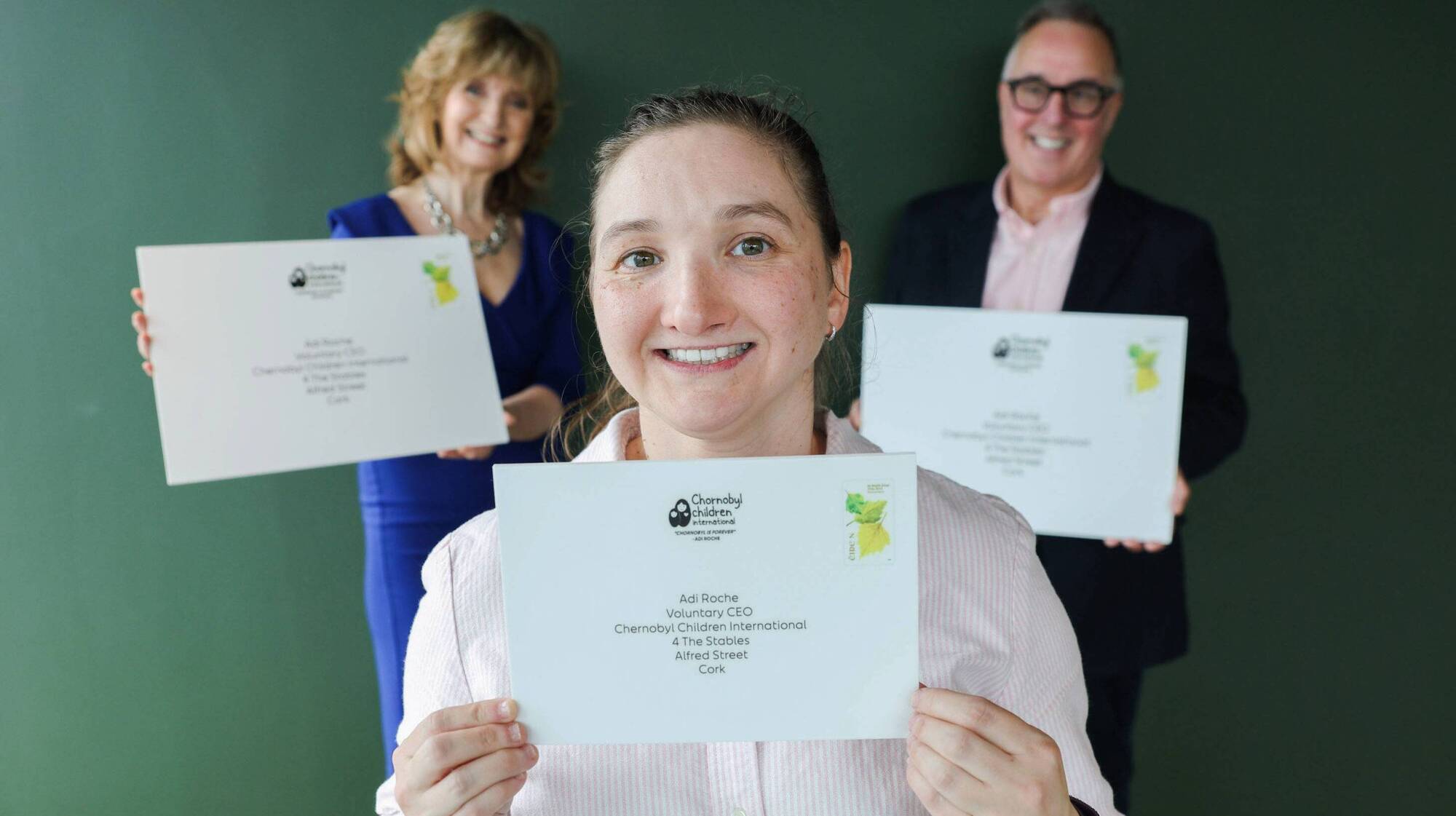
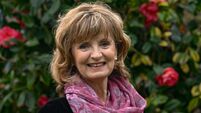
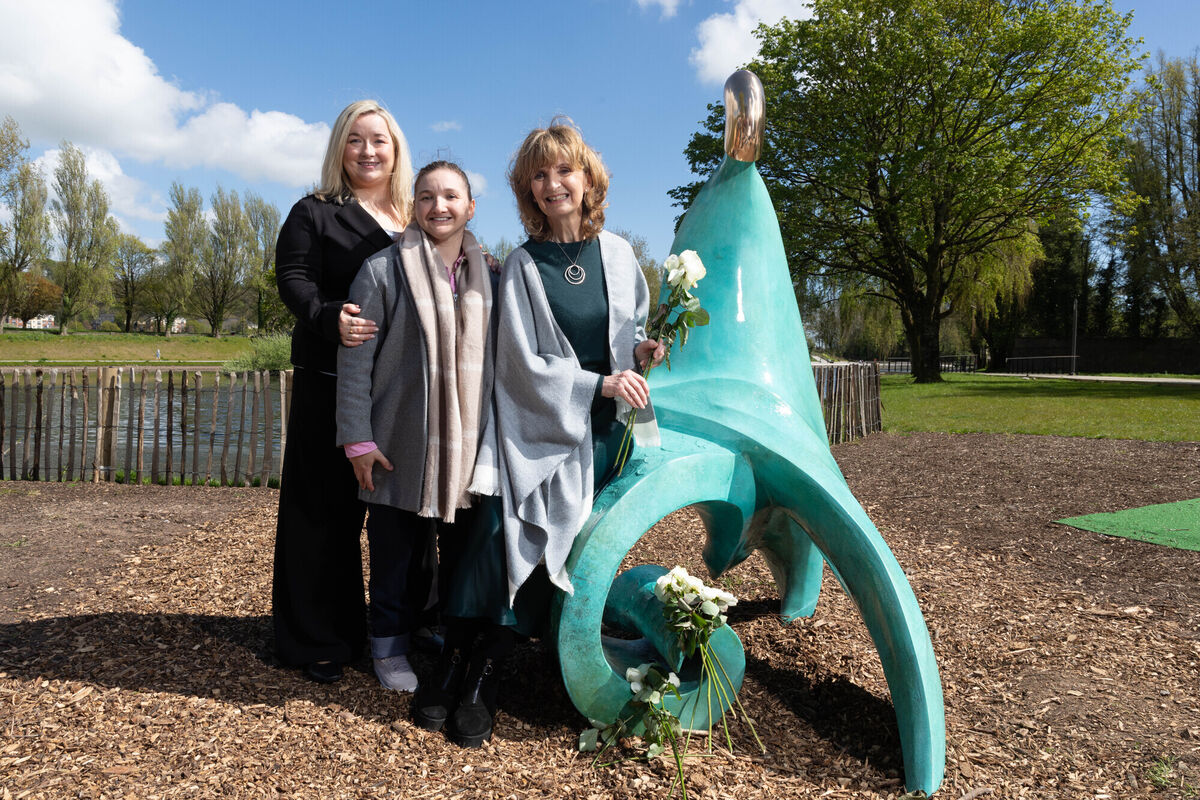
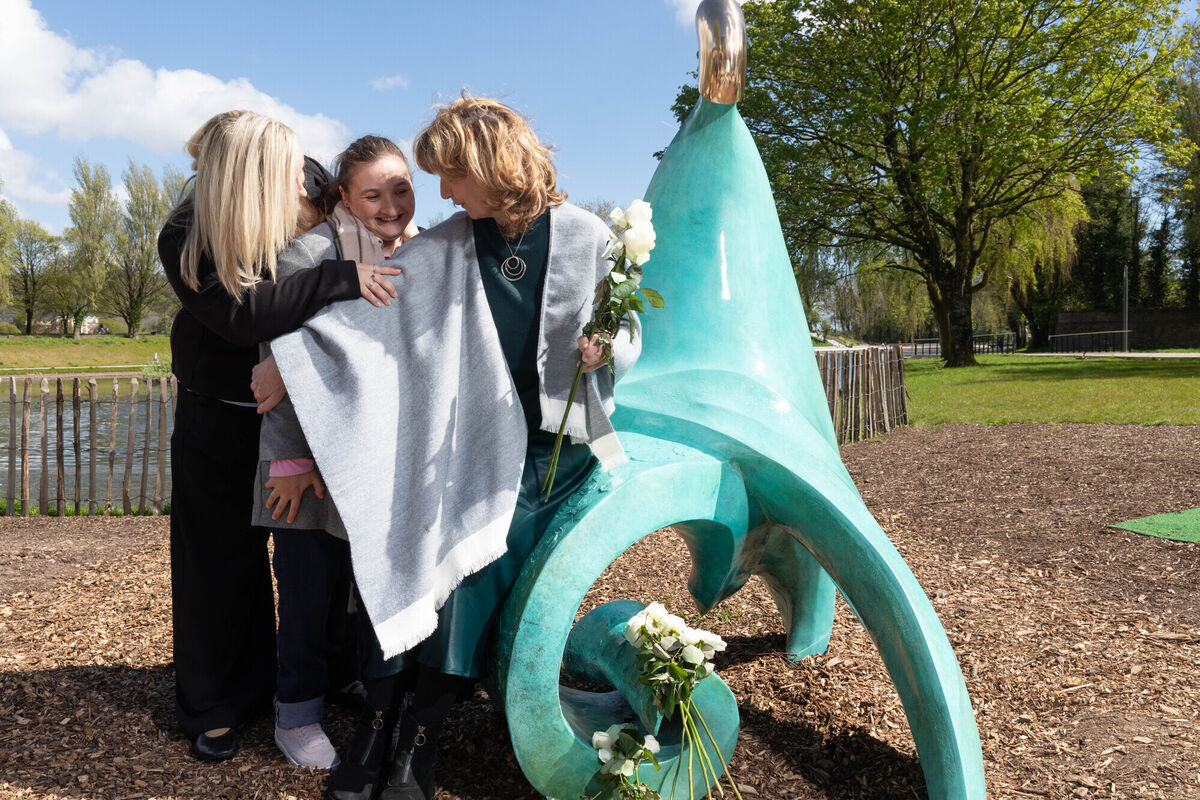
At the unveiling of a special postmark for the 40th anniversary of the Chornobyl nuclear disaster in Ukraine is survivor, Raisa Carolan (centre) who was adopted by an Irish family as a young girl, with Adi Roche (left), voluntary CEO of Chornobyl Children International and David McRedmond (right), CEO of An Post. Photo: Maxwells
It seemed like all had been lost when, at the age of just 10, Raisa Miknovitch Carolan was admitted to a mental asylum. The Belarus native, who now lives in Meath, remembers the unimaginable horrors from her time there.
She remembers the pungent hospital smell and patients rocking back and forth. She also remembers the lengths her adoptive family went to during their search for her, as authorities tried and failed to conceal her whereabouts.
Now 33, Raisa says she might have been lost to the system forever were it not for the perseverance of the Carolans. She had first been welcomed into the family at the age of five after being brought to Ireland through the Chornobyl Children International charity’s Rest and Recuperation programme.
Read More
The initiative had been set up to provide support to communities still impacted by the 1986 Chornobyl disaster. However, it would be a number of years before they could officially adopt her.
An explosion at reactor four of the Chornobyl nuclear plant in Ukraine on April 26, 1986, sent clouds of radioactive material across much of Europe.
Some 31 plant workers and firemen died in the immediate aftermath, mostly from acute radiation sickness. Thousands more have since succumbed to radiation-related illnesses such as cancer, although the total death toll and long-term health effects remain a subject of intense debate.
Soviet authorities strove to conceal the extent of the Chornobyl disaster, refusing to cancel the May 1 parade in Kyiv, around 100 km to the south. Ukraine's current government has highlighted the Soviet authorities' bungled handling of the accident and attempts to cover up the disaster.
Over the following hours and days, it released radiation estimated to be 400 times greater than that of the atomic bombing of Hiroshima in 1945.
In December 2025, the UN adopted a resolution officially endorsing the use of the Ukrainian transliteration ‘Chornobyl’ instead of the Soviet-era ‘Chernobyl’ in all instances going forward.
Abandoned at birth, Raisa suffered from a number of physical impairments due to radiation from the Chornobyl disaster, including a cleft palate, webbed legs and a clubfoot.
The family were able to care for her on medical grounds until Belarusian authorities demanded her return.
She started out life at the No.1 Home for Abandoned Babies in Minsk. Life with her host family, including parents Tom and the late Ann Carolan, in Trim was in stark contrast to the No.3 orphanage for disabled children outside Minsk, where she suffered unspeakable physical and emotional cruelty during her formative years.
Decades later, as we mark the 40th anniversary of the nuclear disaster, Raisa is urging the world not to forget the children still impacted by the tragedy.
Speaking about her own experience, she says: “My father always brings up a story about my first ice cream. My cleft palate made it very difficult to eat. The ice cream was coming out of my mouth and my nose, and I couldn’t manage it. I was six years old at the time, but I looked about two because I was so small.
"My dad just looked at my mum and said 'we have to do something for her'. That was the moment they decided they wanted to adopt me.
Reminders of Raisa’s trauma were never too far away.
“My mum told me about how the little bottles of milk would go missing when my sister brought over her baby. She might be feeding or burping him, and the next thing they knew, the bottle was missing. They would look behind the couch and see me drinking from it.
"I’ve obviously got a lot of counselling over the years, but I suppose that fear of not knowing if or when I was going to be fed stayed with me for a long time.”
She recalled the joy she felt while in the company of her adoptive parents.
“There was a sense of freedom that came with being able to go outside and do things I would not have otherwise been able to do. I can remember having a fascination with light switches. I was constantly switching them on and off. There were no boundaries.”
Tom and Ann were always keen to remind Raisa of how loved she was.
“It was difficult because my mum used to send things to the orphanage for me, but whatever we had was taken away from us. I can remember receiving a gift from my mum of an Easter egg with a little pig pencil case. I was given the pencil case, but they kept the Easter egg from me and ate it during their lunch break.
"There was very little joy in the orphanage. They had a playground, but we never really experienced it. However, this one particular time, for whatever reason, we were allowed out to play on the swings.
"It gave me such a sense of happiness. I felt like I was floating through the air. Feeling the breeze in my hair took me out of the darkness of the orphanage, if only for a short time.
"When I got adopted, I tried to relive that moment as much as possible. Even after getting adopted, the first thing I always wanted to go on in the playground was the swing.”
It was Raisa’s only experience of happiness while living in Belarus.
“After that, I had to go to the mental asylum,” she explained.
Raisa’s adoptive family had no idea of her whereabouts.
“The asylum was very dark and dull. We’re talking about hollow corridors, hospital-type smells and white walls.
"Because I had been in that environment for a couple of months, I picked up a couple of the habits, such as the rocking back and forth.
"It’s a habit that they tried to get rid of after I got adopted because I’d be just sitting in bed at nighttime trying to rock myself to sleep.”
The little girl was unsure if she would ever be adopted.
“I knew the adoption was approaching, but didn’t know if I was ever going to be found again. I think it took my family a couple of months to actually locate me because authorities weren’t exactly forthcoming with information about where I was.
"They weren’t massively in favour of adoptions back then. It’s possible, and I can only speculate, that they were trying to lose me in the system.”
Raisa, often wonders what it might have been like to experience a traditional childhood.
“I always say to people who have experienced a rough or turbulent childhood that you can either give up altogether or pick yourself up and try to find the joy in life.
"Obviously, I never got to experience being a proper child. Even after being adopted, I was always in hospital for surgeries, which meant I missed a lot of school.
"Then, when I was 16, I sadly lost my adoptive mum. I was forced to grow up very quickly, but this also made me very independent.
"I just started thinking for myself and thinking about what would make me happy and what I wanted out of life. I try to look on the bright side.
"I’m very grateful to have had my adoptive mother for the 10 years that I did. It’s nice to know that I was able to give her the satisfaction that comes with being able to look after someone else.
"I think in many ways I kept her young because all of my siblings were a bit older. There’s a 10-year gap between me and my next youngest sibling and 15 and 20 years between some of my other siblings.”
Raisa, who has undergone dozens of surgeries in her lifetime, including a limb amputation, says she owes her life to her family and the Chornobyl Children International charity.
She is also thriving professionally, working as part of tech giant Google’s trust and safety initiative to combat malware, phishing, and abusive content across all platforms.
“If I had stayed in the asylum, I don't even think I would have really even probably made it past my adult years. I had too many problems disability-wise.
"I wasn’t even able to eat properly, so even if the other issues were taken care of, I would have likely starved to death. Adi Roche didn’t give up, and my parents didn’t either, so I will always be grateful to them for that.”


CONNECT WITH US TODAY



Be the first to know the latest news and updates