Snooker still finding its place in a changed world
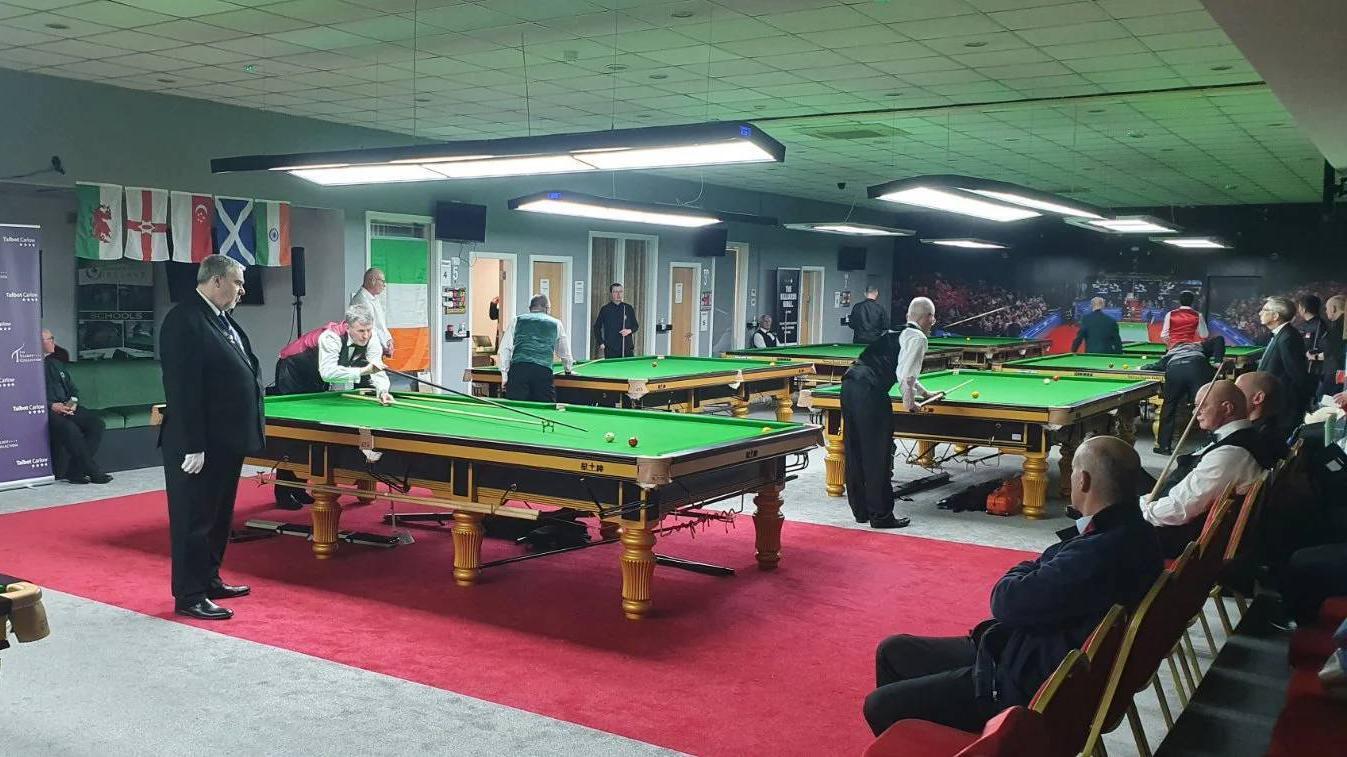
The Snooker & Billiards Ireland HQ in Carlow hosting the Macau Casino World Matchplay Billiards Championship. Pic via the SBI
The young Fergal O’Brien was a man of singular focus, but a world of endless choice lay before him every time he walked out the front door of the family home in Bayside.
Snooker had started to worm its way into his life from the day his grandparents gifted him a small 8x4 table at the age of seven. By 14 he was already thinking umpteen shots ahead. He wanted to go pro. Dublin in the mid-to-late-80s was the ideal canvas for that teenager’s ambition.
O’Brien came of age at the perfect time. He was 13 when 18.5 million people in the UK stayed up until all hours to watch Dennis Taylor pip Steve Davis to the World Championship in 1985, and a touring pro by the time Ken Doherty matched that feat at the Crucible a dozen years later.
Those twin peaks were summited on the back of an exploding domestic scene over there and here at home. One estimate has it that Dublin boasted over 60 clubs and halls at the game’s height. The number for the 26 counties crested comfortably into three figures.
Read More
O’Brien had four or five within walking distance of him on the capital city’s northside. Take a local bus and he could rock up to the same number again. That was before a wander in to town, over to the southside, or towards the city’s western fringes.
It’s been 40 years and the names still reel off his tongue.
“Bayside Squash and Leisure, The Racecourse Baldoyle, The Crucible in Kilbarrack, Joey's in Harmonstown, The Raheny Inn, Terry Rogers in Fairview, Bill’s in Fairview. Into town then: The Cosmo on O’Connell Street, Ned Kelly’s. Green Baize in Bolton Street. Pierrot, the Home of Billiards, on Bachelor’s Walk.”
The list seemed endless.
Breaks in Drumcondra. Langans of Capel Street. CrossGuns in Phibsborough. The Aristocrat in Clanbrassil St… If Dublin was drowning in snooker clubs then the entire country was heavily watered with them. Even smallish provincial towns might have more than the one.
It wasn’t just the volume of venues. It was the sheer size of some of them.
O’Brien eventually started making the commute by DART and bus towards Q’s in Clondalkin. The owner, Pat Lernihan, was sponsoring him as he went about fine-tuning his game and graduating from a hyper-competitive amateur scene in his own backyard to the paid ranks across the water.
“That club had 55 tables. There was another place, Castle Billiards in Drimnagh, that had maybe 40 or just over, but Q’s was even bigger and there were plenty of times back then when I was waiting to get on. I think it originally had 26 or 27 tables and then an extension was built on.”
***
Jim Leacy got the bug as a youngster coming of age in Enniscorthy in the 1970s. There might have been the odd commercial snooker club in Dublin back then, but they weren’t much of a thing around the country. The Atheneum was his introduction. A small members club where the waiting lists were far too long.
He was 27 and working as a psychiatric nurse when, along with a friend, they borrowed enough money to open the Ambassador in the town. Six tables spawned four more before he branched out again, to Carlow, where the proliferation of students at what was then the regional college seemed like a savvy bet.
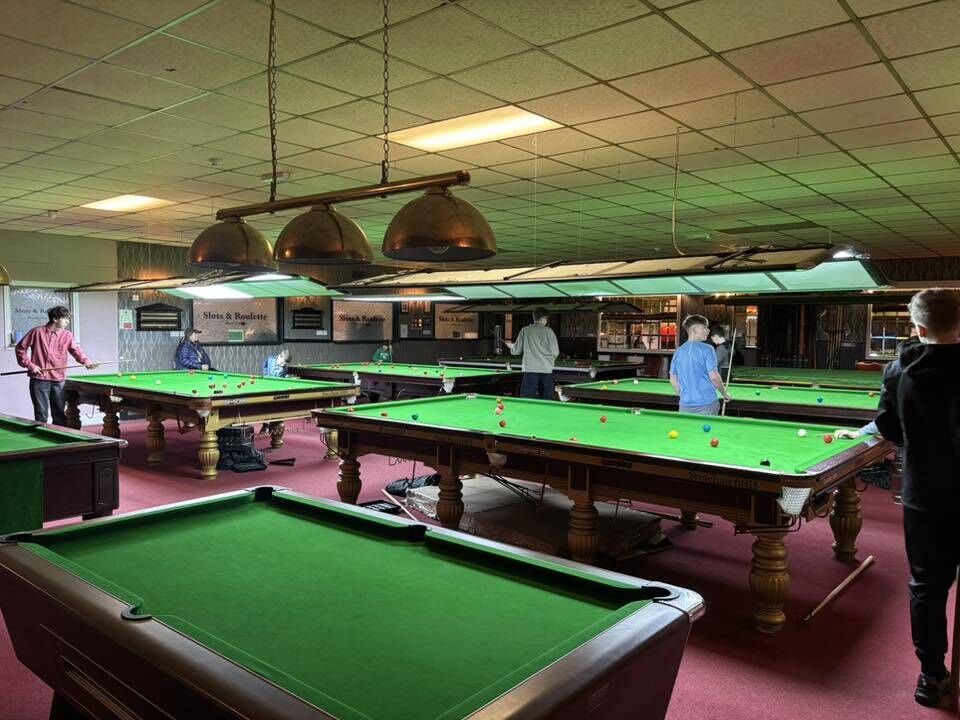
A premises was found on the first floor of a unit in the town centre, and an institution was born. The Ivy had 16 tables, a few video games and a hot and cold menu. It came to be known as the epicentre of competitive snooker in Ireland, and it was home from home for an endless line of third-level students.
Leacy laughs knowingly at that.
“I would have met guys over the years who attended the Regional College as it was then and spent a lot of the time in the Ivy Rooms playing snooker when they should have been in classes instead. I often met parents as well and they knew their lads were spending more time in the club.
“I remember back in those days we used to actually open on Christmas Day. It was the busiest day of the year. The place was packed from 12 o’clock on. I couldn’t believe it. You had to book a table to get one. People just wanted to get out. You didn’t have 200 TV channels. Different times.”
Snooker has always laboured under that snobbish old line about how being good at the game was proof of a misspent youth. Some saw the darkened rooms, the clouds of smoke and, in some cases, the less-than-salubrious surrounds as proof of something sinister. A source of suspicion.
What they were was a rare source of illumination in greyer times.
Take away the pub scene and what was there for people to do? Gyms were still more of a niche idea. Cafes? Nescafé still cornered the coffee market. The ‘Third Place Theory’ has it that people need somewhere other than the home and a workplace to enjoy a balanced life. Snooker clubs offered that.
Ken Doherty, in his autobiography, highlighted this deeper role when he shared his nascent experiences in the famous Jason’s. As they say in Barcelona, it was more than a club. “It was a meeting place and crucial part of the Ranelagh community,” he wrote. “Another world full of life and adventure, noise and people.”
Nostalgia will always paint over most cracks but memories of overspilling ashtrays or dodgy toilets can’t dispel the memories of a time and a place where bonds were made and games played for a few quid an hour. O’Brien can well remember how cold and damp Langdon’s in Capel Street was and still describe the place as “magic”.
“They were places to meet up and a sort of community in themselves. Now, there wasn’t too many women playing so it was very much a male environment. And you were a young kid or 14, 15, 16 hanging around adults and probably hearing bits and bobs that you shouldn’t have, but that was so exciting too.”
***
The Ivy Rooms moved out to a smaller but still successful venue before Covid closed its doors. Jason’s had already called it quits in 2006 and Q’s in Clondalkin has reduced its tables to a mere handful and diversified into the bingo and casino markets. There might be no more than 30 clubs left in the entire country now. Most have just a handful of tables.
The same goes in the UK. The club Willie Thorne originally opened in Leicester was shut in 2012 by a council that wanted to use the space for offices, and other examples abound. The Manse Club in Edinburgh was demolished and replaced by new homes. Snooker City in Bristol gave way to another residential build.
That list goes on, too.
Leacy remembers a time when there were a dozen or so commercial clubs dotted around the counties of Wexford, Kilkenny and Carlow alone. There are none now. Others, like The Crucible in Cork, have managed to survive the storm up to now, but the days of taking a notion and wandering in to a local hall for a few frames are mostly over.
Premises that required staffing and upkeep and the payments of rent and rates and other bills, all for a limited return on investment, were sold for millions. And who can blame people for that? In a way, the disappearance of snooker clubs from our high streets acted as a canary in a coal mine for a retail sector increasingly hollowed out by new societal and economic norms.
If the value of all that floor space was always going to be a threat to the game and the communities it spawned then the advent of the smoking ban, dwindling attention spans, and a boom in leisure activity alternatives accelerated the decline. And that’s before we get to the 2008 financial crash and a pandemic.
A different scene has emerged in its place. Found its place.
Members clubs, like Youghal CYMS and Newbridge CYMS, now keep the flame burning. The UK has seen the odd reassuring rebound as well: a new club in Grimsby not long after another shut down, a social club in Elgin where snooker is one part of a wider sports hub offering.
Snooker & Billiards Ireland has a new state-of-the-art HQ in Carlow and O’Brien, now retired, is coaching out of a club in Celbridge that has been able to surf the game’s boom and bust. New lights and carpets have been installed, and there are still 12 snooker tables and more for the pool afficionados.
Ronnie O’Sullivan spent a good chunk of his year practising there before his latest tilt at the current World Championships.
“The good news is that it’s flying,” says O’Brien.
It’s not time to turn out the lights just yet.

CONNECT WITH US TODAY



Be the first to know the latest news and updates