Ireland’s fuel protests: How rising prices sparked unrest and challenged political parties
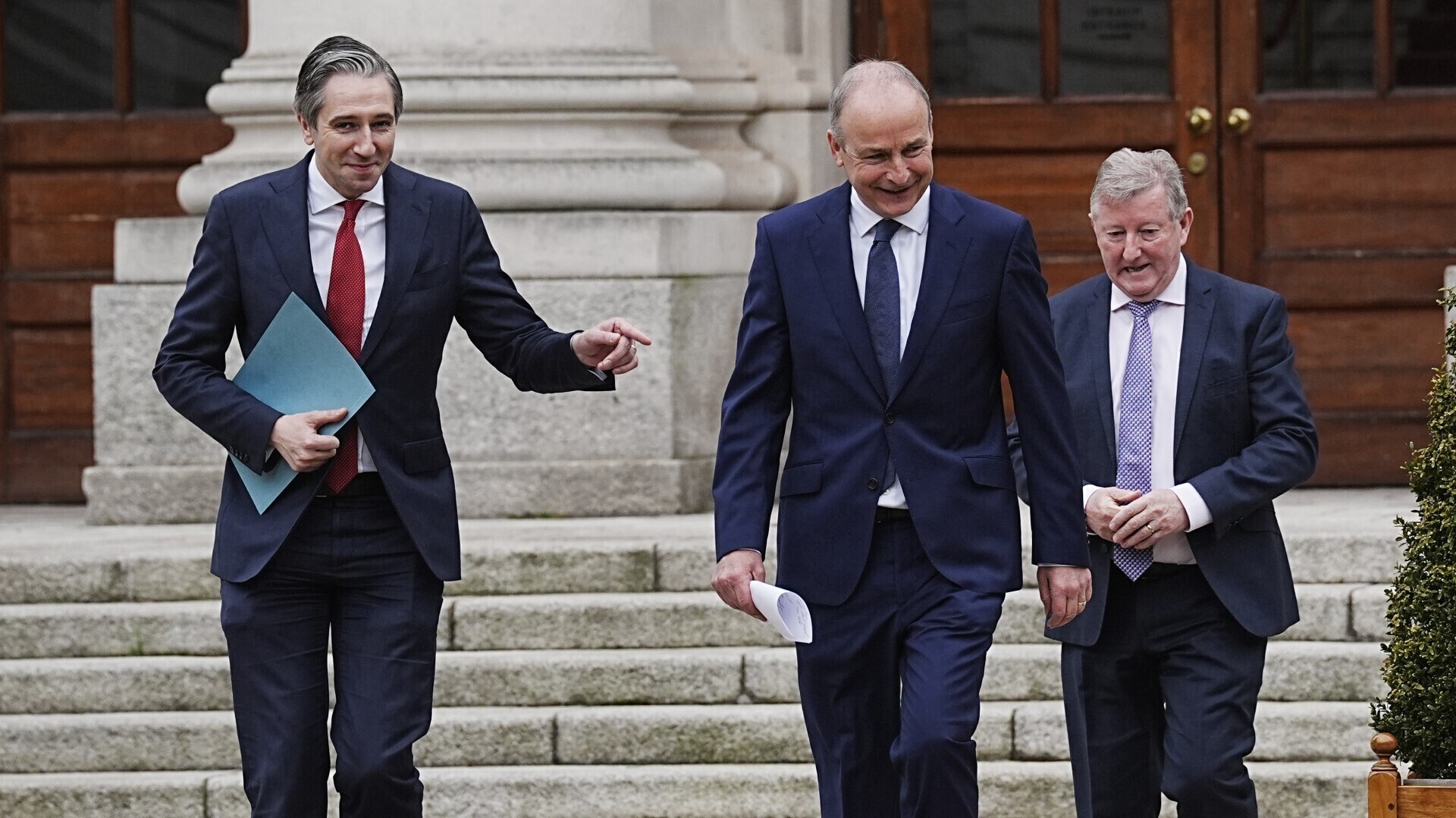
(Left to right) Tánaiste Simon Harris, Taoiseach Micheál Martin and Minister of State Sean Canney in The Courtyard at Government Buildings on Wednesday, April 8. Much of the criticism of the Taoiseach and Tánaiste from within their own ranks has focused on what their handling of the crisis said about their respective parties' ability to understand rural Ireland. Photo: Brian Lawless/PA
"There is another lesson here and it is a lesson for those in government. The people on the streets are more powerful than the people who are supposedly in power. We have seen the power of ordinary people in the past week, and this must now be the start of a new phase of militant, effective protest involving trade unions and communities mobilising for action on behalf of everyone in the context of the cost-of-living crisis."
People Before Profit TD Paul Murphy's contribution to Tuesday's government confidence motion was quickly overshadowed by the departure of junior minister Michael Healy-Rae from government, but could have even further-reaching ramifications than the departure of the Kerryman from the Government benches in the Dáil chamber.
That is, the protests and blockades which hit the country in the week after Easter have shown that there is a large chunk of the electorate which does not feel like it is reflected in the current Dáil.
But who can corral that support, if anyone, is unclear.
These protests, ostensibly driven by rising fuel costs and the impact on fuel-heavy industries, have revealed more than economic frustration.
They highlight a perceived disconnect between policymakers and ordinary citizens, particularly those in rural and working-class communities.
Indeed, much of the criticism of Taoiseach Micheál Martin and Tánaiste Simon Harris from within their own ranks has focused on what their handling of the crisis said about their respective parties' ability to understand rural Ireland.
That creates a problem for both because many of those most impacted by the protests would be traditional voters of either party. Most of the criticism internally from each of the coalition parties is led by rural TDs and senators.
On Tuesday in the Seanad, Longford-based Fianna Fáil senator Joe Flaherty went furthest.
"Having single-handedly championed the cost of living in the previous Government, Fianna Fáil as a party shamelessly forgot the pain and suffering in the delivery of that budget.
"I spoke at length with An Taoiseach yesterday on this issue, and I have left him under no illusion as to where my future loyalties will lie in the absence of a cast-iron and soon-to-be-announced commitment to a raft of cost-of-living supports and indeed, if needs be, a mini-budget."
The term "tipping point", or some variation, was used for the last fortnight about those who supported the protest, though mostly from afar. The logic being that fuel prices and the cost of green diesel were simply a totem for a disaffected core of people unhappy with rising prices.
What that made for was a loose and disconnected protest and anger among working members of the public when they realised that the central points of the protest would be addressed in the Government's hastily-announced package, but not their issue — disability services, childcare, you name it.
The Government response last Tuesday betrayed something of a disconnect from a simple truth. When fuel prices rise sharply — due to global market fluctuations, taxation policies, or environmental measures — these groups feel the impact immediately and intensely.
Yet many protesters argue that government responses failed to acknowledge the realities of their daily lives and, in many cases, dismissed and demeaned their concerns.
This sense of being overlooked feeds into a broader perception that political decisions are made by and for an urban, middle-class population. Policies aimed at reducing carbon emissions or furthering the "green agenda", for example, are often seen as necessary at a national and global level, but their implementation can appear tone-deaf to those who perceive themselves as being without viable alternatives.
But casting this as urban versus rural does not fully capture who was on the streets and who supported them from afar. In Dublin, crowds of disaffected people came out to support the protest purely because it was anti-government. Some were far-right activists, some right-wing elected representatives, many just simply supported the idea of cheaper fuel or of sticking one to the Government.
When Paul Murphy made his way to O'Connell Street to talk to protesters, he was not immediately unwelcome, but far-right elements quickly surrounded him and, in a video online, he can be seen being challenged on immigration and trans rights, two issues which were never part of the initial protest.
Trust in traditional political and social institutions has also eroded for some of these individuals. Established parties are sometimes viewed as out of touch, overly bureaucratic, or aligned with interests that do not reflect the struggles of ordinary people. In this context, fuel protests can become a vehicle for expressing broader dissatisfaction with governance, rather than solely opposition to fuel prices.

But it is important to note that the sense of underrepresentation is not uniform among all protesters. Some are motivated primarily by economic concerns, while others frame their participation in broader political terms.
However, a common thread is the belief that their voices are not effectively heard within existing political channels and that has created a vacuum that a large cohort of people have fallen into. Feeling cut adrift, they have either abandoned the political system or fallen into anger in many cases.
But who can harness that energy and bring it together cohesively?
For all the talk of the protests forcing the hand of the Government — and they did in many ways — this was not a movement which bore the hallmarks of the first steps in a political movement, but more an insurgent, almost spontaneous one.
While some politicians seemed to come to it late, Independent Ireland appeared most in tune with it from the off, with Richard O'Donoghue acting as a marshal at some protests, including at the blockade of Foynes.
Formed in November 2023, the party has found itself a niche in a right-of-centre, sometimes right, populism that aims to attract rural and disaffected urban voters. With four TDs, an MEP and 24 councillors, the party has achieved significant headway in its first two and a half years and is actively targeting a seat in next month's Galway West by-election.
Its candidate there is a former Fianna Fáil councillor, Noel Thomas. Mr Thomas left the party after being reprimanded for his comments on another lightning rod issue - immigration.
Another party which has pitched itself as the voice of the centre right "regular people of Ireland" is Áontú, and both its TDs (leader Peadar Tóibín and Mayo's Paul Lawless) were active with protesters.
But the question of who stands to benefit most politically from a social movement is never clear. Independent politicians and loose grassroots networks are often the quickest to gain traction from movements like the fuel protests, and Ireland has a strong tradition of independents who build support by positioning themselves as directly responsive to local concerns rather than party lines.
Because the fuel protests were decentralised and driven by one stated economic pressure, independents can align themselves with protesters without being tied to national policy decisions that may have contributed to the issue. They are best placed as authentic representatives of “ordinary people”.
Then there is the question of whether this is Ireland's Nigel Farage moment. The country has thus far not seen a right-wing populism rise, due to many factors, but if the momentum created from the protests could be translated to organisation, there is some chance that a wave of the type of politics already prominent across Europe could rise up.
Some far-right or populist figures and small parties are also well placed to benefit, and the left will fight it out for particularly the working classes, which have vocally rejected its message in many cases. That will require a more coordinated and nuanced pitch - that affordability politics and social progress go hand in hand, which will be more difficult to sell while the online culture wars dictate much of the political spectrum.
Sinn Féin is arguably one of the most strategically positioned mainstream parties to gain, having been well-received at many protests. The party has already built significant support by focusing on cost-of-living issues and portraying itself as an alternative to the traditional governing parties. If it can credibly align fuel concerns with its broader economic messaging—without appearing opportunistic or dismissive of climate goals—it could convert protest sentiment into electoral gains.

But the protests present a unique challenge for the coalition, one which needs to be addressed quickly and comprehensively. As one Fine Gael TD said during the week, "these are our voters out there".
For both parties, the question of someone else filling that satisfaction vacuum would mean a loss for them. In support and seats, but more importantly, in relevance. Neither coalition party is strong enough to be solely for the country's urban areas.
In that regard, the letter sent by Albert Dolan, Ryan O’Meara, and James O’Connor, three young Fianna Fáil TDs, on Wednesday was telling.
The three TDs, who are among the youngest in the parliamentary party, said their peers do not see a connection “between what happens at the ballot box and what follows in government”. They said:
The TDs said they were not challenging any individual members of Government, but said there was a need for the party to “do better”.
While some in the party were annoyed at the statement's timing, with regard to a potential leadership challenge, none questioned the intended message, and three more senior members, TDs Seán Ó Fearghaíl and Pádraig O’Sullivan, and Senator Anne Rabbitte, said that following the letter, they were requesting an “urgent meeting of the parliamentary party”.
Fine Gael sources were quick to stress that its parliamentary party has met three times in just six days, and Tánaiste Simon Harris's confirmation that the Budget later this year will contain a personal tax package was seen as an overture to those who felt the €750m already rolled out has not gone far enough.
Beyond the challenges for parties, however, is a question of how damaged the political apparatus is in Ireland. There is an evidently deep disconnect between those who most vocally supported the protests and the political system, while many seemed to misunderstand the role of government, opposition and various arms of the State.
Ultimately, the fuel protests highlight a wider challenge for Irish democracy: ensuring that all citizens feel represented and heard, especially during periods of economic and social transition, but also that those citizens are compelled to engage with the world around them on an ongoing basis.
Without a sense of inclusion, even well-intentioned policies risk generating resistance and deepening divisions.
The fault lines exposed in the last fortnight are deep and meaningful — not least the far-right rhetoric which some seem comfortable to inject into every issue — and they will pose a challenge for everyone from politics to the State to the media.
But whether this is a lightning in a bottle moment, destined to be forgotten once the summer begins, or the genuine start of the kind of mass movement Mr Murphy outlined, lessons for the body politic should be learned.