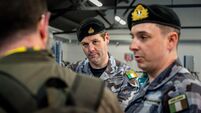
Cormac O'Keefe: Ireland's navy strives to step up maritime security amid wave of reports
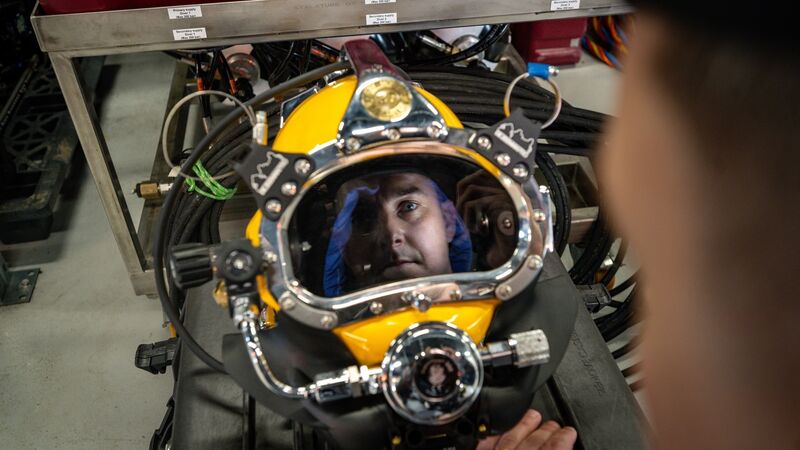
Naval Service Diving Section officer in charge Lt Jason Croke reflected in the visor of a diving helmet during a visit to Haulbowline naval base in Cork Harbour by Irish Examiner security correspondent Cormac O'Keeffe and photographer Chani Anderson.
One thing the Irish Defence Organisation is good at is drafting reports.
The organisation, incorporating the Department of Defence and the Defence Forces, is either working on, or has published, a bewildering array of reports in recent years.
And 2026 is no different.
Already, this year, we had the second Detailed Implementation Plan on the Commission on the Defence Forces (CoDF), the Strategic Framework for the Transformation of the Defence Forces, and Ireland’s first National Maritime Security Strategy.
Also see: 'Irish Examiner' security correspondent Cormac O'Keeffe and photographer Chani Anderson learned more when they visited Haulbowline naval base in Cork Harbour
To come is a Strategic Workforce Plan (due this month), a Civilianisation Plan (due in the summer), a Capability Development Plan 2028-2040 (due later in year), and a Naval Service Regeneration Plan (imminent).
In addition, there are three force design teams, for the army, naval service, and air corps — on foot of which the chief of staff will submit a report on force design to minister for defence Helen McEntee.
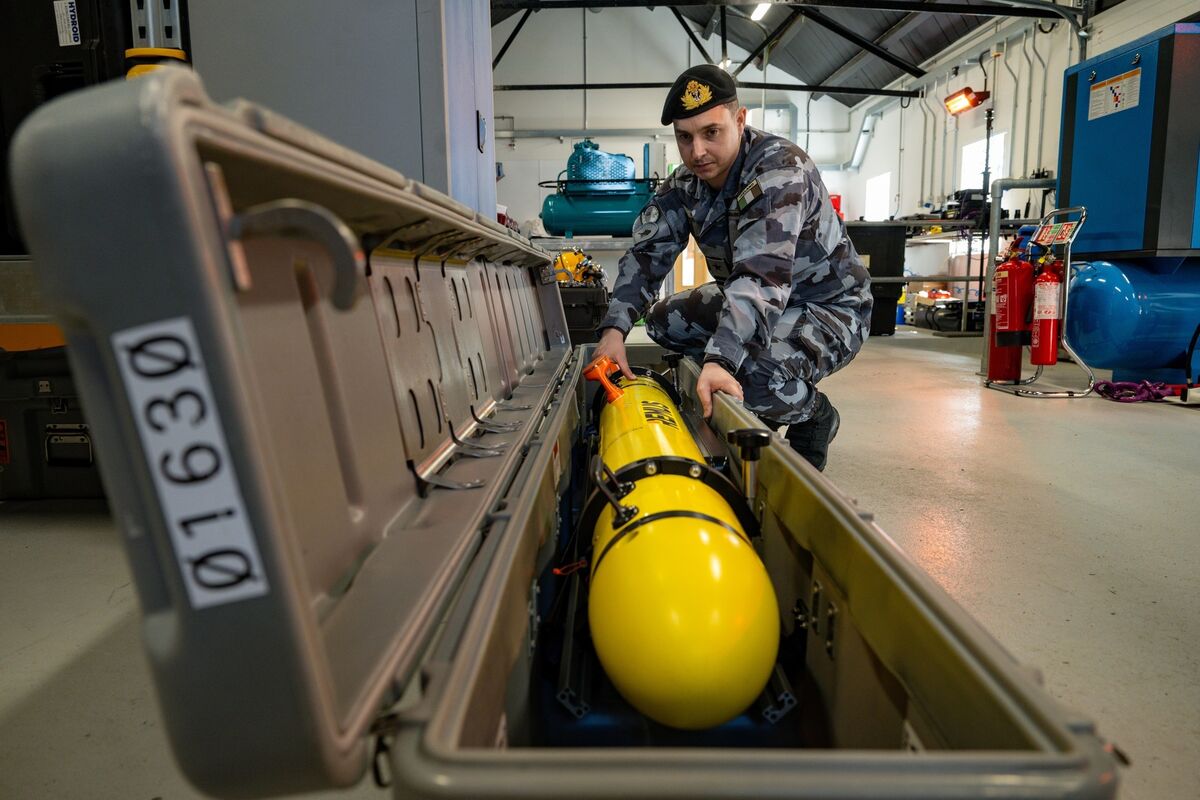
In our tour of the naval service diving section in Haulbowline, the headquarters of the naval service, Lieutenant Commander Aonghus Ó Neachtain from the planning and policy section brings us up to date.
He refers to yet another strategy, the Haulbowline Master Plan, part of the Naval Service Regeneration Plan.
“The strategic force design teams have been established, and have been established now for two years, and they’re now coming towards the end of their process to present a new design for the entire Defence Forces, such as the navy, to Government,” he says.
He says the “strategic importance” of the diving section has been recognised, not just from various tasks, such as search and rescue, it carries out, but from a “maritime defence” perspective.
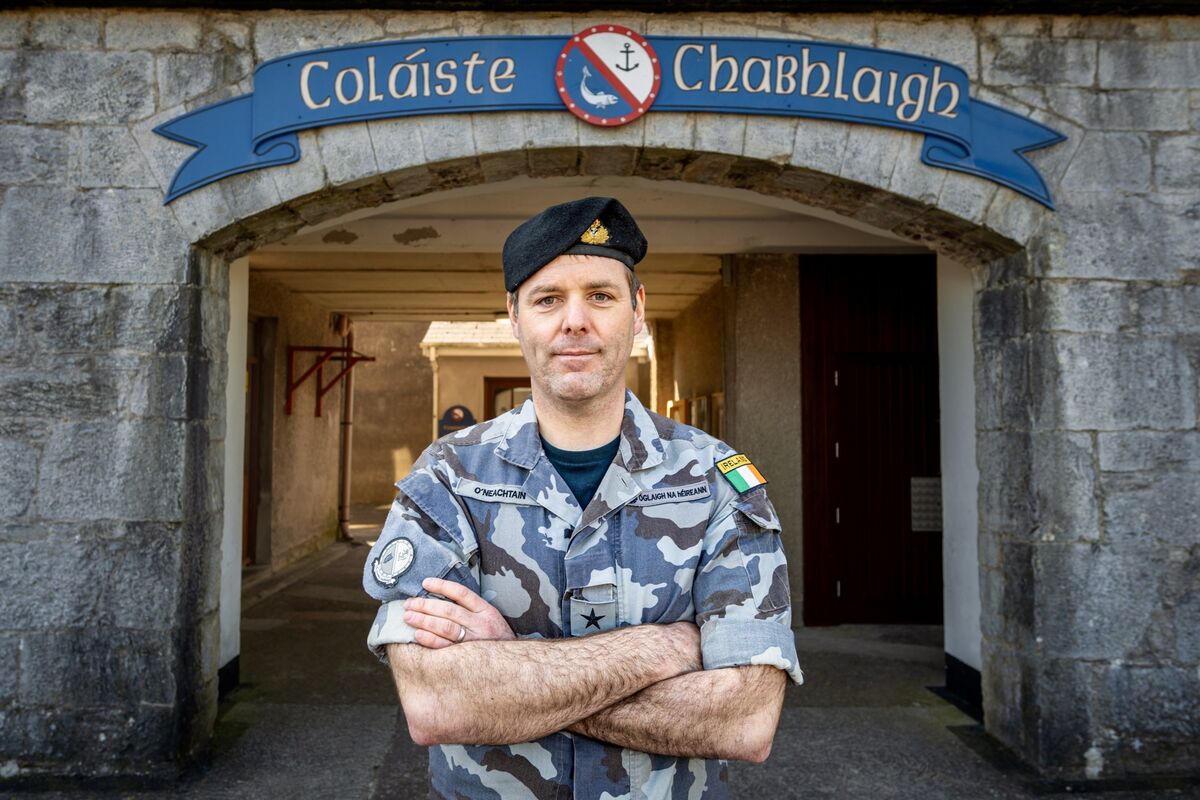
The senior officer says the design teams have “mapped out” internally, within the naval service and the defence forces, and they are now being presented to the Department of Defence for onward approval.
“Hopefully then we would have this new structure across the entire naval service so we can redesign the service and, hopefully, that will lead to an increase in numbers,” he says.
Lt Cdr Ó Neachtain says the recruitment and retention crisis in the Defence Forces, and naval service in particular, has been “well documented” but that naval service recruitment has been on an “upward trajectory” for the last 18 months.
Figures published in the 'Irish Examiner' in February show there was a net increase (inductions minus discharges) of 207 in the Defence Forces in 2025, with the largest increase in the naval service (a net rise of 115).
Defence minister Helen McEntee said last month the total strength of the naval service was 807, but an operational strength of 747 as many recruits were in training.

She says the aim is to reach 1,100 by 2028. This would match the existing naval service establishment strength (what is should be). It will be far off the strength for the naval service envisaged by the CoDF under Level of Ambition 2 adopted by the Government, which targeted 1,794 personnel by 2028.
This would see the naval service having nine operational vessels.
When that will come a reality is difficult to estimate.
What it does not include is the long-talked about multi-role vessel (MRV), to replace the former flagship LÉ Eithne, decommissioned in 2022. Official moves to purchase a new combat vessel go back to at least 2017, but the project has got lost in bureaucracy and reviews since.
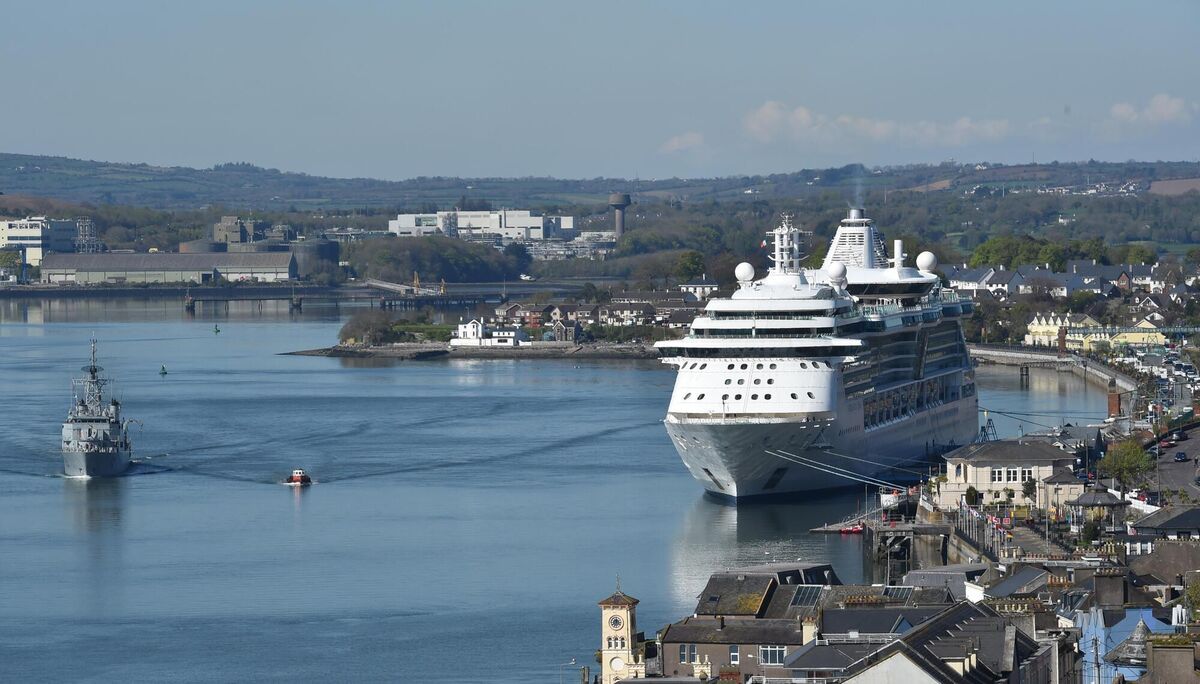
Department of Defence officials have made it clear that the existing vessels need to become operational first before there is any further investment.
“That vessel [MRV] would provide for the defence of the state,” Lt Cdr Ó Neachtain explains. “That is a vessel with the capability, both through sensors and weapon systems, that could actually provide a credible defence at sea.
"By defence, I don’t just mean the firing of a gun or weapons system — I’m talking about sensors with the ability to look under the sea, the ability to monitor the air, and the ability to monitor the surface in a greater capacity.”
While that is some distance away, there have been some improvements in activity levels in the naval service, albeit after a dramatic reduction in patrol days over the years. There are eight ships currently, four of them operational.
The 'Irish Examiner' understands these comprise three P60s — offshore patrol vessels — and one P70 — inshore patrol vessel; two ships are out patrolling at any one time, sometimes three.
The Government stresses that €1.7bn is being invested in the Defence Forces under the National Development Plan 2025-2030 and that the annual defence budget will rise from €1.1bn in 2022 to €1.5bn (in 2022 money) by 2028 — in order to implement Level of Ambition 2.
But it emerged last year that then defence minister, Tánaiste Simon Harris, had sought €3.4bn for capital funding between 2026 and 2030 in order to implement Level of Ambition 2, but that the Department of Public Expenditure would only allot €1.7bn.
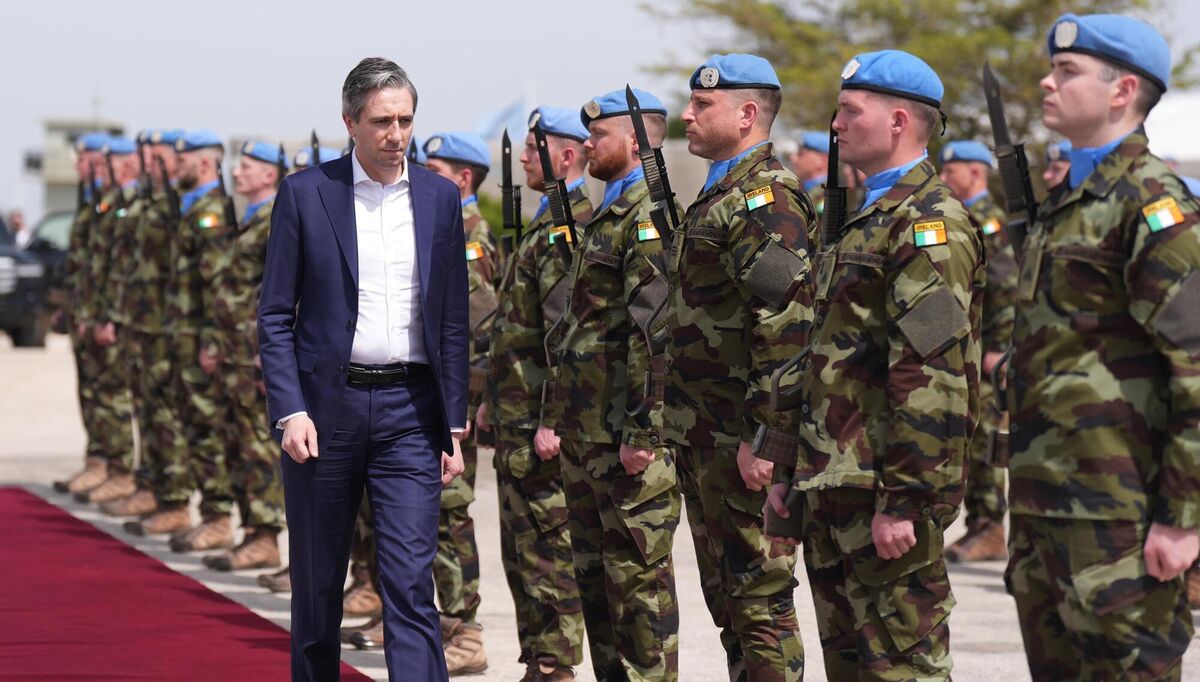
As reported in in April 2025, Mr Harris told the department: “It is simply not credible to state that an annual capital allocation of €220m is sufficient to maintain existing capabilities in a context where the rest of Europe is moving to 3.5% GDP defence spend, having consistently spent almost 2% GDP over the last decade — while Ireland’s defence spend languishes at 0.2% GDP.”
This is the background against which the Naval Service Regeneration Plan, the Haulbowline Master Plan, and the Capability Development Plan (which does look farther out to 2040) are being drafted.
Lt Cdr Ó Neachtain acknowledges that all of this is outside the control of the Defence Forces but points out: “We’ve never seen this level of commitment to investment. OK, there’s plenty of commentary ‘is it enough’ but in terms of investment of buying equipment and capability it’s there.”
Read More
He says external consultants are developing the Haulbowline Master Plan: “They are in the final stages of preparing a master plan. We have a myriad of different problems that need to be solved from accommodation on the island to training facilities to berthing facilities for current and future ships.”
This will include a proper facility for the army ranger wing, which, under Level of Ambition 2, is supposed to have a maritime unit based in Haulbowline.
“The master plan will be seen this year, it will take into account Level of Ambition 2 and it probably will also take into account Level of Ambition 3, if we went down that route, and you’ll probably find that the timeframe for the full completion of everything is right out to 2040,” Lt Cdr Ó Neachtain says.
“These things are matters for the Department of Defence and Government. What we can say is that we do see quite significant progression in these areas, compared to maybe a decade previous.”
Of course, Level of Ambition O2 was recommended before Russia’s full-scale invasion of Ukraine in February 2022.
It was recommended before the deliberate loitering of the Russian spy vessel, The Yantar, over Ireland’s critical gas pipelines in the Irish Sea in November 2024. It was recommended before the deliberate drone activity last December on the edge of Irish territorial airspace just after the plane carrying Ukrainian president Volodymyr Zelenskyy passed on its way to Dublin Airport.
And it was recommended before the significant increase in traffic in Ireland’s Exclusive Economic Zone (EEZ) by the Russian shadow fleet, posing both a security and environmental threat.
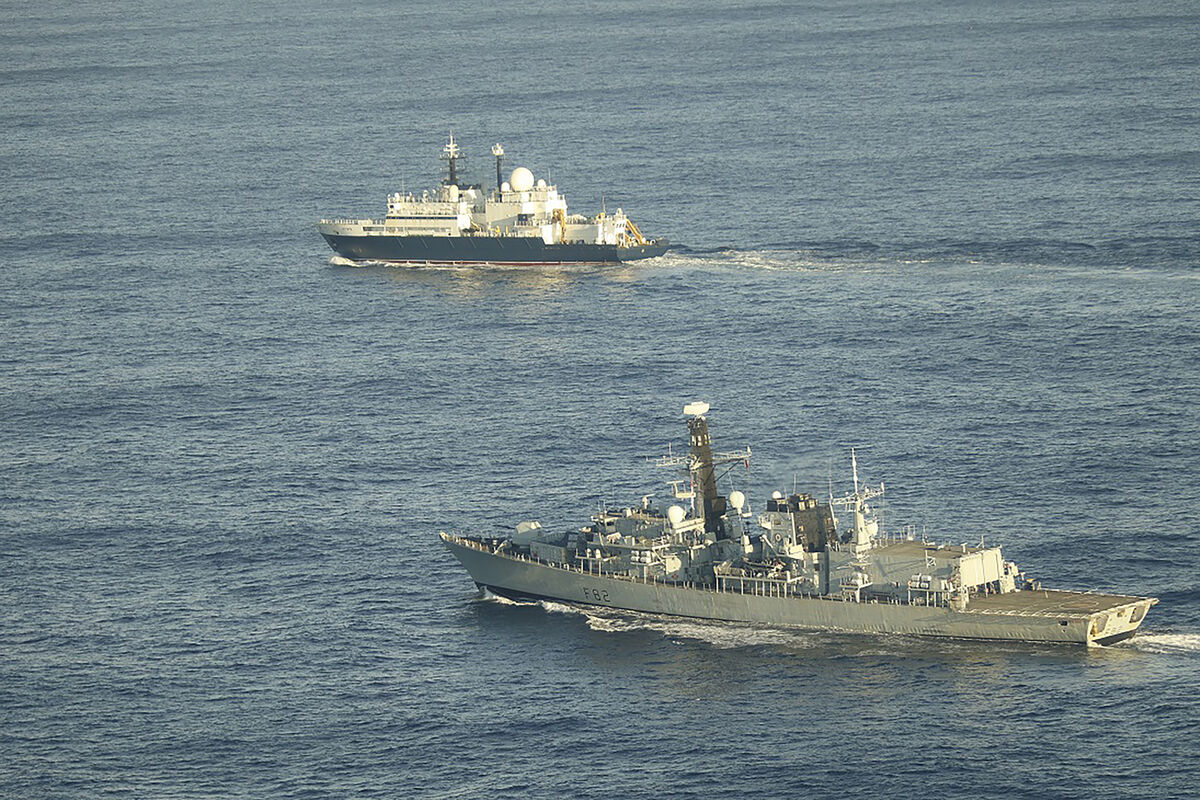
This threat was referred to in a recent 'Irish Examiner' interview with Robert McCabe, who is heading up a two-year Government research project at the National Maritime College of Ireland in Cork to examine, test, and recommend improvements to, Ireland’s maritime security.
Lt Cdr Ó Neachtain says that one of the primary roles of a navy is establishing “maritime domain awareness” (MDA) — essentially knowing what is going on in Ireland’s territorial waters (12 nautical miles out), contiguous waters (24 nautical miles) and EEZ (200 nautical miles).
“That has become an awful lot more to the forefront as Ireland has pivoted towards, and Europe has pivoted towards, the maritime security role and we have the maritime security strategy published in February,” the officer says.
He says navies mainly perform this role though ships, but added there is a lot more to MDA than that.
“We’ve got the surface, we’ve got the air, and we’ve got the water column below and we’ve also got the electromagnetic space and we’ve got the acoustics and we’ve got the seabed,” he says.
“We are developing capabilities to map the seabed, to examine the seabed and an overall understanding of what’s going on in the full maritime environment.”
He says a landmark part of that is the deployment of towed sonar arrays, which will help detect subsea drones or submarines, as part of efforts to protect crucial energy pipelines as well as data cables.
The towed array sonar that goes on the back of the ship is for listening and detecting sound in the ocean, he says.
“So we’re listening for a machine of some description. Now it’s going to pick up any noise in the ocean.”
Lt Cdr Ó Neachtain adds: “The Irish Sea is probably earmarked as probably one of the more critical areas because the energy interconnectors.
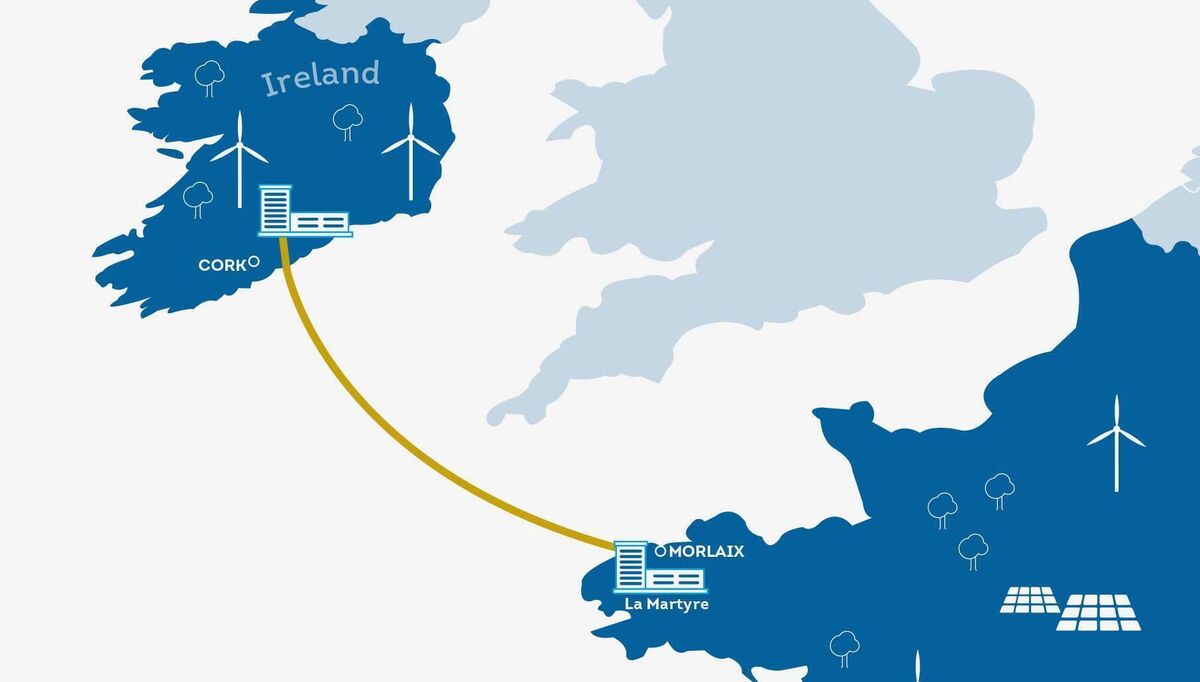
We still have an energy pipeline off the west coast going out to the Corrib [gas field] and we will have an electrical interconnector to France [in 2028], that will be the Celtic Sea, so that’ll be the south coast.”
The sonar will be attached to three P-60 vessels, which will be upgraded one at a time, with the first sonar-equipment vessel [expected to be the LÉ Samuel Beckett] going on stream next year.
A fundamental part of MDA is gathering all the different sources of existing and future data, analysing it, and providing a comprehensive intelligence picture for both the naval service operations centre and military intelligence.
The data sources include the sonars, the new primary radar system (including maritime radar), due by the end of 2028, mapping and surveys carried out by the naval diving section, surveillance and sonar buoy data from air corps surveillance aircrafts, satellite imagery and the EU Common Information Sharing System.
Ireland is also involved in various EU Pesco, European Defence Agency, and Nato projects regarding maritime security, critical seabed infrastructure, and hybrid and cyber threats.
“We have the naval operations command centre at the moment, that’ll probably migrate into a more maritime operations centre,” Lt Cdr Ó Neachtain says.
“That’s just down to how we plan it, so that all the information is fed into this central sort of command node. That will all contribute towards the establishment of what we call the recognised maritime picture, or RMP.”
He says this could then feed into a proposed national maritime security centre which would bring a central cross-government coordination mechanism to a complex area.
In the meantime, Ms McEntee is looking to involve Ireland next year in the Joint Expeditionary Force (JEF), made up of Nato countries, but not a Nato programme.
This programme, which has a large focus on tracking Russian shadow vessels, could help the naval service in terms of training, intelligence sharing, and maritime cooperation.
Both Ms McEntee and Taoiseach Micheál Martin have stressed that Ireland depends on the co-operation of neighbouring countries, such as Britain and France, for its maritime security (and air cover), not least during Ireland’s forthcoming presidency of the EU.
Amid high-level declarations of greater cooperation in maritime security, as well as bolstering hybrid security, discussions are ongoing to pin down the exact scope. In the meantime, the naval service is hosting goodwill visits from the likes of the French navy and taking part, along with the air corps, in long-established exercises with Nato, most recently, a week ago, with the Spanish navy.
- Cormac O'Keeffe, Security Correspondent
CONNECT WITH US TODAY



Be the first to know the latest news and updates