Defence Forces to gain powers to board Russian 'shadow vessels' in Irish waters
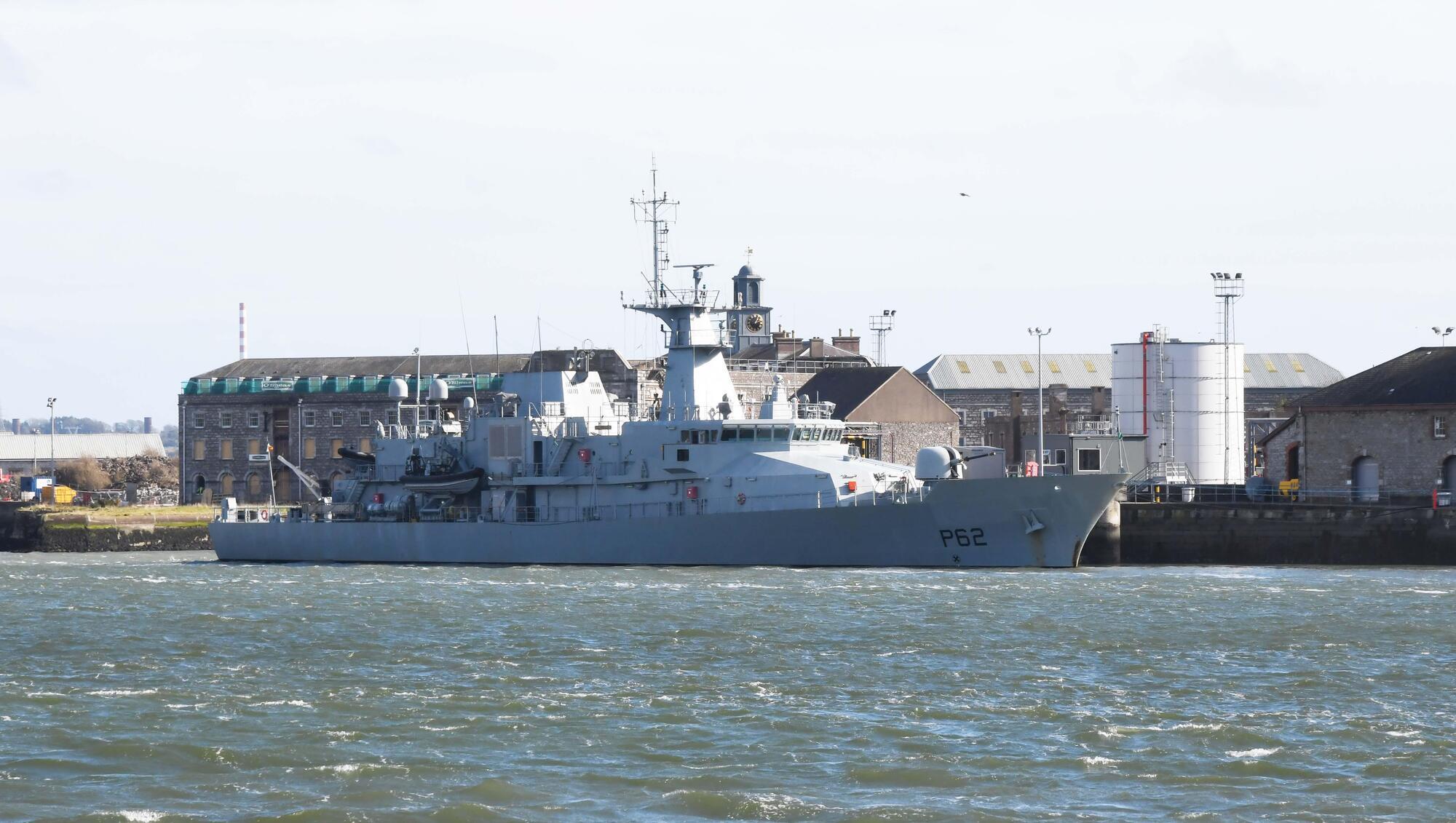
Irish Naval Service ship, LÉ James Joyce. The Government’s first ever National Maritime Security Strategy said there are 'increasing concerns' that this shadow fleet may be utilised for 'espionage and sabotage', by deploying drones from them. File picture: Denis Minihane
The Government is to bring in “urgent” legislation to give the Defence Forces powers to board and inspect Russian shadow vessels travelling through Irish territorial waters.
The proposals are expected to go to Cabinet next month and — subject to Oireachtas approval — be in place before the summer, in advance of Ireland assuming the EU presidency in July.
The provisions would provide the Defence Forces with their own “enforcement powers” and enable them to act “unilaterally” in maritime operations — and not be dependent on the powers of An Garda Síochána, Customs, or the Coast Guard.
The Government’s first ever National Maritime Security Strategy said there are “increasing concerns” that this shadow fleet, typically used to bypass sanctions on Russian oil, may also be utilised for “espionage and sabotage”, by deploying drones from them.
The strategy, which is being published on Wednesday, warns that there are “critical gaps” in Ireland’s surveillance and monitoring capabilities, with capital projects, like primary radar and sonar, expected to improve the picture.
It accepts Ireland’s capabilities — in terms of naval and air assets and personnel — are a bigger challenge and that the Naval Service’s ability to patrol Ireland’s European waters is “currently limited”.
This bigger challenge is behind a strong push in the strategy towards bilateral cooperation agreements with the governments and defence forces of France and Britain in relation to maritime security.
The strategy, covering the period 2026 to 2030, said the Department of Defence is "moving quickly" on progressing participation in international military exercises, such as the Joint Expeditionary Force.
The force comprises northern European nations, and tracks potential threats to undersea infrastructure and monitors the shadow fleet.
Government sources said any practical cooperation involving the navies or air forces of other countries, such as France and Britain, would not be in Irish territorial waters (12 nautical miles off the coast) but in Ireland’s Exclusive Economic Zone (which stretches to 200 nautical miles).
Officials indicate that operational deployment of foreign navies in Irish territorial waters raises potential constitutional challenges, related to provisions that Ireland can not be part of a mutual defence pact or alliance.
Bilateral cooperation is to help protect against drone activity or suspected hostile behaviour by vessels over critical subsea infrastructure, including crucial gas pipelines and electricity interconnectors with Britain and clusters of data cables, both in the Irish Sea and off the southern coasts.
Government sources have also insisted that the Defence Forces will have counter-drone technology in place before July and that personnel will be trained in their use in time.
Defence minister Helen McEntee said she wanted to put defence cooperation with the UK and France on a “more permanent footing”, citing the existing intelligence sharing procedures between the countries.
She said this would be separate to the engagement Ireland will have ahead of its presidency of the EU, where the Government may seek additional support from other countries.
Kenneth McDonagh, Associate Professor in International Relations at DCU, welcomed the strategy as a “step forward in addressing Ireland's security and defence challenges” in an increasingly uncertain world.
“The strategy rightly highlights the vulnerabilities Ireland faces in relation to critical maritime infrastructure with an emphasis on undersea cables and power connections,” he said.
“The strategy also acknowledges the clear gaps in Ireland's capabilities and although detail is absent and points to the Capability Development plan that will address these gaps.”
He added: “In the meantime the strategy tries to walk a narrow line between recognising the need to cooperate with internal partners in both bilateral and multilateral frameworks while maintaining Ireland's miliary neutrality.”