Do you name these figures to your children? The questions raised by Louis Theroux’s Inside the Manosphere
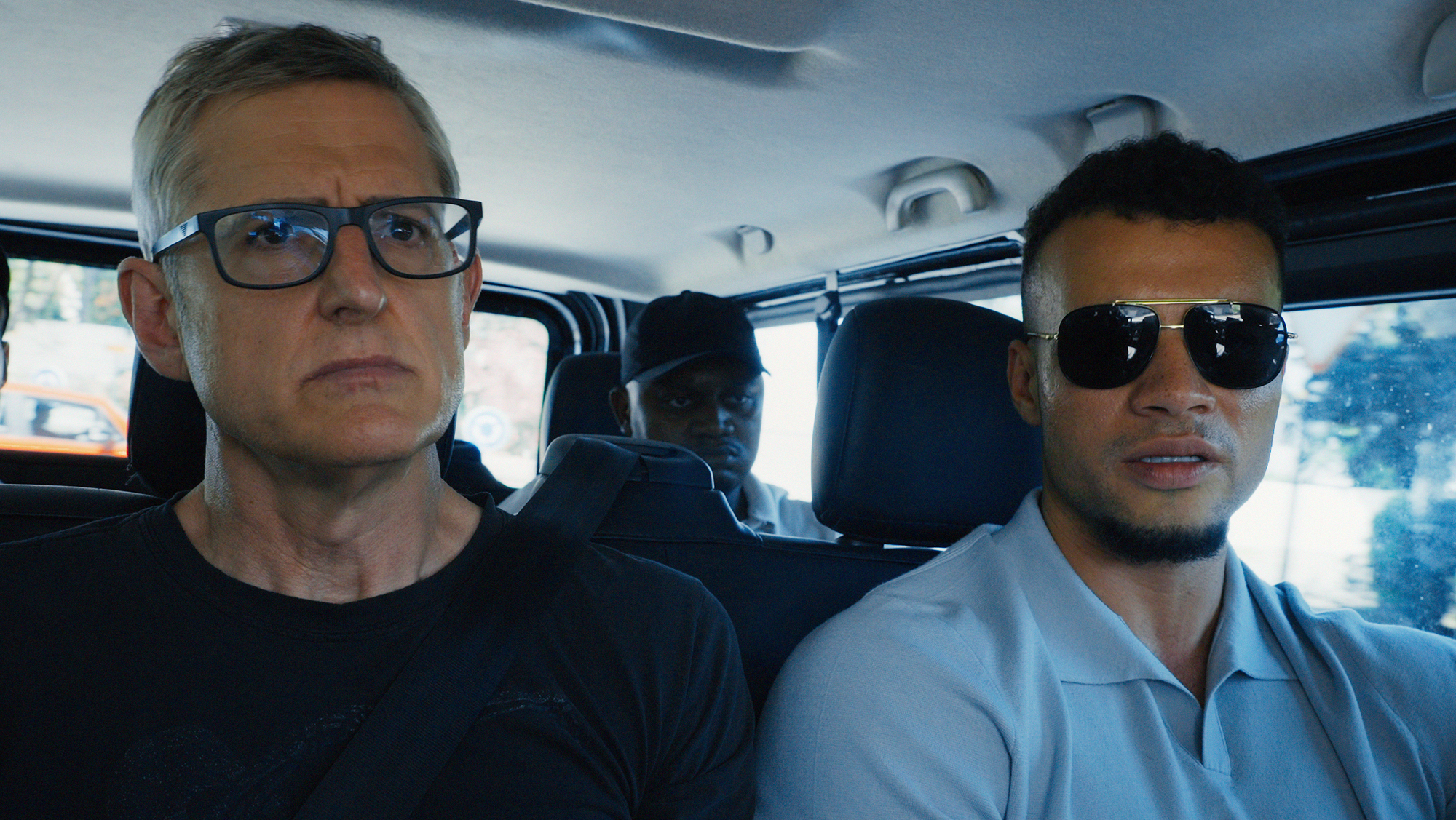
(Left to right) Louis Theroux and Harrison Sullivan (HS Tikky Tokky), in 'Louis Theroux: Inside the Manosphere'. Picture: Netflix © 2026
There is a familiar rhythm to a Louis Theroux documentary. He enters gently, disarmingly. His questions appear naive but land with surgical precision.
He lets people speak — hoping they’ll speak too much — and in doing so reveals the architecture of their beliefs more effectively than a confrontation ever could.
Read More
From white supremacists to religious extremists, from pornographers to survivalists, Theroux has made a career out of allowing the absurd and the dangerous to expose themselves.
In , however, the cast is different. Not hidden away in compounds or fringe communities, but sitting in podcast studios, Airbnb rentals, and slick online set-ups — men who are not on the margins so much as plugged directly into the bloodstream of the internet.
They are not subterranean, nor members of a secret society.
They are absolutely mainstream, and so the manosphere is less of an exposure into a hidden world, more of a walkthrough with the cast of plasticated protagonists.
Take Harrison Sullivan, known to his followers as HS TikkyTokky, a UK streamer broadcasting a sun-drenched life of rented luxury from Spain. Fast cars, villas, a constant performance of wealth.
But beneath the gloss is something colder: a sales funnel. Sullivan packages misogyny as motivation, blending “hustle culture” with a worldview in which women are distractions at best, inanimate obstacles at worst.
The dream he sells to young men is not just financial success, but dominance, over circumstance, over other men, over women.
What Theroux audits is not simply the message, but the mechanism: outrage and aspiration carefully calibrated to convert followers into paying customers.
Then there is Sneako-Nicolas Kenn De Balinthazy, an American creator whose trajectory mirrors the manosphere’s evolution from the fringes to the algorithmic mainstream.
He talks fluently about “red pill” awakening, about “female privilege", about a world supposedly tilted against men. His content thrives on provocation: statements designed to shock, to circulate, to embed themselves in the endless scroll.
What emerges, under Theroux’s gaze, is less a coherent philosophy than a performance of pseudo-certainty that collapses under gentle scrutiny, revealing contradictions and a reliance on recycled talking points borrowed from more dominant figures.
Myron Gaines, real name Amrou Fudl, co-host of the podcast, represents a more confrontational strand of the ecosystem.
His format is brutally simple: invite women onto the show, challenge them, interrupt, and ridicule them, and ultimately attempt to discredit them. It is content engineered for conflict.
Women become props in a recurring narrative in which they are framed as irrational, entitled, or manipulative, while Gaines positions himself as the rational arbiter of truth.
The misogyny here is not subtle: it is structural, baked into the format itself. Theroux’s presence does little to disrupt the dynamic. If anything, it highlights how rehearsed and resilient it is.
Justin Waller, a Louisiana-based influencer with links to Andrew Tate’s wider business networks, offers a slightly different pitch: the aesthetics of old-school masculinity repackaged for the digital age. Discipline, control, hierarchy.
But at the centre of his worldview is a strikingly blunt proposition: one-way monogamy, in which men are entitled to multiple partners while women are expected to remain subserviently faithful.
It is an idea presented not as provocation but as common sense, another example of how the manosphere normalises what would once have been considered extreme.
And then there is Andrew Tate, the absent presence, the gravitational centre around which much of this revolves.
Not directly interviewed, largely due to his ongoing legal controversies, Tate nevertheless looms over the documentary as its arch-villain, its animating force.
His blend of conspicuous wealth, flagrant misogyny, and unapologetic dominance has become the template.
Others echo him, imitate him, build upon his blueprint.
Even in absence, he defines the tone.
Seen together, this is not just a collection of individuals, but a cast performing variations on a theme.
The luxury hustler. The provocateur. The debater. The traditionalist. The kingpin.
Each plays a role in sustaining an ecosystem that is as much about monetisation as it is about ideology.
And naming them, seeing them clearly, reveals something uncomfortable: how deliberate it all is.
Because this is not simply a set of beliefs.
It is a business.
Misogyny is not incidental — it is instrumental.
It drives engagement, builds loyalty, creates a sense of insider knowledge among followers.
The more inflammatory the claim, the greater its reach.
The more divisive the message, the stronger the community it fosters.
This is where Theroux’s method both succeeds and falters.
On one hand, by sitting with these men and allowing them to speak, he exposes the gaps in their logic, the moments where certainty slips, where performance falters.
On the other, the very act of giving them space risks reinforcing their status.
They are, after all, already experts at turning attention into currency.
Theroux, to them, is a nerdy whimp-dad, a pencil of a man who, they’d argue, is nothing more than a browbeaten penis-apologist.
In an earlier era, exposure might have been enough to diminish such figures, to reveal them as fringe, to strip them of credibility.
But in a media landscape driven by clicks and shares, exposure can function as an endorsement's shadow.
Even critical attention feeds the machine.
This is part of why the documentary can feel, at times, belated.
For many — particularly women — the behaviours on display are neither new nor surprising.
The misogyny is not hidden; it is explicit, even performative.
There is, at times, very little to “expose” because the subjects are already exposing themselves, loudly and repeatedly, across multiple platforms.
Which raises a sharper critique: whose voices are missing?
In assembling this cast of men, the documentary risks relegating women to the background, present as topics of discussion, as rhetorical targets, but less so as subjects with their own perspective.
The harm is visible, but not always centred.
There is perhaps another version of this story, one that begins not with the men selling the ideology, but with those living in its wake.
Still, there is value in seeing the machinery up close.
In recognising that these figures are not isolated anomalies, but nodes in a network, interchangeable, scalable, and, above all, profitable.
For a parent, this clarity matters.
Because the audience for this content is not abstract.
It is young, and, by definition, it is impressionable.
It is, increasingly, unavoidable.
Boys encounter it through clips and memes; girls encounter it through the attitudes it helps normalise.
Do you name these figures to your children, explain who they are, what they represent?
Or do you risk introducing something they might otherwise have missed?
Perhaps the answer lies not in shielding or revealing, but in equipping.
In giving children the tools to recognise manipulation, to question easy answers, to understand that confidence is not the same as truth.
The men in Theroux’s documentary offer certainty.
That is their product.
The challenge, for parents, for educators, for society, is to offer something more durable: complexity, empathy, and a version of masculinity that does not depend on dominance to feel secure.
The manosphere thrives on performance.
Theroux, as ever, shows us the stage.
What remains is to decide whether we are content to sit back, tut-tut and watch, or willing to challenge the script.
Strip away the rhetoric, and what remains is a business model, surprisingly structured, highly scalable, and, in some cases, extraordinarily lucrative.
At the entry level, the content is free.
TikTok clips, YouTube videos, livestreams: short, provocative bursts designed to hook attention.
This is where figures like Harrison Sullivan and Sneako operate most effectively, using outrage, aspiration, and algorithm-friendly controversy to build an audience.
The goal is reach.
The wider the net, the more potential customers.
From there, the funnel narrows.
Followers are directed toward monetised platforms: Rumble channels, private Discord servers, subscription-only communities.
Here, access itself becomes the product.
Pay a monthly fee and you’re no longer just watching; you’re part of something.
Advice is dispensed, hierarchies are formed, belonging is sold.

Then come the higher tiers.
“Courses” promising financial independence, dating mastery, or personal transformation.
Prices vary wildly, from €50 for entry-level content to thousands of euros for so-called mentorship programmes.
The language is always the same: invest in yourself, escape the matrix, become “high value".
What is actually being sold, more often than not, is repackaged common sense wrapped in the aesthetics of exclusivity.
At the top end sits a more opaque layer: networking schemes, affiliate links, and, in some cases, connections to broader business ecosystems associated with figures like Andrew Tate.
Here, influence translates directly into revenue streams that are difficult to quantify but clearly substantial.
Some of these creators present themselves as millionaires, and while that image is often curated, the underlying truth is that there is serious money in this space.
What makes this model particularly insidious is who funds it.
Often, it is not financially independent men buying into these systems, but teenage boys, drawn in by the promise of status, clarity, and control.
And, more often than not, the payment method is not theirs.
Subscriptions are charged to a parent’s card, courses purchased through family accounts, small amounts that slip under the radar but accumulate over time.
Total prohibition is rarely effective.
The ecosystem is too diffuse, too accessible.
Instead, visibility matters.
Knowing what platforms your children use, what they are watching, and, crucially, what they are paying for.
Simple steps like reviewing app subscriptions, setting spending limits, and requiring approval for purchases can disrupt the pipeline.
But the deeper intervention is conversational.
Explaining not just that these influencers exist, but how they operate, how outrage is monetised, how insecurity is targeted, how belonging is sold at a price.
When children understand that they are being marketed to, the dynamic shifts.
The illusion weakens.
Because the manosphere depends on more than attention. It depends on conversion.
And the most effective way to challenge it may be to ensure that, at least in one household, the business model stops working.

CONNECT WITH US TODAY



Be the first to know the latest news and updates