Careful planning and bold vision can put Cork on a journey as a city of the future
Being eco-friendly is not limited to rural areas, writes Pádraig Hoare.
Careful planning and bold vision can put Cork on a journey as a city of the future

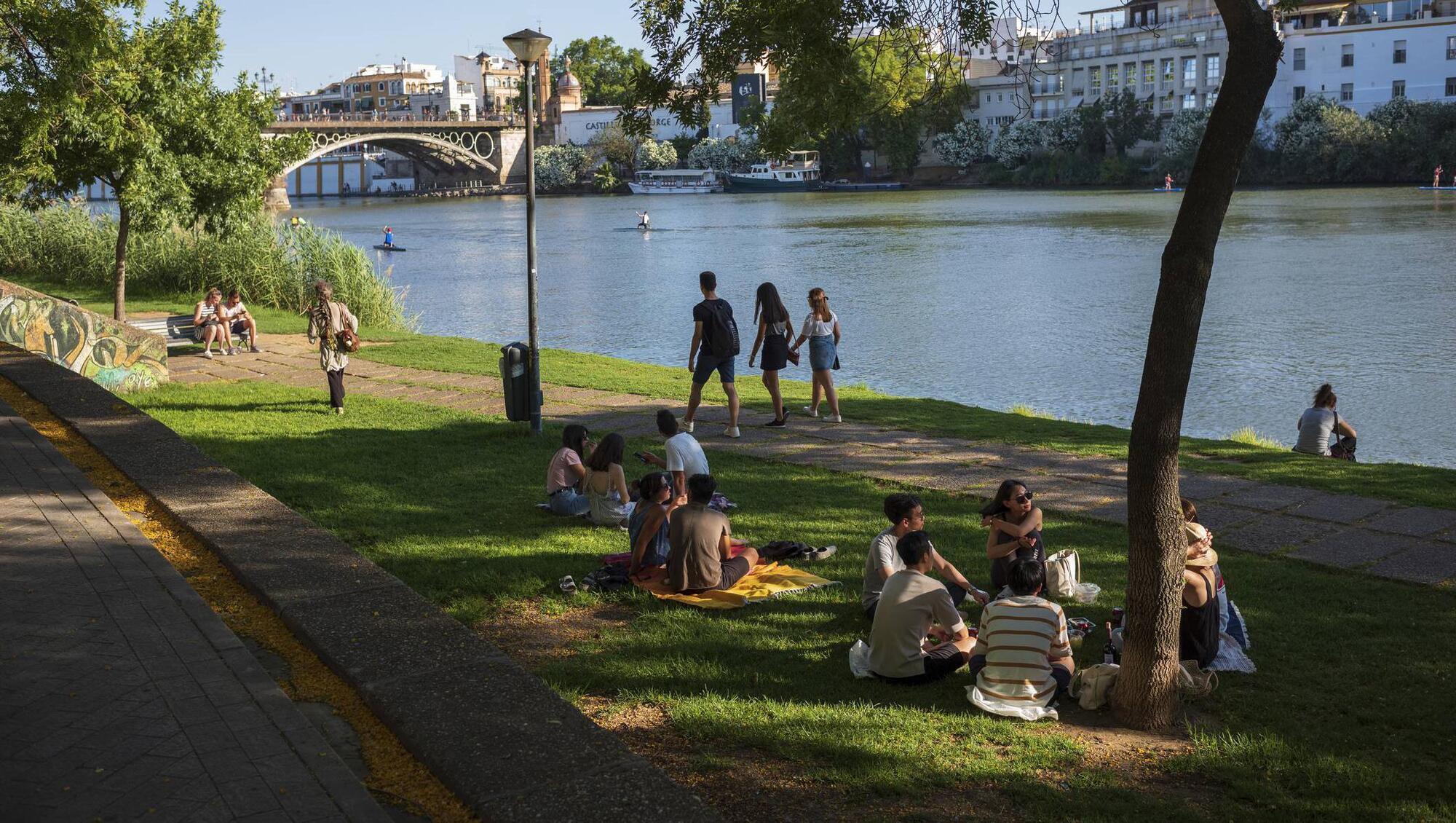
Friends enjoy a summer afternoon at a park on the bank of the Guadalquivir river near the bridge of Triana in Seville.

When the same cities across Europe pop up as some of the best places on the planet to live, it would be tempting to think it was happenstance and good fortune that smiled upon them as they became bastions of sustainable and good living.

Seville in southern Spain, the Danish capital of Copenhagen, Groningen in the Netherlands, Porto in northern Portugal — the list goes on.

However, the only secret sauce in the recipes for their sustainability and future success is planning and community stakeholding.

Good things don’t happen by chance, and cities of the future are not sporadic and decided by ad hoc policymaking.

In 2019, after the culmination of years of back-and-forward between city politics, university leaders, economic think-tanks, business groups, and civic societies, the city of Seville unveiled its strategic plan for 2030.

Plaza de la Encarnación in the old quarter of Seville at noon. The prominent wooden architecture is the Metropol Parasol by architect Jurgen Mayer.

Focused around 10 themes, including employment; industry and innovation; governance and participation; citizenship and equality; sustainable tourism; environment and climate change; housing, urban space and healthy habitat; and culture and sport, more than 350 stakeholders took part.

It wasn’t all plain sailing for the Andalucian jewel, with an ambitious plan drawn up in 2000 and 2003 for the decade ahead, which was marred by the financial crash of 2008 and beyond. The plan for 2020 was similarly affected, but the remnants of that plan have been included in the 2030 vision.

The guiding principles for the projects to be executed in the next decade are in line with the Sustainable Urban Development Goals of the UN, with creating a sustainable city that mitigates and adapts to climate change a key aim, as well as the likes of governance and citizen participation a major element.

A significant initiative was launched in 2020 called Respira Sevilla, or Seville Breathes. Mayor of Seville for seven years until January of this year, Juan Espadas, said the initiative aims to generate healthier, more habitable areas with limited circulation of private cars and vans.

The purpose is to “reduce carbon dioxide emissions into the atmosphere, fight against climate change, recover spaces for pedestrians, promote public transport and promote mobility on foot”, the mayor said, but also a transformation of some of the less advantaged areas of the city with an injection of €60m — the largest allocation ever afforded by the city council.

The Respira plan “is committed to the progressive and consensual restriction of the use of private transport in the historic centre of the city and on Betis and Pureza de Triana streets, making the rights of residents and economic activity compatible with an increase in public transport and the promotion of mobility on foot, by bike and electric”.

The pedestrianisation of the Avenida de la Constitución and San Jacinto and Asunción streets was “courageous” in its social, commercial, and economic revitalisation, planners said, as they aimed to extend the successful rollout elsewhere.

Respira Sevilla also sees the geographical expansion of the so-called 30 Zones — speed limit of 30km/h. The Old Town has already been declared Zone 30 with priority for pedestrians and bicycles over vehicles, and Zone 20 with absolute priority for pedestrians.

Seville
Seville

“Along with these limitations, the creation of more green lungs in the city is proposed — through parks and gardens,” the city council said.

That is not to say that Seville has been problem-free. It, like many other in Iberia and the Mediterranean, are suffering from the fallout of climate change. However, decisive action is being taken.

According to the European Commission, as one of the most threatened cities by global warming, Seville has a comprehensive medium- and long-term vision to become a climate-neutral city in 2030.

The city launched groundbreaking projects to achieve climate neutrality, based on bioclimatic and healthy parameters from the traditional architecture [use of plants, water, materials, etc] and technological innovation,” it said.

The city has converted 264 public buildings into smart and energy-sustainable buildings in a €5m investment, and is working on state-of-the-art solutions to deal with high temperatures, in both public space and public buildings.

Porto

Cityscape of porto in portugal at dusk

While Sevilla is on the up, a neighbour on the opposite end of the Iberian peninsula, Porto in northern Portugal, is also thriving.

Monocle magazine, the influential current and public affairs publication, crowned Porto as the winner of its Best Small Cities Index last year, up from ninth in the world the year previously.

Always known for its industrial and commercial heartbeat, the 220,000-population Porto has become a sustainable and thriving place for arts and culture, as well as accessibility.

“The plethora of cultural offerings in Porto reflects the affection of the city’s inhabitants for all things arts and crafts,” Monocle stated. 

"International designers have long sought Porto for its manufacturing capacity, but increasingly they are choosing to move closer to their supply chains, giving this small city a can-do, cosmopolitan feel.

“Porto is small but it has big-city ambitions, with the advantage that most of its action happens within a compact radius of medieval winding streets that are easily walkable from top to bottom."

A new masterplan in 2021 pledged to improve Porto’s burgeoning reputation as a liveable and sustainable small city.

Just like Cork, an increase in housing availability is key, as well as jobs and investment, but also doubling the city’s green areas.

The European Commission is impressed with Porto’s lofty ambitions, holding the Portuguese city up as one of standouts of the smart cities of the future.

Nominated as one of the European Smart Tourism Cities of 2023, the commission hailed the 900-year-old city as offering “a rich heritage, combining tradition and modernity, and is a place of multiculturalism”.

“Porto is a tourist destination par excellence, particularly because of its beauty and the plurality and diversity of experiences for visitors. Classified as Cultural Heritage of Humanity by Unesco since 1996, visitors can explore the historical centre of medieval origin, which has continued to evolve, modernise, and keep up with the trends and new demands of both residents and visitors,” it said.

An example is the management and sustainability plan 2020-2030 that covers buildings’ rehabilitation, it added.

“It is easy in Porto to enjoy examples of Roman, Gothic, Baroque or contemporary architecture, and Art Deco shouts aloud in commercial spaces and historic cafés.”

Crucially, the city centre is becoming less car-centric and more pedestrian and mobility friendly, according to the commission.

“The Tourism Transport Regulation has defined parking locations, circuit timetables and number of registrations per operator to encourage the use of electric vehicles and to reduce traffic and pollutant gases emission," it states.

“Most public transport is already hybrid, electric or natural gas powered, and soft mobility network is being consolidated, with 55km of cycle path and 210 bicycle and scooter sharing points.

“Beyond this, the city is working on implementing various other solutions to improve structural issues. These solutions are based on the Municipal master plan which is designed to help increase energy efficiency and combat climate change with the overall aim of achieving carbon neutrality by 2030.

By doing this, Porto is actively educating its stakeholders and residents on the environment, building a widespread practice of urban cleaning, and planning for effective water cycle management.”

Imaginative reinvention of existing places has been a new concept successfully implemented in Porto, akin to Ireland’s brilliant marketing of the Wild Atlantic Way. Like the Irish tourist trail, the execution was simple, but brilliantly transformative for Porto.

“Designed as a metro line, the City Museum in Porto is a disruptive concept based on a polycentric idea of the city that emerged in February 2020,” the commission gushed, as it marvelled at the almost 200,000 visitors using the service since it began less than three years ago. 

"With different dispersed museum stations, visitors can move as if it were a metro railway network, interconnecting five thematic axes: Sonorous, Nature, Material, Liquid and Romanticism. It incorporates archaeological sites, water places, houses, libraries, industrial spaces, gardens, among others."

Copenhagen

People enjoy a summer day in the busy Nyhavn quarter on the waterfront in Copenhagen.

The Danish capital of Copenhagen has long been admired by city councils and local authorities across the world for the perception of its high quality of life and forward-thinking.

That hard-earned reputation shows no signs of abating. Monocle magazine awarded Copenhagen the enviable title of Most Liveable City in 2021.

“Copenhagen is one of those cities where there is a real ambition to deliver a better quality of life for everyone... The ambitions around creating a cleaner environment are best in class and the city is reaping the rewards of years of urban investment,” said Monocle editor Andrew Tuck.

Monocle pointed to the new City Circle Line metro opening in 2020, as well as making new areas of the city more accessible, and its clean harbour, a favourite for outdoor swimming all year long.

Copenhagen takes so-called “samfundssind” very seriously, according to Visit Denmark. Roughly translated as “community spirit”, the concept was reborn during the Covid-19 pandemic, and has been elevated even further as a way of Copenhagen becoming even more in tune with the desires of the population to have one of the best living experiences in the world.

The rise of Copenhagen in being a mainstay on every liveability and quality of life index is no accident, according to experts.

In the scientific publication Field Actions Science Reports (FACTS), Copenhagen is described as achieving its lofty ambitions through careful and thoughtful urban planning, using green spaces and environmentally friendly practices as a guide.

“In the past 30 years, Copenhagen has undergone a great transformation,” FACT said in a 2018 paper..

From an ageing, indebted city with fleeing industries and inhabitants, it has become one of the happiest cities in the world according to different city rankings. 

Copenhagen has based its resilience on a dynamic economy and a green and inclusive urban environment for its inhabitants. This has materialised through a comprehensive urban development strategy.

“The city has launched the revitalisation of several declining neighbourhoods over the course of decades with the objective of building a liveable city with ambitious economic, social, and environmental objectives and that offers every citizen a homogenous urban and social fabric.

A cyclist, pedestrians and tourists in Christianshavn neighborhood in Copenhagen.

“The aim of Copenhagen is to make the city liveable, so all aspects of citizens’ lives are taken into consideration in an inclusive strategy of urban planning, making cities and inhabitants more resilient to shock and stresses."

Copenhagen implements bold infrastructure projects, with green credentials at the forefront of planning.

“One of the most striking examples of this is the integration in neighbourhoods of green spaces that can retain water when rainfalls cause risks of flooding,” FACTS stated.

In the neighbourhood of Osterbro, a park was opened in 2015 that fights soil waterproofing and heat islands. 

When rainfalls are too heavy, the water is retained in parts of the park and then slowly redirected to the city’s water system and is also used in the summer to water the plants of the garden."

Wind turbines supply one third of the country’s electricity and Copenhagen aims to add above 100 turbines, it said.

“As for heating, 98% of households are connected to the district heating system that uses waste heat from power plants to warm houses. For the transportation sector, fostering cycling is a major element of the climate neutrality plan, but public transportation is also involved.

“By 2025, 75% of all trips should be made by bike, foot, or public transit and all buses will be replaced by electric buses. Lastly, private cars are targeted and already 85% of the city’s cars run on electricity and hydrogen.”

Cork may not turn into Copenhagen, Seville, or Porto overnight, but careful planning and bold vision can put Leeside on an irreversible journey as a city of the future. 

It cannot say there is no inspiration to be found among its European counterparts.

CLIMATE & SUSTAINABILITY HUB

More in this section

Lunchtime News

Newsletter

Keep up with stories of the day with our lunchtime news wrap and important breaking news alerts.

Cookie Policy Privacy Policy Brand Safety FAQ Help Contact Us Terms and Conditions

© Examiner Echo Group Limited