'Irish is having a moment all over the country': Why more people than ever are speaking our native language
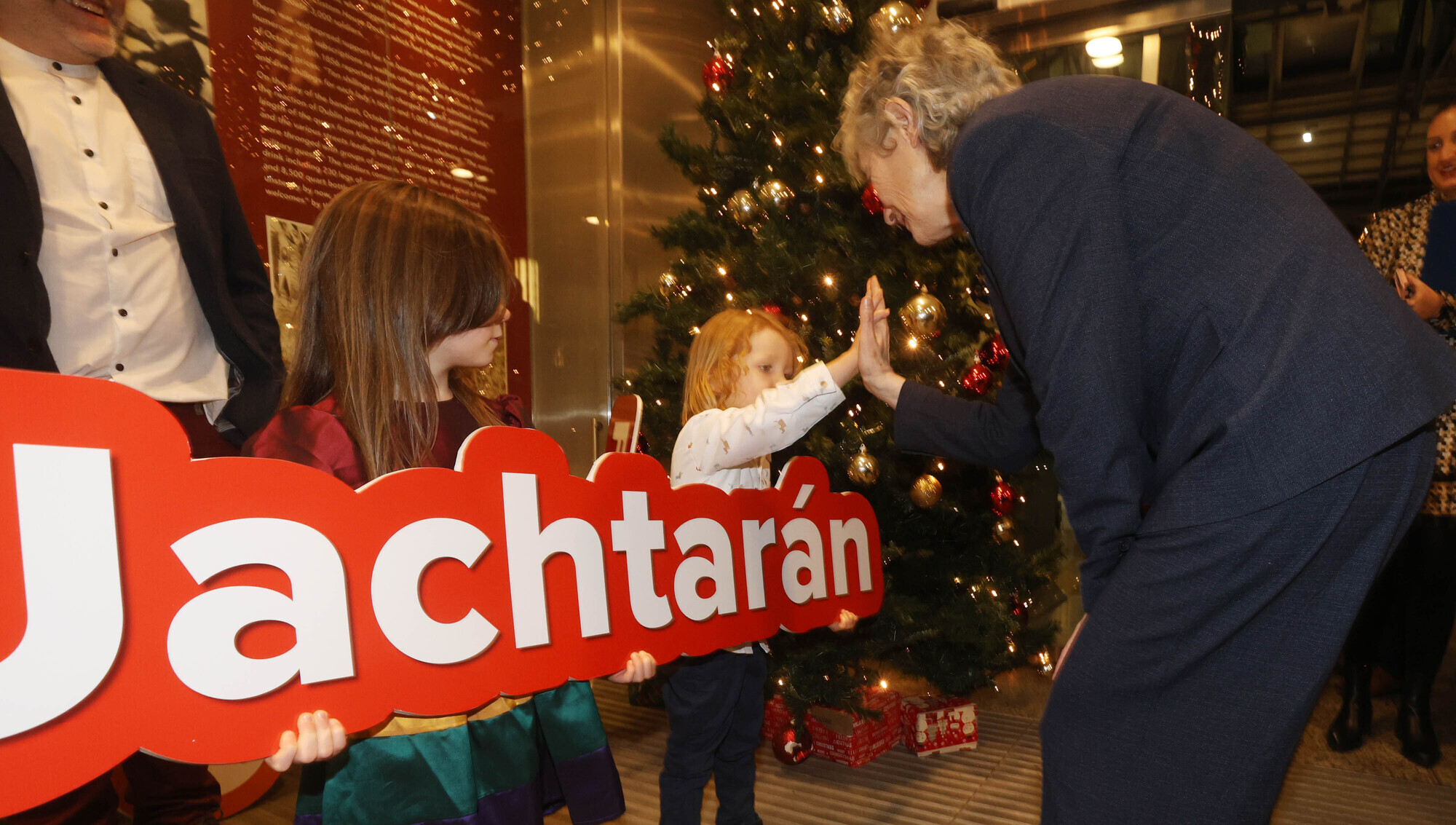
President Catherine Connolly at the launch of An Foclóir Nua Gaeilge with Éile Ní Dhuinn Ní Bhric (5) and Iolann O Duinn Ó Bric (4). Picture: Leon Farrell / Photocall Ireland
The Irish language is having its moment — from the first-of-its-kind dictionary aimed at ending the need to understand Irish words through the lens of English, to a new president devoted to the use of Irish in the Áras, there is a new pride in speaking the native tongue.
But is it any different to previous spikes and fads from the 1890s to the 1990s? The 2022 Census recorded 1,873,997 speakers of the language, an increase of 6% in five years.
But the real story is among the young.
For the first time, an Irish census sought to assess the level of Irish fluency. It found fluency among younger age groups was much higher than older age groups.
Some 63% of those aged between 15 and 19 said they spoke it either very well or well.
In contrast, 27% of Irish speakers aged 50 to 54 recorded they spoke Irish either very well or well, the census found.
In itself, the census substantiates research from the Department of Education that among the younger citizens, “positive sentiment for the Irish language is widespread”.
The department responsible for the language, the Department of Rural and Community Development and the Gaeltacht, led by minister Dara Calleary, told the "the language is in a very good place at the moment".
Budget 2026 saw record funding — €159m for the Gaeltacht, Irish language, and the islands, an increase of 29%.
“The scale of the funding increase for the Irish language obtained by Minister Calleary and announced in Budget 2026 will build on this positive sentiment and provide citizens with more of what they want, that being the Irish language and opportunities to immerse themselves in the language," the department said.
It demonstrates Mr Calleary’s “deep interest in the language”, a spokesman said.
This allocation will provide a wide range of supports for the development of Irish-speaking communities both within and outside the Gaeltacht.
Capital funding is also increasing in and outside the Gaeltacht, and there are increases in grants for households providing new and renewed accommodation for the summer colleges. This includes starter grants of up to €6,000 for fire alarms, beds and mattresses.
Funding is also being made available to an innovative Irish language and cultural hub on Harcourt Street in Dublin to serve the needs of the increasing numbers of Irish speakers in the capital.
TG4, the Irish language station, also got a hike in aid. The Department of Culture has sanctioned €5.4m, or a 9% increase, from the exchequer for TG4 next year for more high-quality Irish language content, children’s programming and expanded news services, bringing its total funding to €65.4m.
This is the second-highest increase for TG4 in recent years. Some €7.3m was awarded to the station in Budget 2023 to launch new children’s channel Cúla4.
Across the other Government departments, there are increased supports.
Language activists believe the new pep in the step of Irish speaking is different and that funding and gaelscoileanna have ensured a new attitude towards the language has taken hold.
Lecturer in modern Irish at UCC, poet Dr Ailbhe Ní Ghearbhuigh thinks the "surge" right now feels different.
“There’s a huge surge in interest. We’ve been here before. There was a fad in the 1990s, for instance. But this feels a bit deeper," she said.
The reasons for people “re-engaging” with Irish are deeper than just watching TG4, she said.
“They are genuinely trying to connect with some part of themselves."
People react positively now when they hear Ailbhe speaking Irish to her children. Five years ago, that would not have been the case, and there would have been “a look”. Now people come up and say how great it is to hear Irish spoken, she said.
In the 1990s, TG4 and television presenter Bláthnaid Ní Chofaigh laid ground work and created a wave. It didn’t last, “but there would be no Kneecap" or others without that 1990s wave, Ms Ní Ghearbhuigh believes.
Bilingualism is part of life on the continent. However, Ireland has had “an all or nothing approach", probably to do with its colonial past, she said.
Poverty and shame were connected to the Irish language psyche. That has changed. Gaeltachts are happening now in cities.
But Ms Ní Ghearbhuigh warns against an overemphasis on an urban setting.
“We really need to invest in the Gaeltacht,” she said.
"The Irish language movement is a community, ultimately, where people connect with each other. There had historically been an overemphasis on correct grammar but — it’s time to let that go and 'let it rip' so the language is used and confidence is built."
Irish cultural organisation Conradh na Gaeilge is one of a number of bodies under the umbrella of the ultimate Irish promotional body Foras na Gaeilge that is involved in promoting the language. It numbers 200 branches now, several of which are abroad. The newest has been formed in December in Strasbourg, France.
Meadhbh Ni Cheallacháin, who is national organiser with Conradh, says the organisation is a long way from when the traditional image of Conradh members was of them going around on bikes teaching Irish language classes.
“We’ve seen growth of over 700% in our membership since 2021 and have members across 22 countries."
The growth has been happening for a while, Ms Ni Cheallacháin says.
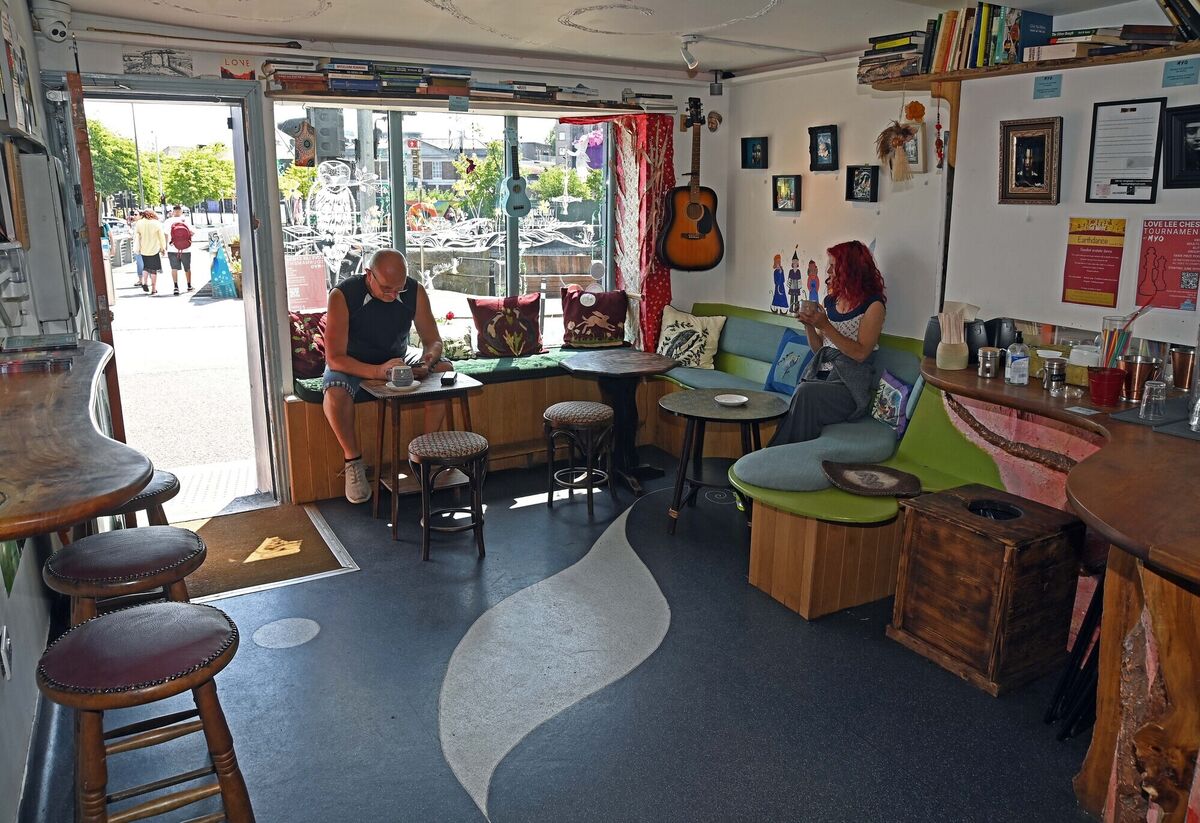
Cork-based Donal Breathnach is involved with Liú na Laoi, a two-year-old “meitheal” type organisation promoting Irish in Cork city.
“In Cork, there’s an awful lot of stuff happening,” Mr Breathnach said.
He points to meetings like the Sos Lóin lunch through Irish on Tuesdays and Thursday, evening meet-ups as Gaeilge at Myo cafe on Pope’s Quay, where Irish speakers are welcome, and meet-ups in pubs. He sees as a groundswell of energy for Irish speaking.
“For such a long time, Irish was not the coolest thing,” Mr Breathnach said.
But thanks to Gaelscoileanna and a more positive attitude, “people were seeing that every country had its own language, so shouldn’t we?”.
“Irish is having a moment all over the country,” added Mr Breathnach, who works now as a youth coordinator with Conradh. The organisation itself has increased to a workforce of 40, from just a handful not so long ago.
Some 20,000 people marched for Irish language rights before the budget.
The funding increase is welcome, but it was the first real increase since 2003.
One of the main things lacking in Cork is an Irish centre. The Áras hall and pub on the Mardyke, which was a meeting place run by Conradh in the 1970s and 1980s, has long closed.
Belfast had a centre, as did Dublin, and a centre is among the main objectives now to make the Irish language “more normalised” in the second city.
Other targets will be street signs — many of the streets in Cork have colonial-era names and Liú na Laoi is putting together a campaign.
Earlier this month, the first comprehensive all-Irish dictionary or monolingual work with 20,000 entries was launched by President Catherine Connolly.
The “groundbreaking” work provides people with a new way to understand, use and learn the Irish language — without relying on dictionaries in English or in other languages, publishers Foras na Gaeilge, the body responsible for the promotion of the Irish language, said.
“ An Foclóir Nua Gaeilge means that for the first time, the Irish language will not be filtered through the lens of English," chief executive Seán O’Coinn said.
The compilation of the dictionary, which will be free to users, began three years ago and will continue until 2027, when about 30,000 entries are reached.
Until now, anyone trying to understand an unfamiliar Irish word or phrase typically had to look it up in an Irish–English dictionary.
Looking up the meaning of Gaeilge on Focloir.ie, one finds the following definition of An Ghaeilge: “Teanga dhúchasach na hÉireann, agus príomhtheanga oifigiúil Phoblacht na hÉireann.” It means the native language of Ireland and its main official language.
Among the key phrases underneath are “athbheochan na Gaeilge”. And there is this one — "níl an téacs Gaeilge agus an téacs Béarla i gcoibhéis le chéile" — meaning the Irish and the English texts are not equivalent.

CONNECT WITH US TODAY



Be the first to know the latest news and updates