Driven to despair: Irish hauliers say industry at risk of grinding to a halt
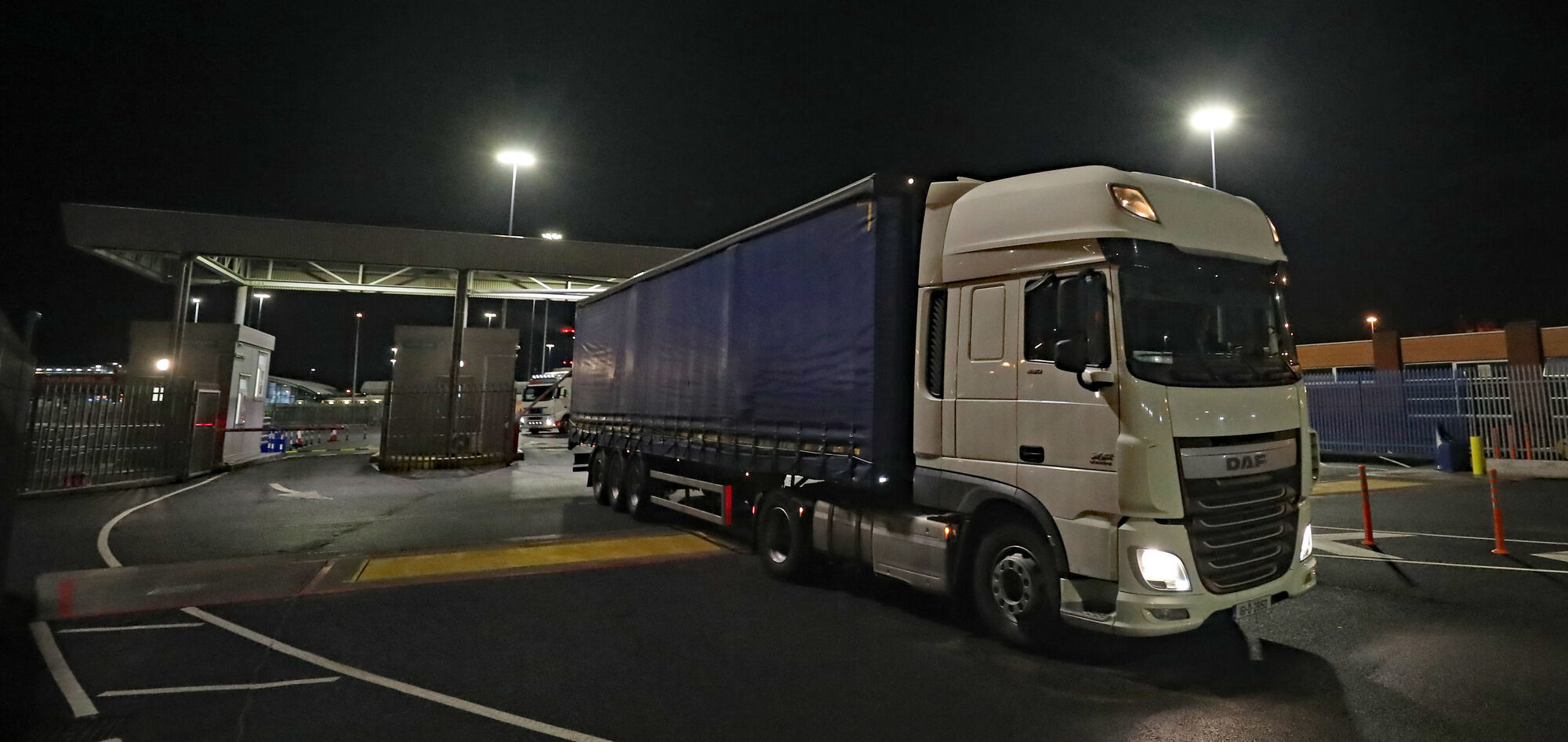
Trucks arriving from Holyhead pass through a customs post at Dublin Port as the new Post Brexit Irish Sea trading arrangements came into operation in January 2021. Many of the hauliers were 'Brexit-prepared' and had established new, direct relationships with consumers and suppliers on the European mainland in favour of former relations with UK firms. File Picture: PA
Not many people can say they have driven Coke from Ireland to Iraq, but haulier Tony Quinn has.
In the 1970s, he established Quinn Transport based out of Athlone, and at the time it was cheaper to drive Coca-Cola dilute to Iraq than to ship it. Mr Quinn has spent the best part of 50 years as a haulier, mostly transporting goods across Europe in addition to Middle East trips, but he now fears for the industry's survival.
Mr Quinn told the Irish Road Haulage Association’s (IRHA) recent national conference in Killarney that he has witnessed major upheavals in the industry in the past but nothing quite like the challenges it faces today — from soaring fuel costs to Brexit, wage inflation due to the cost-of-living crisis, shortage of drivers and the pressure to decarbonise.
“For the last 12 months it has been extremely, extremely challenging,” said Gordan O’Keefe who has run K&L Deliveries, a company with 37 trucks, for more than 35 years.
Mr O'Keefe's fuel costs have risen by a staggering 70% in the last 18 months. “When you’re burning 75,000 litres a month, that’s a lot. My diesel bill effectively went up €70,000 a month.”
Irish hauliers collectively drive 1.8bn kilometres a year — burning 700 million litres of diesel in the process. Last year, the industry contributed an estimated €500m in fuel tax to the Exchequer. Recent fuel increases have been so drastic that haulage companies say they have been forced to raise their costs to stay in business, thus contributing to the cost-of-living crisis.
“I had no choice,” Mr O’Keefe said. “I wouldn’t be in business in six months if I didn’t pass it on. So I had to implement a fuel surcharge with my customers.” He said his customers are understanding but “not able to absorb everything”.

The cost of AdBlue, a key product added to diesel engines to reduce emissions, has doubled in the last 18 months, Mr O’Keefe said. The 1,200 litres K&L Deliveries burn every week starts to add up.
“Wages have gone up because you have to pay your staff,” he said. “Every cost is going up. To be honest, we have been getting reasonably good support up to now from the Government with a fuel surcharge,” he said, but he warned if the Government cuts fuel supports in the upcoming budget “I would predict very strongly there will be a major exodus in the transport industry in Ireland”.
In its recent budget proposal submitted to the Government, the IRHA said there is “considerable resistance to any attempts by members to recover increased costs through higher charges to customers”.
Among the IRHA’s proposals, the group is seeking supports to offset the impact of Brexit, maintain the reductions in excise duty on fuel, funding for AdBlue, removing the 2 cent National Oil Reserves Agency charge for hauliers and rebate the costs to them backdated to January 1, 2020, financial supports in upgrading fleets to greener technology and the abolition of tolls charged for green vehicles.
Speaking to reporters at the IRHA conference, Minister of State for Transport Hildegarde Naughton pledged to support the industry with further supports if necessary to ensure its survival.
The minister told industry representatives present at the conference that the upcoming budget will focus on minimising costs as much as possible for hauliers.
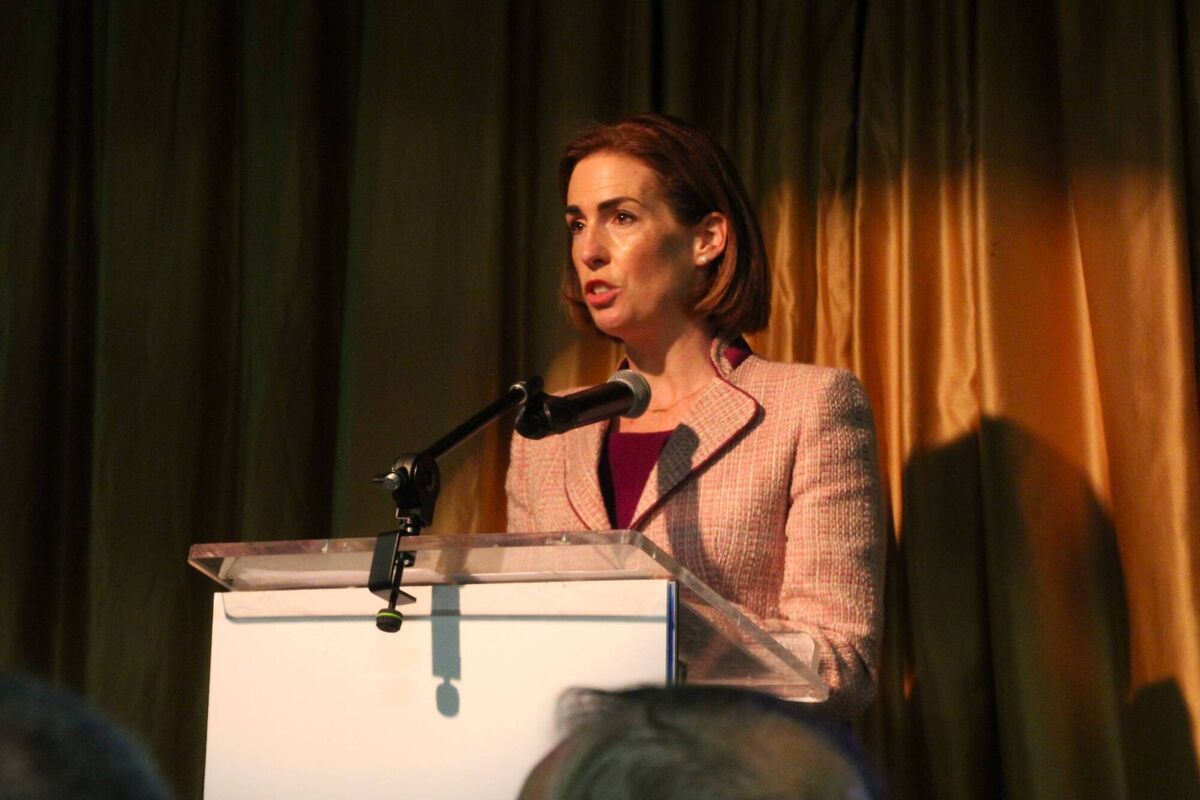
She said the Government does not have a “complete crystal ball” on the future of fuel prices and supply, but it is “planning for every contingency” and is “optimistic” regarding potential fuel shortages in the coming winter.
“I can’t pre-empt the budget, but what we’re saying is we have to make sure this sector survives,” the minister said.
The conference also heard claims that oil demand will likely increase as China recovers from the Covid pandemic, forcing fuel prices even higher.
Tony Quinn warned that in the event that fuel remains at the current historically high rates, and if Government supports don't continue, the industry will “come to a standstill” as customers will only pay so much.

Verona Murphy TD, who headed up the IRHA between 2015 and 2020, worked in the industry all her life and established her own business at the age of 21. She left the industry after being elected to the Dáil, shutting her business which had a fleet of four trucks.
“[If I were in business today] it would be very difficult without seeing almost a 100% increase in the contract price [in order to] operate viably. I think that’s where the issue is, we would have been operating on quite low profit margins.
"That’s something nobody ever considers, that the small to medium enterprise (SME) does an average of about 3%-5% profit margins. There are exceptions but they are few and far between.
“The reality of what’s happening is [SMEs] will not survive,” she said. “They cannot go to their customers and garner that exponential increase that’s required. So ultimately, they will have to consider whether they give up or go into liquidation”.
She said that profit margins in the industry never recovered after the recession in 2008, and inflation has made it near impossible for the “thriftiest.” of haulage companies to survive.
Earlier this year, the Government paid more than €15m in supports to about 3,000 haulage companies, and since March it reduced the excise duty by 20c per litre of petrol and 15c per litre of diesel.
Looking at the long-term, however, hauliers say they have other pressing problems apart from fuel.
“The driver shortage is very acute at the moment,” said Sean Murtagh, who up until two years ago ran Freightshift Nationwide for 35 years. “The office hours are longer [in the haulage industry] than similar type jobs in other sectors.”
He said there has been scarcity in the sector for the last 20 years and an influx of drivers from Eastern Europe got the industry over the last hurdle following the 2008 crash.
“But now, it’s really exacerbated because during lockdown a lot of guys left the industry and didn’t come back,” he said. “They either took the opportunity to retire early or found less taxing jobs.”
“The age profile of drivers is certainly very high, there are very few people coming into the industry unless they’re coming in through family lines or joining existing family businesses.”
The International Road Transport Union (IRU) has said the industry is a “demographic time bomb”. In a recent survey, the IRU found just 6%-7% of truckers around the world are under the age of 25, dropping to just 3% in passenger transport services. Europe has the highest average age of truck drivers at 47 years old.
“There’s not that many young people going into the business because it’s very unsocial… A lot of the Irish drivers don’t want to [go to] the continent anymore,” Mr Quinn said, and added that in his experience most drivers in Ireland nowadays tend to come from European countries such as Poland or Lithuania.
The IRU said it expects driver shortages in Europe to increase by 40% this year - meaning 14% of jobs will remain unfulfilled.
IRU secretary general Umberto de Pretto said: “Chronic commercial driver shortages are getting worse, with millions of positions remaining unfilled. This is putting already stressed economies and communities at higher risk of inflation, social mobility issues and supply chain meltdown.”
![A lot of the Irish drivers don’t want to [go to] the continent anymore. Picture: PA](/cms_media/module_img/6389/3194789_9_articleinline_2.57331409.jpg.jpg "A lot of the Irish drivers don’t want to [go to] the continent anymore. Picture: PA")
Looking around the IRHA conference at the Gleneagle Hotel Killarney, one potential solution to the shortage of truckers is blatantly obvious: women – or the lack thereof in the industry.
Last year, just 3% of truck drivers across the globe were women. The rate of female bus and coach drivers in Europe was higher than average at 12%. However, these rates are all still well below transport sector norms, especially in Europe where 22% of all transport workers are women.
Part of ongoing efforts by the Government to address driver shortages is expanding the pool of eligible drivers.
Minister Naughton told the conference the Road Safety Authority (RSA) will soon make a recommendation to her regarding truck licence exchange agreements with Argentina and North Macedonia. The RSA is also in the process of developing training for Ukrainians residing in Ireland under the EU temporary protection directive.
One of the biggest crises facing the industry is the need to decarbonise to meet its climate targets. Ireland has committed to reducing its climate emissions by 51% by 2030, which includes a 50% reduction in the transport sector.
Part of this process will require a decrease in emissions from hauliers, and although the sector is overwhelmingly on board with decarbonising, it says it is struggling to afford the transition.
“We are willing to take on our sector’s targets of emissions by 2030,” said Eugene Drennan, president of the IRHA. “We can get there, but we need the State to work with us.” However, he said a broad decision not to support fossil fuels “doesn’t work” for hauliers right now.
The word on everybody’s lips at the conference was 'Euro VI', the most carbon-efficient diesel engine on the market. A Euro VI truck emits 12 times less carbon dioxide than its predecessors in the 1990s.
Mr Quinn, whose fleet runs on Euro VI, said:
“I don’t know how much more efficient we can make them.”
But in the eyes of the State, diesel engines remain a non-renewable polluting system in need of urgent replacement if Ireland is to have any chance of hitting its 2030 targets.
“We have to rely at the moment on diesel,” Mr Quinn said, expressing doubt about the current viability of alternative fuels and electric batteries on the market today.
Hauliers insist that alternative technology or renewable fuels are not yet commercially viable, unless there is significant investment from the Government.
Mr Drennan claimed “the whole of Government depends on the Green [Party] vote”, and party leader Eamon Ryan must “face the ideology of his backbenchers” on decarbonisation and assist the hauliers in upgrading older vehicles to Euro VI trucks in the coming years.
However, amid an EU-wide effort to divest from fossil fuels, the likelihood of subsidisation towards diesel vehicles appears slim. So how close is the industry to electrifying the fleet as a potential solution? And can they do it in time to meet the country's 2030 climate targets?
“[It will be] a long time before even 10% of the fleet is electric,” said Joe Crann, managing director of Westward Scania, one of the leading importers of trucks into Ireland as part of the Swedish Scania Group.
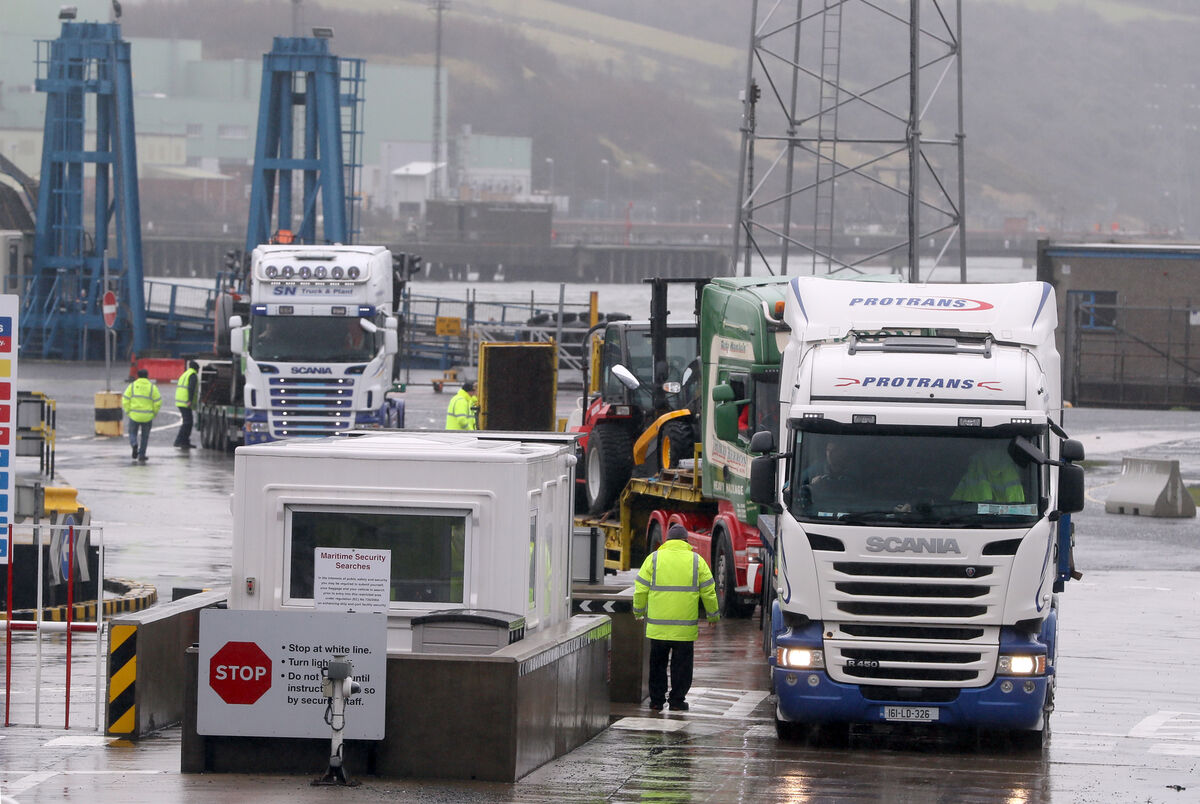
His company, which has more than 9,000 trucks on Irish roads, offers CNG gas trucks and recently launched a battery electric truck – at about twice the price of a diesel truck – but he says that “diesel is still the only show in town”.
Scania’s one all-electric vehicle can do about 250km in “ideal conditions” or as little as 200km before needing a recharge - most hauliers would do multiples of this journey in a day, he said.
“Unless a haulier really wants to be an early adopter, we would be encouraging people to wait off a little bit for the next generation [of] electric trucks coming in the next 12-24 months… Particularly because we know what’s coming is infinitely better. It’s a bit like the cars in that we’re at the very early stages of the technology.”
“We’ll be led very much by the infrastructure available [for electric],” he said. Scania and two of its competitors are working on building a charging network across Europe, but this remains in its infancy.
Another barrier to the Irish haulage industry going electric is that one of Scania’s corporate goals is to only sell to companies that have access to green electricity, something that Ireland falls behind when compared to the rest of Europe.
Scania's latest range of second-generation Euro VI trucks have 8% better fuel economy on previous models and can be run on hydrogenated vegetable oil or 100% biodiesel.
“They’re probably still the most practical options for somebody on the market,” said Joe Crann.
Haulier Paul Jackman told the conference that policies pursued by the Green Party are “extraordinarily daft” in the context of €8bn earmarked for retrofitting homes when a standard truck can burn as much fuel within a couple of weeks as a house does in a year.
Mr Jackman, who sits on the IRHA management team, called on the Government to dedicate more funding to the haulage industry in the upcoming budget to help it decarbonise.
“I considered buying an electric truck for my work in Dublin,” he explained. “There is no State-based advantage to running an electric truck versus a diesel as it stands, and the truck was four times the price of the equivalent diesel.” He said while there is a €60,000 grant to buy electric, “it still doesn’t mitigate the costs”.
Speaking at the conference, Kerry TD Michael Healy-Rae said, “it is very hard in the present climate to see hauliers investing in the massively expensive [green] vehicles, unless they know they’re going to get support and it will not attract massive taxation measures in the coming years”.
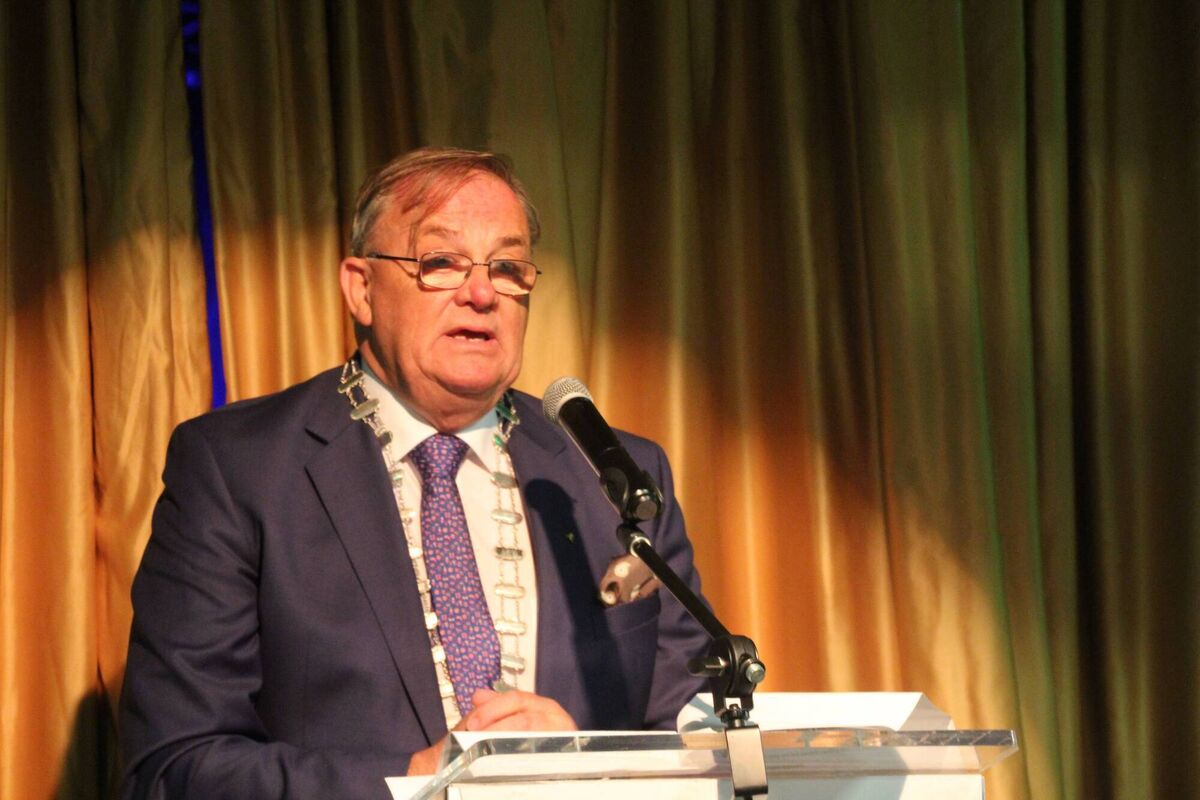
“The green agenda: while we have to do our part, we have to try and cushion the affects it will have on our hauliers,” he said. “We have to maintain the 12.5% excise reduction and the reduction on fuel has to be enshrined in law through its incorporation in the diesel rebate scheme. It is also critical to keep the 7.5c rebate in the [diesel rebate scheme]”.
He said the Government should take a “new approach” to the taxation of biofuels and remove any excise levy on non-fossil fuels.
“The reality is we need a just transition,” Verona Murphy said. “At the end of the day, all of these things come at a cost, but we can’t afford to drive into the green climate at the pace we are [and] sustain competitiveness.”
While one would assume that Brexit would dominate any gathering of hauliers — given delays at ports and custom checks — it was one of the least controversial issues behind fuels costs, driver shortages and decarbonisation.
One positive impact of Brexit, is a fall in the amount of used trucks imported by Irish hauliers from the UK due to the change in VRT rates. As a result, many hauliers are purchasing newer — and thus greener — vehicles from the continent.
Many of the hauliers were 'Brexit-prepared' and had established new, direct relationships with consumers and suppliers on the European mainland in favour of former relations with UK firms.
Customs difficulties did raise their head, but the IRHA were firm in the belief that many of the difficulties arise at the UK end, where they have little influence.
For hauliers, it’s impossible not to be apprehensive about the future. Driver shortages are on the rise and fuel prices are stifling the sector at a moment of profound change when investment is needed to decarbonise the Irish fleet.
Why would anybody enter this industry today?
“I put the doom and gloom to one side,” said Tony Quinn. “We have to be optimistic, because otherwise what do you do? It’s a very difficult time. We’ve had challenges before, and we’ve got through them. And we’ll get through this too.”
“We have to keep going. We don’t have the alternative to stop — because if we stop, we’re gone.”
CONNECT WITH US TODAY



Be the first to know the latest news and updates