Stroke Awareness Week: Rehab could be the difference between someone going back to work or not
Stroke Awareness Week: Rehab could be the difference between someone going back to work or not

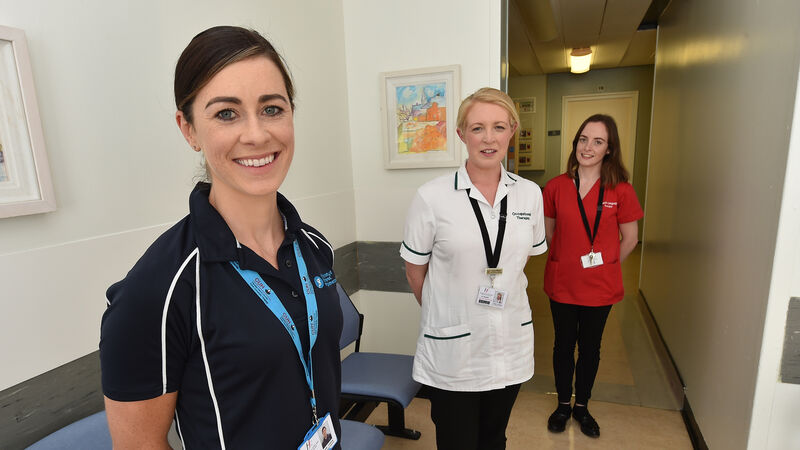
Marie Condon, Louise O’Regan and Anne Barrett members of the early support discharge for stroke team at the Cork University Hospital. Picture: Dan Linehan

Life after a stroke is helped considerably by CUH's Early Supported Discharge (ESD) team which comprises an occupational therapist, a speech and language therapist and a physiotherapist. The team, led by consultant geriatrician and neurologist, Dr Liam Healy, provides stroke rehabilitation to patients in their own homes. Despite being the busiest stroke hospital in the country, CUH has one of the smallest ESD services in Ireland.

Louise O'Regan is the occupational therapist in the team and works closely with the other therapists in contributing to the goals of the patients: "I work with people on their everyday activities, getting them back doing everything from getting up, washed and dressed in the morning to taking medication, getting out of the house to go to the shop, driving and getting back to work."

"My role is to manage difficulties around these tasks, so it can be physical difficulties as well as the psychological impact of stroke on a person trying to carry out everyday tasks."

Returning to normal depends on the severity of the stroke: "People sometimes come onto our programme only three days after their stroke, or it could be nine weeks later. With some of the milder stroke patients, we're able to facilitate or support them getting back driving or using public transport and going back to work. For someone with more severe difficulties after a stroke, we're looking at the more basic tasks."

Having a stroke can be a big blow to a person's confidence: "Mood can often be impacted and you can really see that when they get home because in a hospital environment, a person can have a high level of expectation for themselves."

Medication for difficulties with mood "would be a medical decision. We would very much be looking at the psychosocial impact we can have", says Louise.

Talk therapy "is very much under-resourced", she notes. "That can have a huge impact on patients. Even support groups for stroke survivors are quite limited. Obviously, in the context of Covid-19, it's even more challenging to access support services. There is the Cork Stroke Support Group at St Finbar's Hospital."

The ESD team's main access to psychological support is through Headway — a service for people who've had a brain injury. "There can be a waiting time to access services which makes managing the adjustment after a stroke quite challenging at times. We are lucky in that we have a good relationship with Headway."

After a stroke, patients would have a follow-up appointment with their consultant six to eight weeks after the event. They would usually be seen by their GP when they come home from hospital.

From the very beginning of helping a stroke patient to regain skills and confidence, speech and language therapist, Anne Barrett, says she and her two colleagues in the ESD team "have a shared goal".

"We very much work together to see how we can optimise the outcome for the person post-stroke and we support the patient's family, the people they live with. Staffing would always be an issue. 

We'd love to give more intensity to our patients because we know from evidence that intensive input to stroke rehabilitation results in better outcomes. It could be the difference between somebody going back to work, or not. 

"A big driver for us is to help people go back to their roles and identities, as close as they can, be it as a parent or whatever their role is."

After a stroke, a patient can have a number of communication difficulties such as slurred speech. To improve the patient's speech, practising making phone calls is one way of dealing with the problem.

While the occupational therapist and physiotherapist would look at aspects of getting to the shops such as mobility, Anne overlaps with her colleagues, with the focus on maybe asking a question while out shopping: "I'd be looking at the clarity of speech side of things."

Can afflicted speech be brought back to normal after a stroke?

"It depends on the degree of the stroke and its location. There are so many different factors. Generally speaking, we see gains and improvements. But often times, we don't know long it might take. Everyone is different. There's the person's age, their baseline and the severity of the stroke."

Families living with stroke patients can play an important role: "With visits to homes more restricted because of Covid, we adopted a blended model. We do some video calling with people who can engage that way. Families have been very helpful in supporting people post-stroke. We try to include everyone affected on the journey."

The Royal College of Speech and Language Therapists recommend that stroke patients get 45 minutes of therapy each day. "It is of course resource and staff dependent. We give three to five sessions a week."

Anne says that part of her remit is to work on swallowing difficulties as the muscle for eating, drinking and swallowing can be affected by stroke.

The ESD team's physiotherapist is Marie Condon. She makes sure her patients' mobility is ok: "I would work on the patient's walking and stair-climbing. I would see if they have the strength, the power, the balance and the co-ordination and endurance needed. Depending on what goal the patient wants, it could be about seeing if they're good enough to get on a bus and working on what physical demands are there down the line for going back to work."

To help prevent a further stroke, Marie says it is really important "to get an exercise regime going. Exercise can help control blood pressure and heart rate and it can reduce the risk of diabetes".

Patients have to be motivated to exercise. "They may have been sedentary before they had the stroke so it can be about encouraging and supporting patients to exercise. Sometimes, a stroke patient may have problems with their bowel and bladder. With nurses, we can help get continence control for the patient."

The home environment is conducive to motivation: "Patients can see a meaningful task that they want to do. They want to be independent going up and down the stairs. The research shows that people do best in their own environment. The support of the family and the therapist calling to the house is a good combination."

Marie says that during lockdown, she had to "convert to a lot of virtual sessions"

"Now as the restrictions are lifting, we are doing more home visits. 

But we definitely see that there will be a place for tele-rehab going forward. 

"I suppose it's trying to get the balance right between home visits and what can be done virtually."

Post-stroke, people can lose confidence in their physical abilities, particularly those with balance problems and a higher fall risk. "But generally, they want to get up and move and get better. A big thing is repetitive practice. It allows for motor relearning. It causes 'neuro-plasticity' — which is the brain relearning after a stroke."

The ESD team is committed to helping return patients to their best selves. The therapists work with patients from CUH, the Mercy Hospital and St Finbar's Hospital. With no dedicated inpatient rehabilitation beds in Cork for the under-65s who have suffered a stroke, the ESD team is kept busy while being under-resourced.

'I am one of the lucky ones: there is life after stroke'

Michael Lynch is proof that there is life after stroke. He has been through a terrible time yet describes himself as "one of the lucky ones with no permanent damage". 

The 67-year-old sales rep, who lives in Carrigtwohill, went into CUH in an ambulance on March 26. His partner, Nora, called the ambulance as she was very concerned about him. Michael had Covid-19 symptoms including shortness of breath. He must have been extremely ill as he was put into an induced coma once he arrived at the hospital. 

During the three weeks when he was 'out of it', he suffered two strokes and kidney failure in one of his kidneys. Altogether, he spent nine weeks in hospital.

Nora took time off work to support Michael in his recovery — a recovery that seems quite remarkable. 

Mick Lynch, who has recovered from Covid-19 and a stroke, doing exercises at home while online with a physiotherapist from CUH.

"I don't remember being in the ambulance. When I came out of the coma, I realised I was after having two strokes on both sides of my head. I had to learn to walk again. The physiotherapy started immediately. It took a while, doing exercises. My balance was the biggest problem. When I came out of hospital, I used a walking aid for a while. My walking now is quite good although I wouldn't run a marathon." 

Michael was assigned to the Early Supported Discharge (ESD) team, with expert help given to him by the physiotherapist, the speech therapist and the occupational therapist: "My speech was affected a small bit by the stroke but it came around very fast through exercises and making the right choices when trying to talk. It was done online because of Covid. 

I came out of CUH on a Thursday and I had my first physiotherapy session online the next day. It was unusual but it worked. It was intensive, one-to-one, but easy enough to follow.

Being unwell was new to Michael. He says it was about 14 years since he had been sick. When he had the strokes, Michael weighed eighteen and a half stone. He lost more than three stone and says he is reasonably fit. 

He is now part of a group of six people doing physiotherapy twice a week on Zoom: "I have to do a warm-up and a warm-down. The session is about an hour long. I walk for about half an hour every day. The exercises really help me. I have benefited from doing rehab at home. I had restricted movement in my shoulder but it's almost 100% again." 

Mick Lynch says: "The kidney is back 90%. I've been back to the kidney doctor at CUH and I don't have to go back until next March." Picture Denis Minihane.

Michael is looking ahead as opposed to focusing on the trauma he has been through. He intends to go back to work. His sales job involves a lot of driving around County Cork: "I'm back driving now three or four weeks. The doctor signed off on it. The occupational therapist organised it and I was passed to drive. I was a bit nervous the first day but now I'm fine." 

As a result of kidney failure, Michael had to go on dialysis for a while.

He says: "The kidney is back 90%. I've been back to the kidney doctor at CUH and I don't have to go back until next March."

Renal failure is a risk factor for stroke. The risk of stroke is five to 30 times higher in patients with chronic kidney disease. It raises the question — which came first for Michael, the kidney problem or the strokes? 

To try to prevent a further stroke, Michael is taking blood-thinning tablets. 

He is also on cholesterol-lowering medication: "My cholesterol had been slightly high but not drastically high." 

Asked if he has any challenges yet to overcome, Michael makes light of what he has been through and says he is doing very well. There is a gap in his memory, because of the coma. When he came out of it, he took a number of phone calls from concerned friends but says he doesn't remember some of them.

Now in much better fettle, he will continue doing physiotherapy sessions twice a week until September 22.

Clearly, Michael is choosing to focus on the positive after serious illness: "I couldn't praise the care I got enough. It was 100%. There is life after stroke, no doubt about it."

More in this section

Lunchtime News

Newsletter

Keep up with stories of the day with our lunchtime news wrap and important breaking news alerts.

Cookie Policy Privacy Policy Brand Safety FAQ Help Contact Us Terms and Conditions

© Examiner Echo Group Limited