Stroke Awareness Week: Speedy and appropriate treatment in hospital is key to recovery
If someone presents with stroke-like symptoms at CUH emergency department, they will be assessed as quickly as possible, but an off-site neuro-rehabilitation facility is needed to continue patient care, writes Áilín Quinlan
Stroke Awareness Week: Speedy and appropriate treatment in hospital is key to recovery

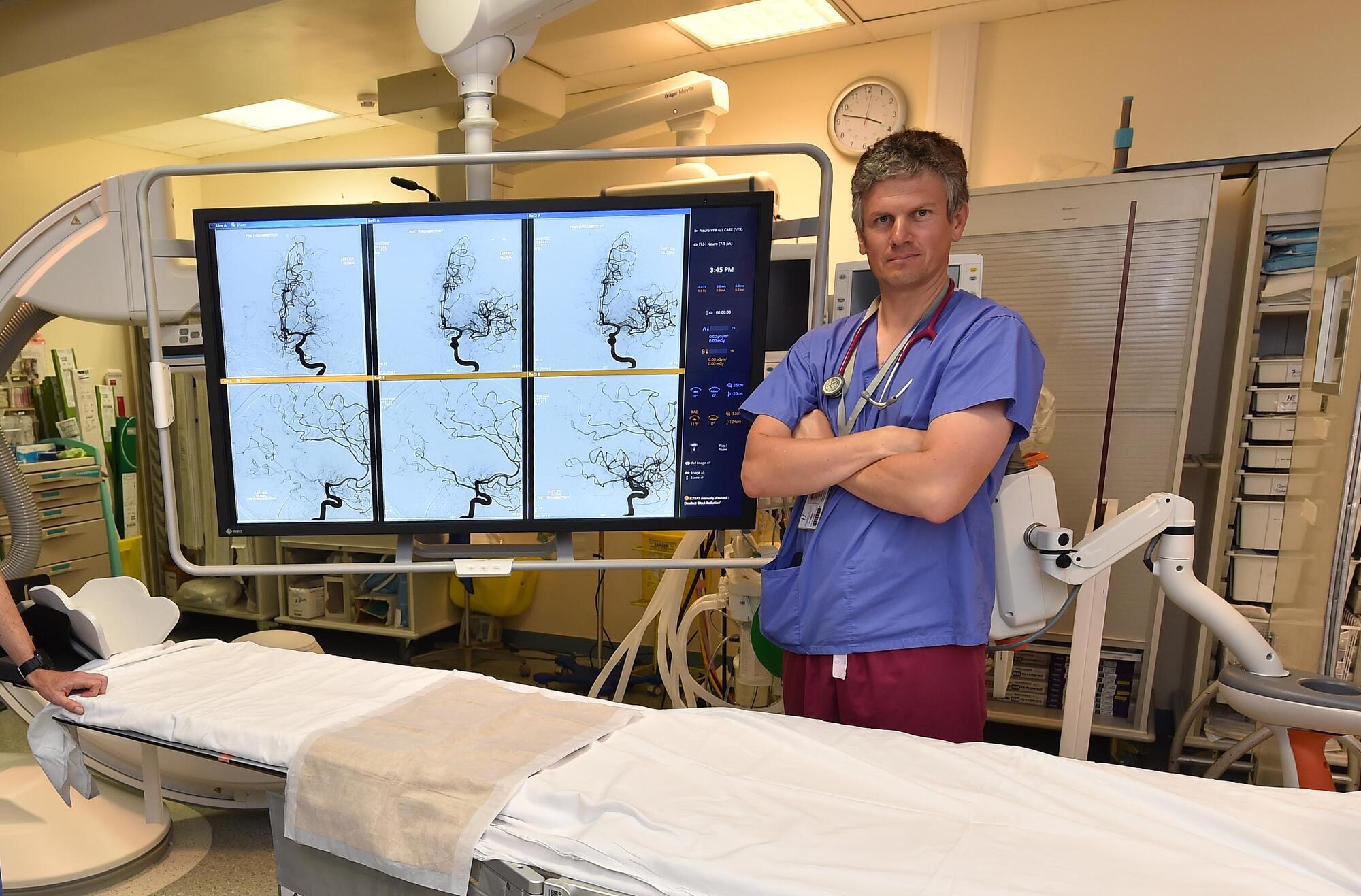
Dr Liam Healy, clinical lead for stroke services, pictured in the thrombectomy suite at the Cork University Hospital. Picture Dan Linehan

There are many initiatives aimed at diverting patients away from overstretched emergency departments — but these never apply to people with symptoms of stroke, says Liam Healy, consultant stroke physician at Cork University Hospital, who oversees the country’s busiest inpatient stroke service.

In the case of stroke, speed is of the essence, he warns. “If someone presents with stroke-like symptoms, they can be expected to be seen as quickly as possible. Stroke patients are a priority, along with other serious presentations at the emergency department.”

So if you have a stroke, don’t delay — get to the emergency department. “There are things that can be done for you if you go to hospital quickly that can’t be done if you delay in getting in hospital,” he says.

Any patient presenting with symptoms of stroke will be seen by a combination of emergency medical and stroke teams at the hospital.

“The first thing doctors will try to establish is whether you’ve had a stroke," says Dr Healy. "This includes a clinical examination and radiology imaging or scans of your brain."

“The next step is to determine whether you are suitable for acute treatment,” he says, adding that acute treatment takes two forms.

First, there is a clot-busting medicine. A drug can be administered to dissolve the clot which caused the stroke.

This is a moderately effective treatment, he observes. “It works very well in some instances — but in others, it does not help.”

The second approach is a thrombectomy. “This is where the clot causing the stroke is removed by a procedure performed by our neuro-radiology team,” he says.

A puncture is made in a blood vessel in the groin, he explains. The team inserts a device up through the blood vessels of the body to remove the clot in the brain that has caused the stroke. “This can be an extremely effective procedure and can effectively ‘cure’ someone," he says. "If patients get to hospital quickly enough, this treatment can remove all symptoms of stroke."

“A thrombectomy is most effective within six hours, but can be effective up to 24 hours. However, really you are most likely to benefit most from this procedure if you get to hospital as quickly as you can.”

Cork University Hospital is the only hospital in Munster to offer thrombectomy, he explains. The country’s other thrombectomy centre is based at Beaumont Hospital in Dublin.

 Members of the stroke team at the Cork University Hospital. Picture Dan Linehan
Members of the stroke team at the Cork University Hospital. Picture Dan Linehan

“This is an extremely specialised procedure which cannot be done in every small hospital, as you need highly specialised staff for it," he explains. "It’s not something which can be done outside of the two major neuro-science centres at CUH and Beaumont."

One of the challenges facing the service, says Dr Healy, is ensuring that structures are in place to deliver this treatment to as many patients as possible.

“We must identify people in the community quickly who are having a severe stroke and bring them to CUH as quickly as possible,” he says, adding that the CUH stroke service liaises with local hospitals to have stroke patients rapidly transferred to the CUH Stroke Unit.

“If you attend your local hospital, they can assess you, liaise with CUH and transfer you to the stroke services at CUH as quickly as possible.”

Once a patient has been assessed and or treated with each of the clot-busting methods, they are brought to the specialised Stroke Unit.

“This is a separate special ward dedicated to caring for the unique care needs of patients with stroke,” explains Dr Healy. "It is staffed by doctors and nurses and therapists with specialised stroke training."

The majority of patients in the unit are people over the age of 65, often with underlying serious medical conditions, he says, adding that these are best managed by experts in the area of geriatric medicine.

About 30% of the unit’s stroke patients would be under this age. These patients are more appropriately cared for by neurologists, he says.

Once a patient arrives at the unit, the medical team carries out a battery of tests on the heart, blood vessels, and blood to establish the cause of the stroke, while nursing staff and therapists determine the effects of the stroke on the patient.

 “The patient may experience difficulty in walking, talking, or swallowing," says Dr Healy. "He or she may not be able to go to the bathroom, and they are often paralysed down one side, so they would have very high care needs.”

Stroke, he explains, is essentially a spectrum of symptoms which range from very minor symptoms — a slight weakness in one hand, a slight disruption in speech or problems with vision and balance, all of which would necessitate a short stay on the stroke unit — through to extreme disability.

“The physiotherapist, for example, assesses your ability to move, walk or sit up; the occupational therapist will assess your ability to do everyday tasks like get dressed, wash yourself, drink from a cup, or go to the bathroom; while the speech and language therapist will assess your ability to swallow and communicate.”

Meanwhile, the unit’s medical team also work to minimise any collateral damage.

“People who are unable to communicate or move are at risk of complications," says Dr Healy. 

The thing we try to do is identify, prevent or treat further strokes, pneumonia, abnormal heart rhythms, seizures, or blood clots in the lung after a stroke. These are the main medical complications. That is best done on a stroke unit.

He adds that patients who are admitted to a stroke unit versus a general medical ward immediately after having a stroke are 20% more likely to recover.

In an effort to further improve services, the stroke unit is set to undergo a major refurbishment — this will include a new therapy suite on the ward to allow rehabilitation to begin immediately after the patient is admitted to hospital.

A family room is also necessary.

“We can have difficult conversations with patients and their relatives every day," says Dr Healy. "About one in 10 patients admitted to hospital with stroke die of their stroke — in fact, more people die on the Stroke Unit than on any other medical or surgical ward in our hospital. We need an appropriate environment to care for these people and their families.”

The third plank of the redevelopment project is the provision of a Hyper Acute Stroke Bay, which is a specialised area within the Stroke Unit with advanced monitoring systems to care for the most acute patients on the ward.

The development is estimated to cost a little under €1m, “which is a modest sum, given the number of stroke patients in the hospital,” says Dr Healy.

Rehabilitation following treatment is a crucial part of a patient’s recovery — but services here are significantly under-resourced. Although the CUH Stroke Unit has an early supported discharge team, which comprises of personnel such as a physiotherapist, occupational therapist, and speech and language therapist, it is the smallest ESD team in the country and badly needs to be expanded.

Much-needed increases in therapy staffing such as in physiotherapy and occupational therapy, would allow the unit to offer significantly more stroke rehabilitation to patients than is currently the case, he believes.

Currently, the unit lacks the services of a clinical neuropsychologist, which, Dr Healy says, helps patients deal with “what can often be a very significant change in their lives, their roles within their families and their own sense of identity".

A 10-bed Stroke Rehabilitation Unit at St Finbarrs’ Hospital in Cork, staffed by consultant geriatricians, caters for patients over the age of 65 with a higher degree of disability who require a greater amount of dedicated rehabilitation to enable them to get home again. However, he observes, there is a long waiting list for these beds.

 Dr. Liam Healy. Picture: Dan Linehan
Dr. Liam Healy. Picture: Dan Linehan

Meanwhile, there is nowhere for stroke patients under the age of 65 who need inpatient rehabilitation, and who therefore face a prolonged stay on the stroke unit in CUH. 

“We need a dedicated off-site neuro-rehabilitation facility to enable us to get these younger people out of hospital and into a suitable environment more quickly,” says Dr Healy. “A modest investment in this area would help us get people into a suitable environment, thus freeing up beds for those who need them. We have 36 people in our stroke ward at the moment, and about 16 of them would be better cared for at a suitable facility off-site.”Tomorrow: thrombectomy — a very specialised form of acute medicine that can make a considerable difference to the outcome of a stroke patient

If someone is suffering a stroke, act fast. 

If someone experiences symptoms of stroke in the community phone 999 immediately, says Liam Healy, Consultant Stroke Physician at Cork University Hospital.

“Get to hospital as quickly as possible, and by ambulance if possible,” he says.

He repeats FAST, the well-known acronym for recognising the symptoms of stroke:

F is for facial drooping, A is for arm weakness, S is for speech difficulties, and T is for Time to ring 999 (or 112).

Dr Healy, who oversees the busiest inpatient stroke service in the country, based at Cork University Hospital, warns that it is crucial that partners, spouses, relatives, or friends be aware of stroke symptoms and know what to do.

Every year about 9,000 people in Ireland have a stroke.

“Stroke is the second biggest killer worldwide,” says Dr Healy.

“One in five people will have a stroke during their lifetime. Strokes kill more people than breast cancer, bowel cancer, and lung cancer combined. People don’t realise this and it’s really important that people know just how prevalent it is.”

Case Study: 'One of my goals was to be able to cut the grass again — I'm back gardening now'

Stroke survivor Paul Manley describes his rehabilitation journey and says investment in hospital facilities is overdue

It came with no warning — when pensioner Paul Manley reached up into his kitchen cupboard to get a cup last April, he realised that his hand suddenly didn’t seem to be working properly.

“I was getting a cup out of the cupboard and I found I couldn’t control it. I couldn’t get the cup out of the press; it went flying and broke on the floor,” he recalls.

Something else happened — his mouth, he says, developed “a very slight twist". 

Paul Manley at his home in Cork. Picture: Jim Coughlan.

His wife Mary immediately realised that Paul could be having a stroke, and called for an ambulance.

“The paramedics came; they said there was a twist in my lips,” says the 71-year-old father of three adult children.

“I was brought to Cork University Hospital. I had a lot of tests in the accident and emergency department," he says.

"After that, I was admitted to a ward in the hospital.

"They carried out more tests, including an MRI of my brain. 

"Later on, the doctors told me that I had had a bleed to the right side of my brain.”

Paul stayed in hospital for three weeks. 

Members of the stroke team lost no time in starting him on a programme of rehabilitation.

“I started doing exercises with a physiotherapist," he says.

One of the exercises required him to hold a peg open with one hand — an exercise which initially posed great difficulties for  him.

He also had to do facial exercises and practise tying up buttons, dressing himself, and going to the bathroom.

“Every day in the three weeks I was there, I was brought to the gym in the hospital to go through a series of exercises; on a bicycle, walking up steps, and walking between two bars, for example," Paul says.

"At first I was very unsteady but I improved, and three weeks later I was released from hospital,” he adds.

Paul believes that more investment is required in terms of rehabilitation facilities at the hospital.

“The gym could be improved, for example. The facilities and equipment have been there for years," he says.

"There’s a lot of equipment there but it’s all a bit out-dated. 

I think more funding should be invested in rehabilitation facilities in CUH because they are so important for stroke victims. 

He says that the rehabilitation team continued to work with him after he was discharged and returned to his family home on Dublin Hill, Cork city.

“I continued to have Zoom meetings with the physiotherapist and the occupational therapist, who did exercises with me," he says.

Paul has recovered well, he says, and continues to make steady progress.

Paul Manley at his home in Cork. Picture: Jim Coughlan.

“I’m very good now, although I still have a limp in my right leg. The doctor was not sure if that would ever correct itself," he says.

"I'm happy that I have recovered so well. I’ve come a very long way. I’m able to do things again."

He hopes to build back up to his previous daily walk of about two miles — a journey he usually completed in about 40 minutes.

“My next goal is to get back to walking the two miles in about 40 minutes. I’m working towards that. It’s in my head to do it," he says.

"I’ve come a long way. People say they can’t believe that I had a stroke. 

"At the moment I’m not walking as far as I used to go before the stroke. I’m slower now; it would take me about 30 minutes to do about a mile, but I’m determined to build it back up again.

“I am a very determined person.”

It is no surprise that Paul has already achieved another goal.

“When I was in hospital the occupational therapist asked me what my goal was and I said it was to get back out in my garden," he says.

"I love gardening and being outside and I’m back gardening now.

"I’m back cutting the grass. I’m a bit slower at it, but I can do it. One of my goals was to be able to cut the grass again and I have achieved that!”

x

More in this section

Lunchtime News

Newsletter

Keep up with stories of the day with our lunchtime news wrap and important breaking news alerts.

Cookie Policy Privacy Policy Brand Safety FAQ Help Contact Us Terms and Conditions

© Examiner Echo Group Limited