Arrest of Jeffrey Donaldson came at the height of his political powers
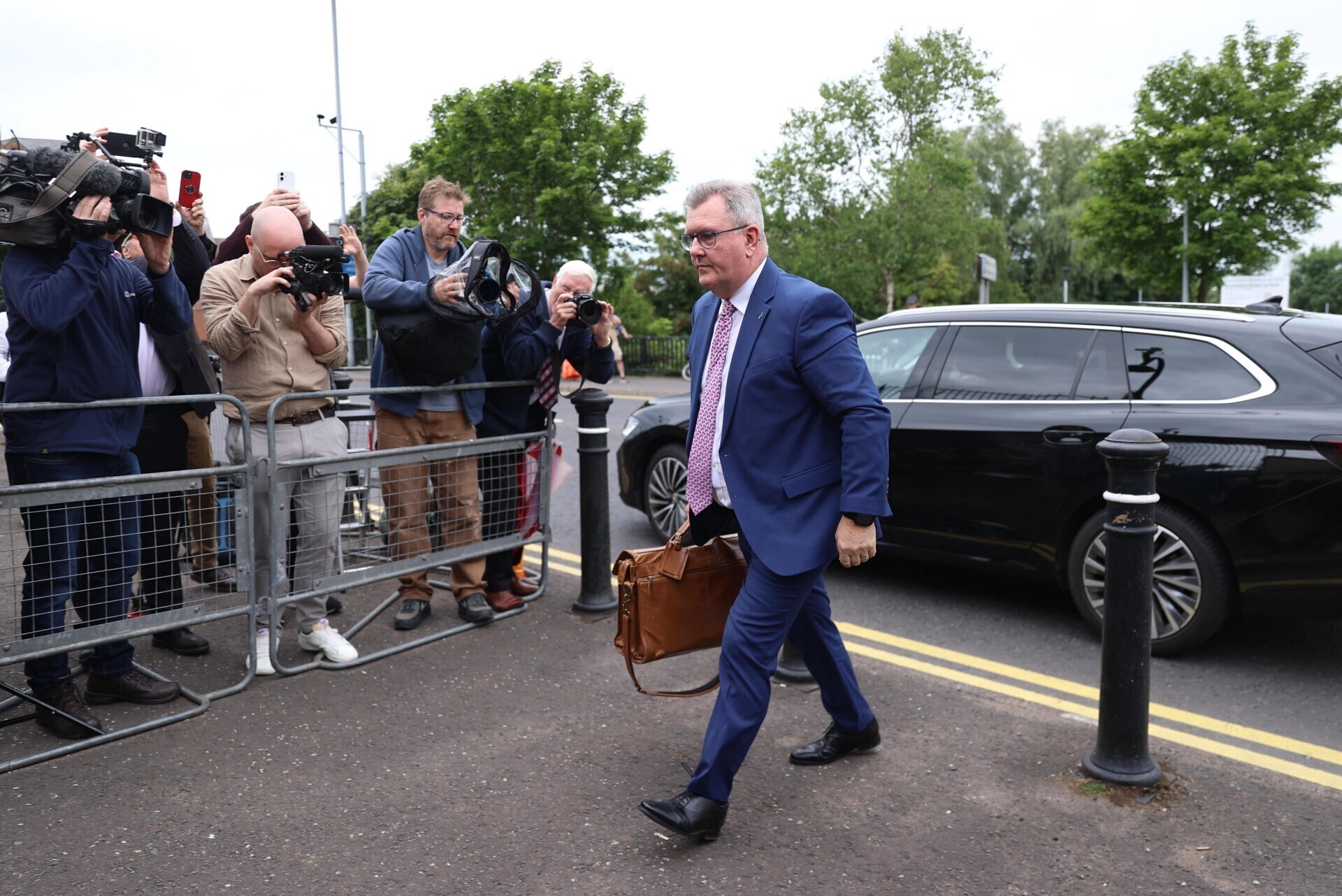
Jeffrey Donaldson arrives at Newry Crown Court on Monday, June 22. Picture: Liam McBurney/PA
Jeffrey Donaldson was at the height of his long political career when police officers knocked on his door early in the morning on March 28, 2024.
Two months previously the DUP leader had led his party back into the devolved institutions at Stormont, having struck a deal with the UK government to end his two-year boycott of powersharing in Northern Ireland in protest at post-Brexit trading arrangements.
That Donaldson felt emboldened enough to face down intense criticism from unionist rivals unconvinced of the substance of the Safeguarding the Union agreement was indicative of a politician confident in the authority he wielded.
It was arguably the zenith of his 40 years in politics. But then came the fall.
Read More
When detectives arrived at his house in Dromore, Co Down, at 6am that morning to arrest him over historical sexual offences, everything he had built across four decades in politics imploded.
Within hours he had quit as DUP leader and was suspended from the party. On Monday afternoon, he was found guilty of 18 historical sex offences against two women when they were children.
He had assumed the leadership of the DUP in 2021, after a chaotic period that saw Arlene Foster ousted in an internal revolt, only for her successor Edwin Poots to suffer a similar fate weeks after taking over.
Donaldson, who had been narrowly defeated by Poots in the first leadership contest, was returned unopposed. He was seen as a safe pair of hands who would bring stability to a party that had been rocked to its core by a summer of upheaval.
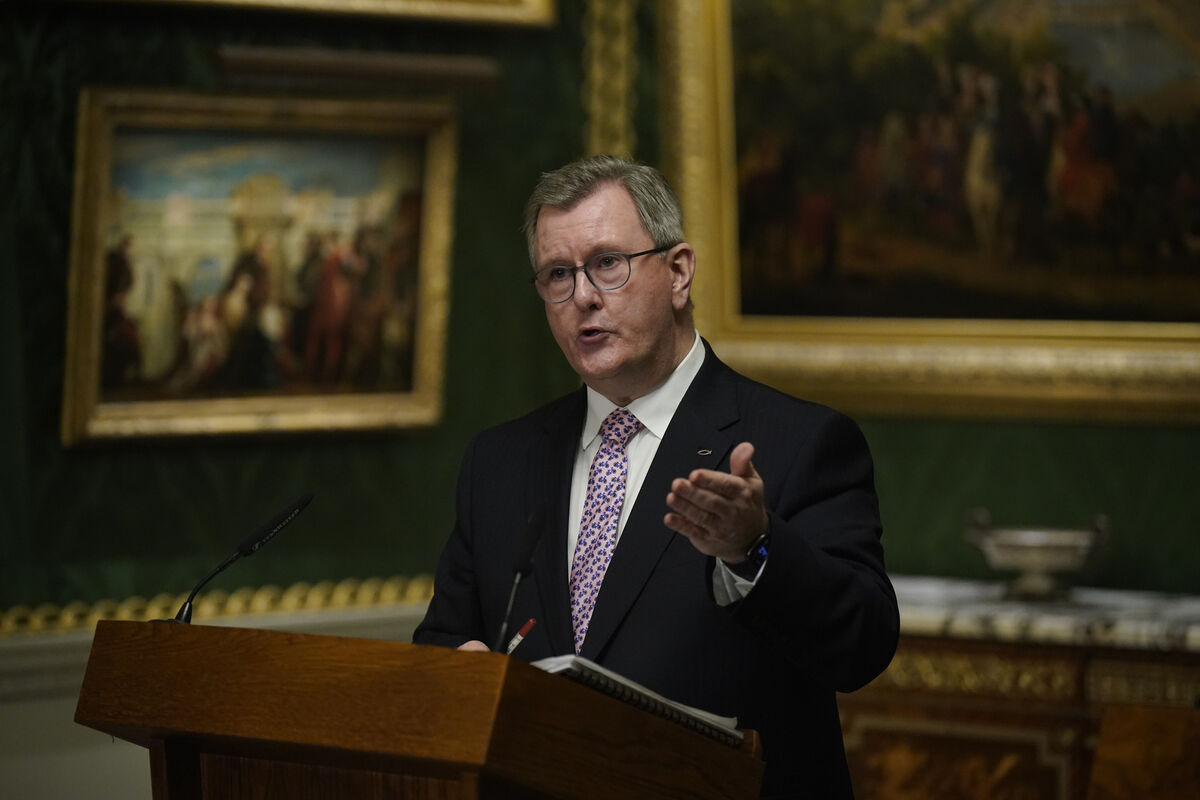
Born in Kilkeel, Co Down, Donaldson began his political career with the Ulster Unionist Party (UUP), joining in his late teens.
His policeman cousin Samuel Donaldson was murdered by the IRA during the Troubles and he often claimed that event influenced his decision to enter political life.
At the age of 16, he continued a family tradition by becoming a member of the Orange Order, and later followed in the footsteps of his late father Jim by joining the Ulster Defence Regiment (UDR).
In the early 1980s, he worked as personal assistant for former Conservative cabinet minister and then UUP MP Enoch Powell, running the veteran politician’s election campaigns.
In 1985, aged 22, he was elected to a short-lived incarnation of the Northern Ireland Assembly, becoming the youngest person to win a seat at Stormont.
He became MP for Lagan Valley in 1997 — a seat he would hold continuously until his forced exit from politics in 2024.
He was also an Assembly member for the same constituency from 2003 to 2010 and a Lisburn councillor for six years until 2011. He ultimately had to vacate the latter two roles and concentrate on his work as an MP ahead of legislation being introduced to prevent politicians from so-called “double-jobbing”.
Through the peace process in the 1990s Donaldson became an increasingly influential figure within the UUP and by 1998 — the year of the historic Good Friday Agreement — he was a senior member of the Ulster Unionists’ negotiating delegation.
He famously walked out of those talks just hours before the peace accord was struck.
The MP left Castle Buildings at Stormont in protest at what his party was about to sign up to.
He refused to back a deal that proposed the early release of paramilitary prisoners but did not include firm commitments to decommission terrorist weapons.
The former UDR soldier also had concerns about the establishment of a commission on the future of policing and the prospect of the Royal Ulster Constabulary (RUC) being disbanded.
His relationship with then UUP leader David Trimble began to crumble from that point on.
Arlene Foster was also in the UUP at the time and the pair became prominent members of a tightknit, hardline faction within the UUP that opposed the Good Friday Agreement and questioned the direction of Mr Trimble’s leadership.
In late 2003 they sensationally quit the party and weeks later defected to the DUP.
Although Donaldson was more experienced and higher profile than Ms Foster when they joined the ranks of the DUP, she would go on to eclipse him in terms of influence in the two decades that followed.
Donaldson did assume a senior role with the party — and his thinking factored into many of its key strategic decisions — but being based at Westminster sometimes saw him cast as a peripheral figure who was detached from the cut and thrust of devolved politics back at Stormont.
He did serve a brief stint as a junior minister at Stormont the year before his tenure as an MLA was cut short due to the looming double-jobbing law.
Ms Foster, by contrast, operated at the heart of devolved government in Northern Ireland across that period, taking on a range of ministerial roles before ultimately assuming the party leadership and becoming Northern Ireland’s First Minister.
Donaldson was appointed to the privy council in 2007 and was recognised by the late queen in her 2016 birthday honours and given a knighthood In 2009, he was caught up in the parliamentary expenses scandal and apologised for claiming for pay-to-view films during hotel stays in London.
He denied the films were adult in nature, insisting he paid to watch movies like and .
Nevertheless, Donaldson repaid around £600, acknowledging he was wrong to submit the claims.
One occasion that did see him handed a leading part was in the post-general election shakedown of 2017 when prime minister Theresa May found herself in need of the DUP’s support to form a government.
As the party chief whip at Westminster, he was heavily involved in negotiations that led to the DUP/Conservative confidence and supply agreement and, when it came to announcing the deal, it was him and his Conservative counterpart Gavin Williamson who signed on the dotted line and shook hands for the cameras while Ms Foster and Ms May watched on.
There was no inevitability about him ever taking on the leadership of the DUP, and prior to Ms Foster’s dramatic downfall in summer 2021 there was a sense that any chance of him landing the top job had passed.
That was underscored when he lost out to Mr Poots in the first leadership race.
It would later emerge that following that defeat he held a secret meeting with then Ulster Unionist leader Doug Beattie, allegedly to scope out the potential of returning to the UUP fold. Donaldson would deny that was the purpose of the discussion.
The encounter with Mr Beattie proved immaterial, as events in the DUP leadership saga soon took another unexpected twist when Mr Poots was forced to resign after only 21 days in charge.
Donaldson was handed a second chance to lead the party he was allegedly thinking of quitting only days earlier.
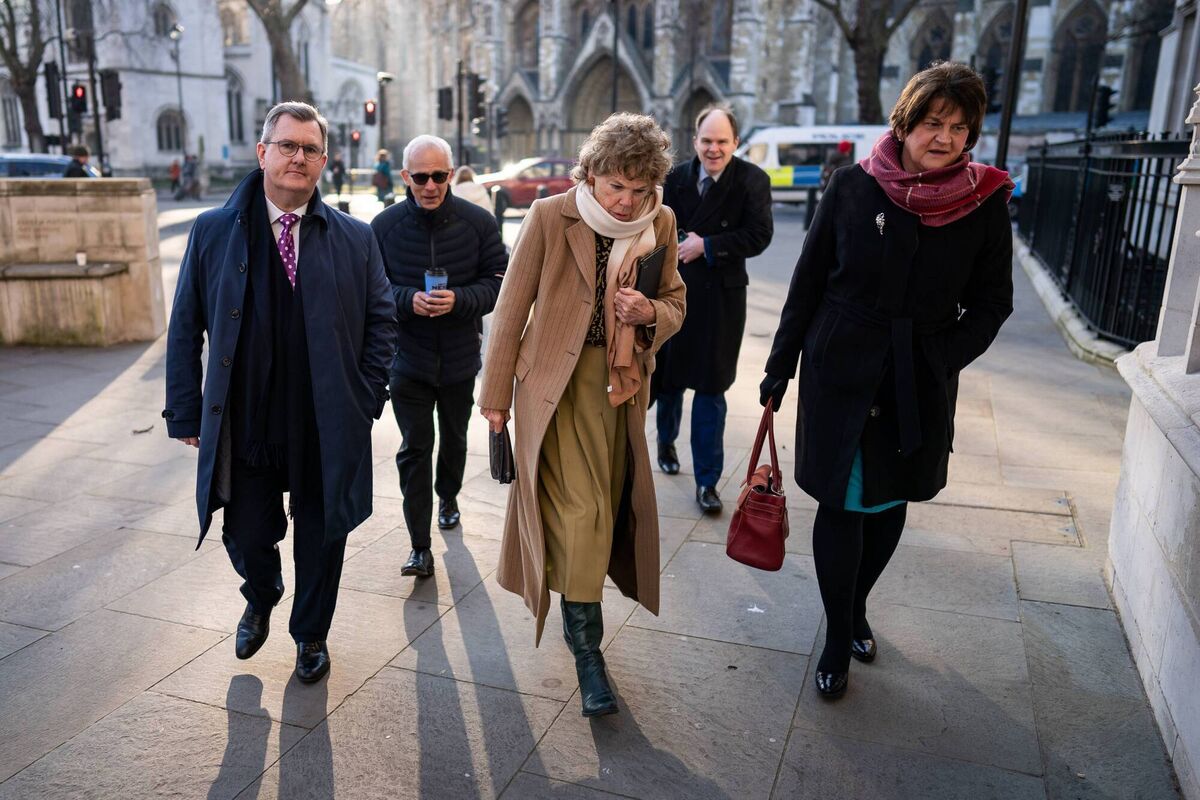
He took the reins amid the protracted tumult over Brexit’s Irish Sea border and intensifying unionist anger at checks and inspections introduced on goods moving from Britain into the North.
In February the following year, Donaldson pulled DUP First Minister Paul Givan out of the executive, effectively collapsing the powersharing institutions. The bold move was designed to heap pressure on the UK government to take steps to cut post-Brexit red tape.
The stand-off would last for two years before Donaldson finally decided he had secured enough concessions from the Government to allow his party to return to Stormont.
It was a high-risk play but one he appeared to have pulled off.
He adopted an energetic approach to selling the deal to the public, making various confident claims about the significance of the measures he had extracted from No 10. They were claims that the party would later concede had been oversold.
Nevertheless, as Easter approached in 2024, Donaldson seemed to have achieved his objective. The DUP had returned to government without any notable revolt from the party grassroots.
He position as leader was secure, having taken the biggest gamble of his political career.
All that would change, and change in an instance, when the door knock came at 6am on Thursday, March 28, 2024.

CONNECT WITH US TODAY



Be the first to know the latest news and updates