German minister calls during Irish visit for co-operation on extremist threat
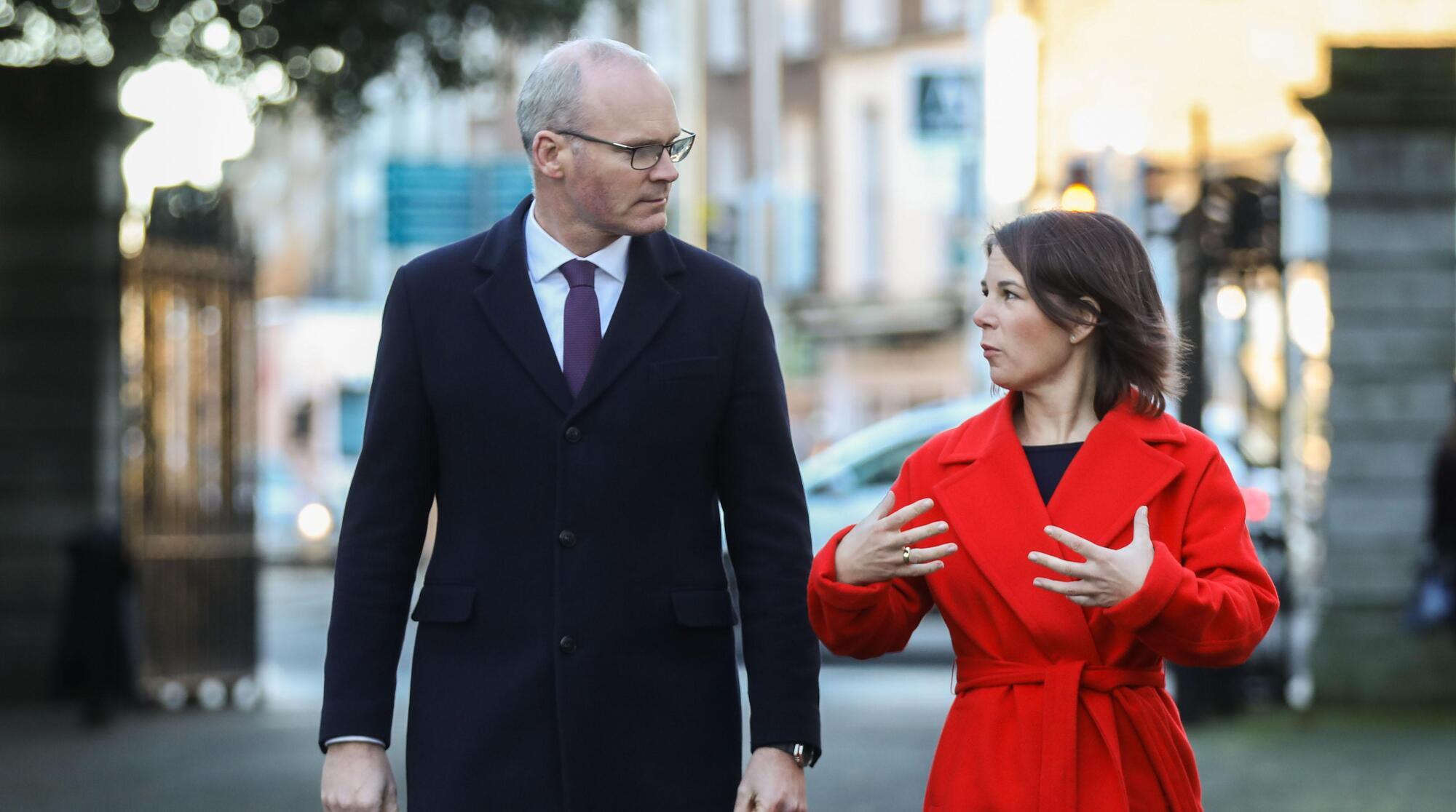
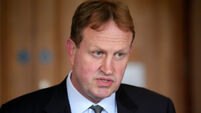
Simon Coveney and German foreign minister Annalena Baerbock today in Dublin, where they discussed Brexit, Iran, and the war in Ukraine. Pictures: Leah Farrell/RollingNews.ie
European leaders need to co-operate to fight off right-wing extremism.
That is according to Annalena Baerbock, the German foreign minister, who met her Irish counterpart Simon Coveney today in Dublin, where the two discussed Brexit, Iran, and the war in Ukraine.
Both ministers were asked about an operation yesterday in which German authorities arrested 25 people in connection to a coup to overthrow the government.
Mr Coveney said leaders need to be transparent with the public in order to avoid conspiracy theories spreading.
“I think Ireland has been somewhat fortunate not to have had the same challenge as some other countries in the European Union, in terms of the rise of far-right movements," he said.
"That doesn't mean it doesn't exist here. It does. But the numbers are far smaller.”
Mr Coveney said any political movements or parties linked to the far-right in Ireland have not yet got any traction at election time.
He warned, however, that they will try to use vulnerabilities in order to gain traction, often linked to migration and to different cultures, in order to advance their cause.
“We work not only as politicians around a Cabinet table but also within the communities to make sure people understand why solidarity is important at this time in Ireland and we don’t allow resentment to build or gain any traction. Ireland prides itself actually on not having a far-right movement,” he told reporters.
Mr Coveney also said he has faith in German democracy.
“And I have a lot of faith in the current chair of the German government to manage the sensitivities and the security issues that they have dealt with yesterday,” he said.
Ms Baerbock said European leaders have also focused on fighting right-wing extremism and that EU-wide co-operation is needed in that regard, especially in a digitised world.
“When you look to the way in which people network across the internet, so we have to watch closely what's happening. And this is why we are also engaging here with our Irish counterparts," she said.
"Earlier today, we briefly touched upon this talk. We will continue to talk about this because Ireland too is tackling this threat with regard to politicians being threatened. Unfortunately, here too, these events occur,” she said.
On Brexit, Ms Baerbrock said the impact of the British decision to leave the EU is most keenly felt in Ireland and she insisted that the integrity of the EU single market as agreed in the Northern Ireland protocol must be upheld.
She said her message to the British when she travels to London will be that the “window of opportunity” which has emerged following discussions with James Cleverly must be used to ensure a successful outcome.

The European Union is likely to expand sanctions against Iran at a meeting of its Foreign Affairs Council on Monday, Mr Coveney also said.
“I think we will see the EU taking strong and unified action, expanding sanctions to more people, more entities,” he said following his talks with Ms Baerbock, who travels to London tomorrow for talks with the British government.
Mr Coveney said the Irish-German relationship has never been stronger.
“It hasn't happened by accident. It's because as countries we've worked together through various different challenges in recent decades," he said.
"We've also formalised the structure and co-operation; we've taken a joint action plan. And we've implemented it over the last number of years,” he said.