Government pledges €300m for defence and anti-drone technology after Zelenskyy visit

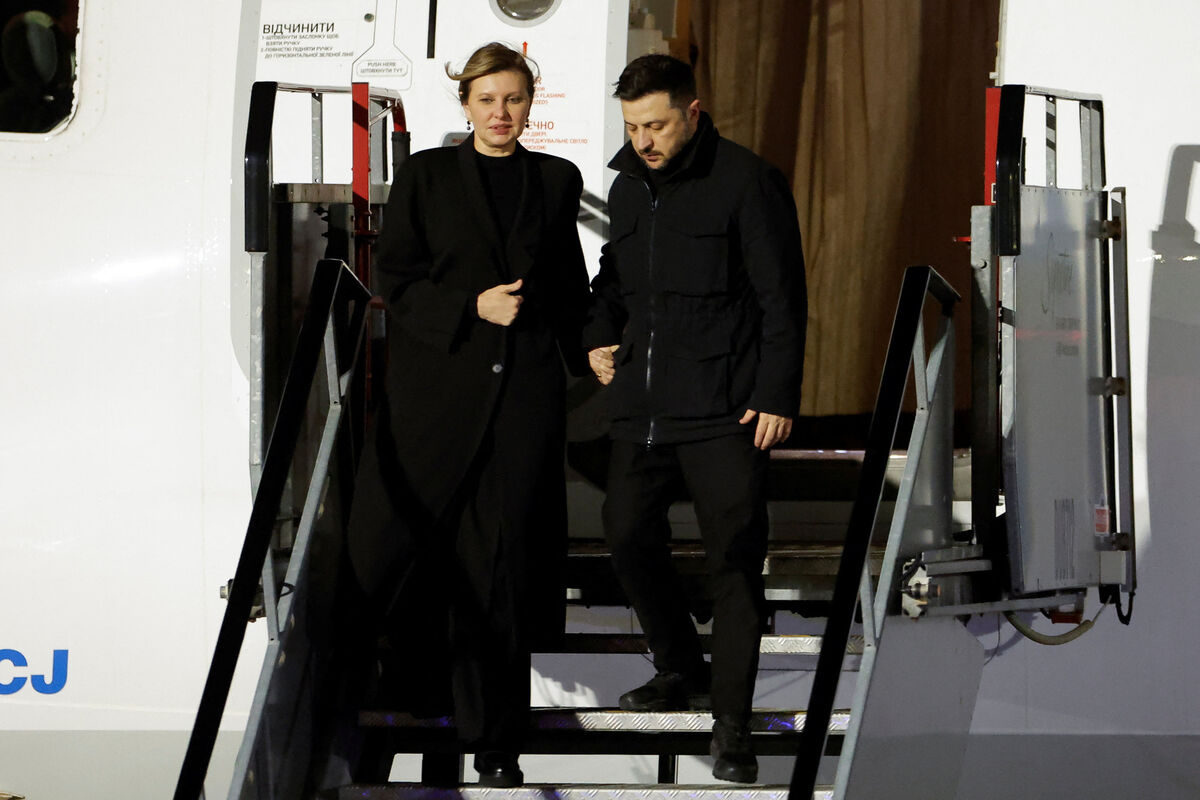
Taoiseach Micheál Martin with Ukrainian first lady Olena Zelenska and president Volodymyr Zelenskyy at Dublin Airport on Monday. The revelation that drones may have targeted Mr Zelenskyy's flight added impetus to calls to step up security measures. Picture: Liam McBurney/PA
The Government will inject €300m into defence equipment and infrastructure such as anti-drone technology next year, amid increasing concerns about defence capabilities following the visit to Ireland of Ukrainian president Volodymyr Zelenskyy.
At least €15m will be spent on anti-drone technology, as justice minister Jim O’Callaghan said devices spotted operating near the flight path of Mr Zelenskyy were deployed to put “pressure” on Europe and Ukraine.
Gardaí are investigating reports that an Irish naval ship spotted up to five drones operating near the flightpath of the Ukrainian president’s plane last Monday.
As pressure grows to beef up security capabilities ahead of the EU presidency next year, foreign affairs minister Helen McEntee will brief her Cabinet colleagues on details of the revised National Development Plan allocation for the Department of Defence.
Some €1.7bn will be spent on defence equipment and infrastructure up to 2030, including investment worth €300m next year.
In Brussels on Monday, Mr O’Callaghan said Mr Zelenskyy’s visit had been a success but confirmed further investment in drone technology would be forthcoming.
“It certainly wasn’t the back garden drone enthusiast,” he said.
“The gardaí did a very good job in terms of ensuring that security was at a very high and effective level.
“There’s an investigation ongoing in respect of the presence of drones out in Dublin Bay.
"But, more importantly, I know that the gardaí have very good anti-drone technology, and we’re going to be spending more in terms of defence, in terms of seeking to combat drone technology.”
Mr O’Callaghan said more money would be spent on this anti-drone technology ahead of Ireland’s presidency of the EU in the second half of next year.
Taoiseach Micheál Martin, meanwhile, said it was “not a surprise” that drones were spotted during Mr Zelenskyy’s visit, noting that there has been a “pattern” emerging over recent months, including incursions in the UK, France, Denmark, and Belgium.
He said he would be receiving a report on the drone incident, with a meeting of the National Security Council due to take place shortly.
However, Mr Martin conceded that increased investment would be required ahead of the EU presidency, including cybersecurity and radar.
“We understand the challenges, no more than any other member of the European Union who has had to deal with this,” he said.
Meanwhile, the EU’s law enforcement agency, Europol, has warned of increasing use of drones and robots by criminal organisations and terrorists.
Recent wars including Russia’s invasion of Ukraine sparked innovation in unmanned systems such as drones, advancements which are being capitalised on by criminal organisations and terrorists, the agency states in a report.
European police forces may need to develop their own ‘robocops’ to fight technology-enabled crime, it says.
There has been a reported increase in drone use around European infrastructure, especially airports, and there are examples of drone pilots selling their services online, transforming this criminal process from crime-as-a-service to crime-at-a-distance, Europol’s Unmanned Future(s) report found.
Drones and robots are already being used in law enforcement for surveillance, to access dangerous areas, in search and rescue, to efficiently map a crime scene, for bomb disposal, and handling hazardous material.
however, the adoption of unmanned technologies in law enforcement is being hampered by limited suppliers, the report found.
It says criminals increasingly use drone and robotic technology to smuggle drugs in unmanned, submarine-type boats and in aerial drones.
Drones may also be used increasingly by criminals and terrorists to gather vital intelligence undetected.
Technologies such as 3D printers are making them cheaper and easier to produce and modify.
And, as AI (artificial intelligence) and sensor technology develop, their integration will enable robots to navigate and interact with their environment more effectively, with some amphibious drones being able to move from the water to the air seamlessly.

CONNECT WITH US TODAY



Be the first to know the latest news and updates