Cork Airport security alert and Dublin flight diversion part of wave of European bomb threats
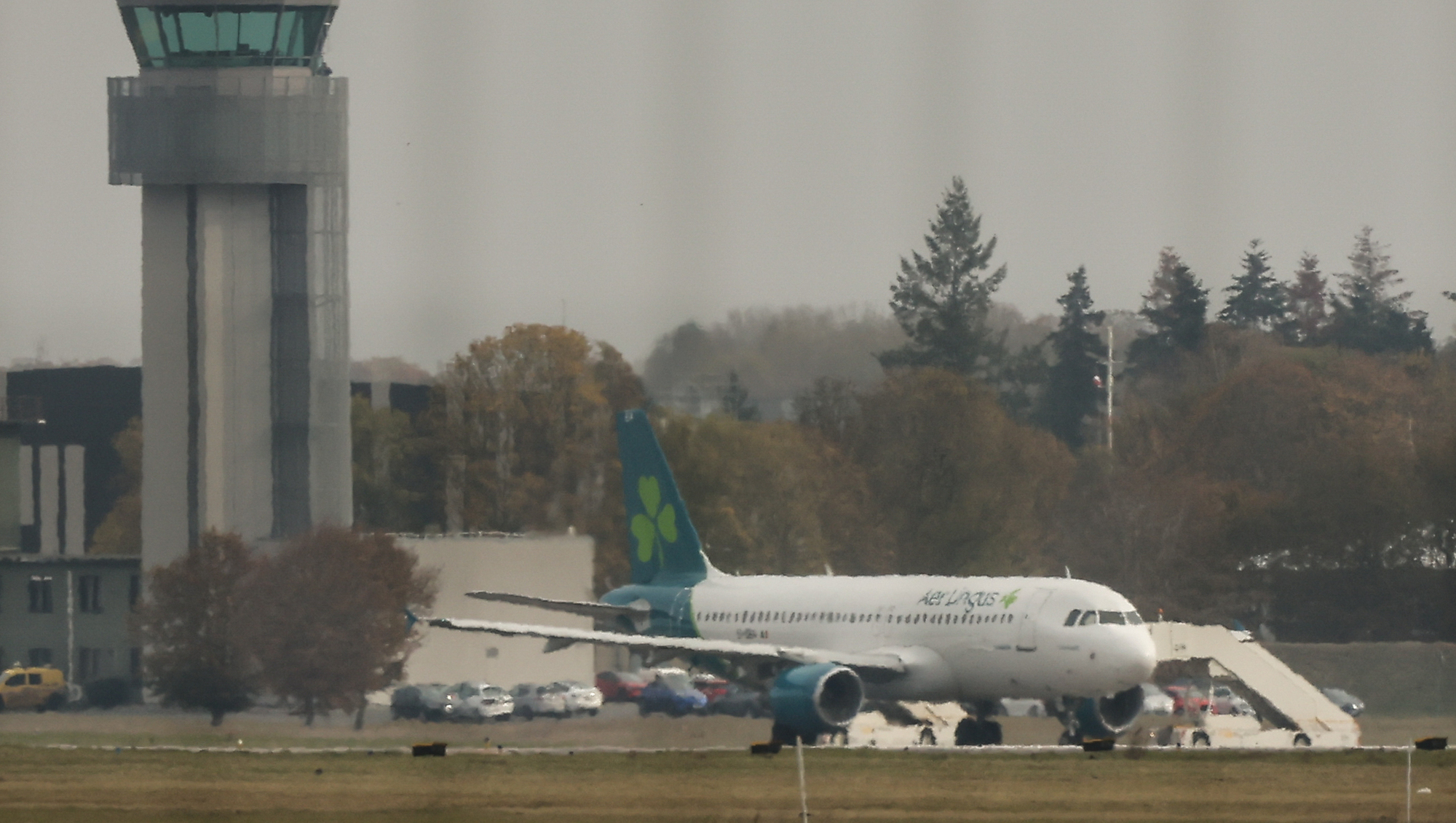
An Aer Lingus Airbus A320 aircraft is seen at Evreux military air base after a flight from Dublin to Rome was diverted to France amid reports of bomb threats targeting multiple flights across Europe, in Evreux, France, Thursday, Nov. 5, 2026. (AP Photo/Thomas Padilla)
Cork Airport received an anonymous phone threat on Thursday morning as a wave of bomb alerts affecting flights across Europe prompted additional security measures, delays and diversions.
The threat related to a specific flight and led to extra security measures being introduced in conjunction with An Garda Síochána.
A Cork Airport spokesperson told the that no issues were identified and the flight resumed operations following a 90-minute delay.
“The incident has been fully stood down,” the spokesperson said.
An Aer Lingus flight from Dublin to Rome was also diverted to France following a bomb threat.
Flight EI402 departed Dublin at 6.25am and landed safely at Évreux airport, a French military base in Normandy, at approximately 10.35am.
It is understood that 151 passengers and six crew members were on board, with a bomb squad carrying out an inspection of the Airbus A320.
An Aer Lingus spokesperson said the aircraft was diverted “as a security precaution”.
“The flight landed safely, and Aer Lingus will work to reaccommodate customers to their final destination as soon as possible,” they said.
Read More
A listener to Newstalk's , identified as Ruairi, said a friend travelling on the flight with his family had sent photographs of French fighter jets escorting the aircraft.
“He was sending us through a group message to some of our friends, some photos of Air Force jets flying beside the plane,” he said.
He added that passengers had been asked to remain on board while waiting for the bomb squad, but that everyone appeared “fine and calm”.
Shannon Airport also acknowledged the security alerts across Europe, with a spokesperson for The Shannon Airport Group praising the response of aviation and security authorities.
At least 25 flights were affected by bomb threats across Europe on Thursday, with some aircraft making unplanned landings or being escorted by fighter jets.
The alerts affected services to and from Milan, Rome, Paris, Prague, Sofia, Brussels and Vienna, with airlines including Ryanair, Wizz Air, LOT Polish Airlines, Finnair, EasyJet and Iberia among those targeted.
Bulgaria's air force escorted three aircraft to the ground following threats against Ryanair flights bound for Sofia from Copenhagen, Madrid and London. The London flight was diverted to Plovdiv, while the other two landed as planned. No suspicious items were found during subsequent inspections.
In Spain, authorities received three emailed bomb threats in less than 20 minutes, involving flights operated by Air Europa and Iberia. Some aircraft were held on the ground and passengers disembarked while security checks were carried out.
Czech police said threats against four flights arriving in Prague were considered to have low credibility. The aircraft landed safely and inspections found no explosives.
Other affected services included Finnair flights from Helsinki to Rome and Vienna, a Wizz Air flight from Milan to Bucharest, and a LOT Polish Airlines service from Warsaw to Brussels. A LOT flight bound for Paris was also stopped while taxiing at Warsaw airport as a precaution.
No explosives or dangerous devices were reported to have been found in the inspections.
The latest alerts follow a similar wave of threats on Tuesday, when at least seven flights and a cruise ship were targeted, causing disruption at airports across Europe.
The incidents have prompted questions about whether the threats could form part of a wider campaign of disruption. Several European governments have previously accused Russia of carrying out sabotage and so-called hybrid attacks, although no country has attributed responsibility for Thursday's threats.
Eric Schouten, head of aviation security group Dyami, said the possibility of hybrid warfare should be considered, pointing to alleged disruption affecting transport, supermarkets, blood banks and other essential services.
Eliran Almog, chief executive of aviation cybersecurity firm Cyviation, said repeated aviation threats could be intended not only to disrupt operations but also to observe how airlines, airports and national authorities respond.
“These aviation threats are also occurring in the same period as cyberattacks on supermarket refrigeration systems across Europe,” he said.
“Different essential services are experiencing disruption that carries economic costs and can undermine public confidence.”
European Union transport commissioner Apostolos Tzitzikostas said it was too early to establish whether the reported incidents were connected, but stressed that threats against civilians were unacceptable.

CONNECT WITH US TODAY



Be the first to know the latest news and updates