'Relocation of some communities' urged due to rising sea levels
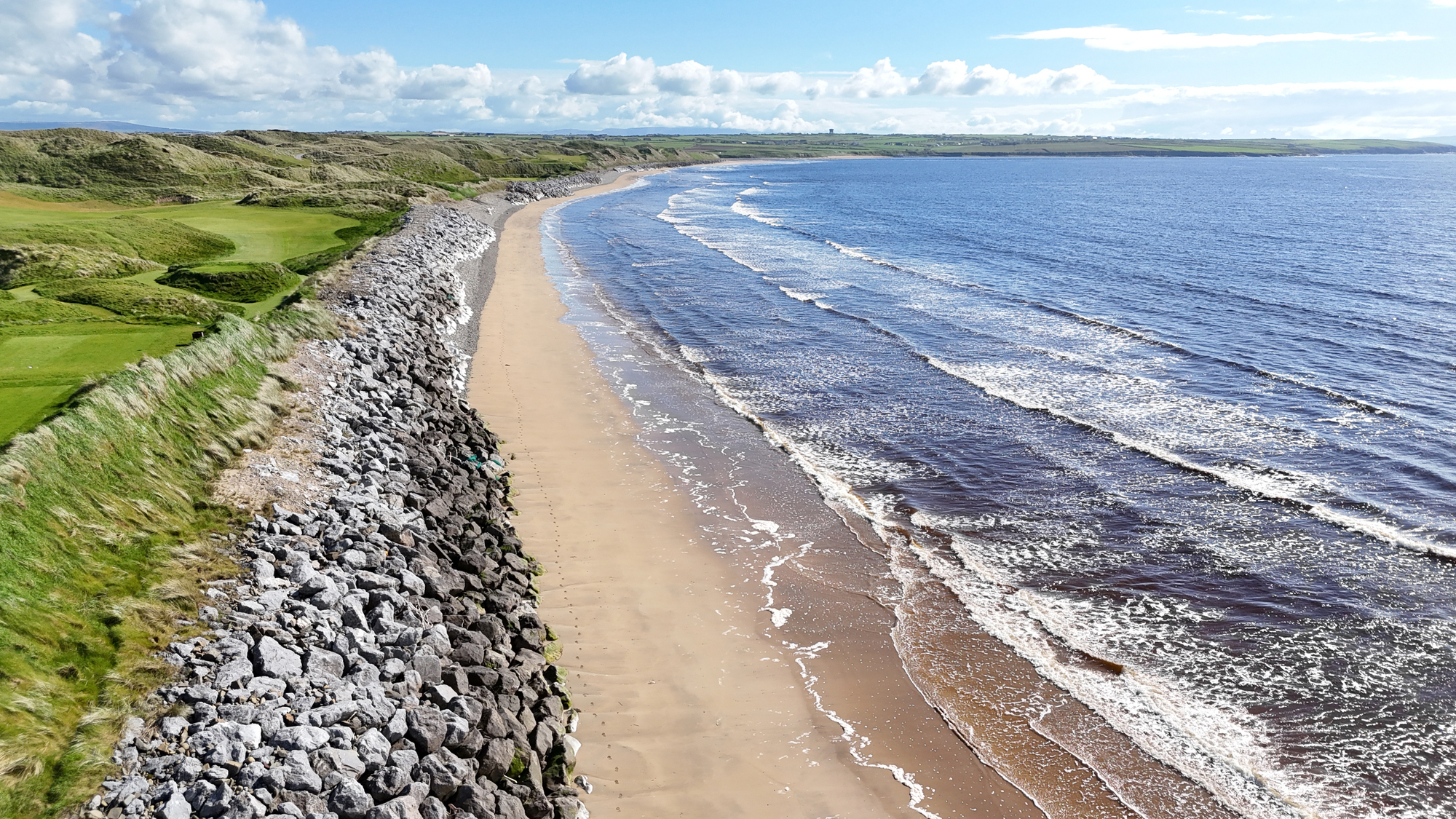
The seaside golf course at Ballybunion Golf Club added rock armour to stabilise dunes and slow the erosion by the sea. File picture: Larry Cummins
A national coastal management plan, including relocation schemes, is needed to protect future generations from rising sea levels, a climate expert has warned.
A report by the Climate Change Advisory Council found coastal erosion is already affecting coastlines, putting ancient forts and properties in the south and south-east at particular risk.
Residents in Rosslare reported worsening erosion in April, pointing to storms such as Bram and Chandra accelerating the loss of beaches and dunes. They raised fears that some properties may not survive another winter.
The report also found that coastal erosion is threatening hundreds of ancient forts, including sites on the Copper Coast in Waterford.
Read More
Peter Thorne, chair of the council’s climate adaptation committee, warned that coastal flooding would become a growing problem and “condemn future generations”.
“If we don’t get our act together, we could see tens of metres of sea-level rise — well after reaching net zero. This is not in my lifetime or yours, but it is what we will be condemning future generations to deal with,” he told the .
Mr Thorne said a 10m rise in sea levels would affect not only soft-sediment shorelines, mainly in the south-east and east, but major cities.
“You cannot protect any of our substantial cities — Dublin, Cork, Galway, or Waterford — in that scenario," he said.
“It is not a future that you and I will have to worry about, but it is one we are bequeathing to future generations."
Mr Thorne reiterated the council’s call for a “proactive approach to planned relocation” to identify vulnerable properties.
“We cannot protect every inch of coastline, particularly soft-sediment areas such as sandy beaches and clay cliffs. They have never been stable,” Mr Thorne said.
“It is hubris to pretend that, because we are human, we can simply say the coast must remain unchanged forever. It would be impossible.
“We need a coastal management plan and must stop allowing homes to be built in harm’s way. We also need to manage the relocation of some communities, particularly as sea levels could rise by one to two metres within two or three generations.
“That will be a huge challenge."
Mr Thorne said the Government could follow the approach taken with “the handful of properties” affected by Dublin’s MetroLink and relocate residents somewhere “safe and secure”.
He said the alternative was “spending tens of millions” protecting one stretch of coastline, only to create larger problems elsewhere and incur further costs.
“We’re better off saying, ‘Sorry, we cannot protect everything. We will compensate you generously and let the property go.’ In a sane world, that is what you would do,” he added.
The report also found that properties facing repeated flood or coastal erosion risks often experience rising insurance premiums, excess payments, restricted cover, or withdrawal of insurance altogether.
“In Ireland, 5% of buildings, or around one in 20 properties, have limited access to flood insurance, with over half of this protection gap concentrated in Co Dublin, Cork, Louth, Clare, and Kildare,” states the report.
CLIMATE & SUSTAINABILITY HUB
CONNECT WITH US TODAY



Be the first to know the latest news and updates