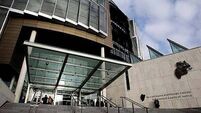
Court seeks radicalisation report on jihadist who stabbed garda and set fire to Conor McGregor pub

Special Criminal Court has previously heard Khan shouted 'Alluha Akbar' ('God is Great') when he attacked two gardaí from behind as they walked along a street in Dublin city centre on July 29, 2025.
A special report on addressing the radicalisation of a jihadist who stabbed a garda and set fire to a Conor McGregor pub is being sought by a court before handing down its sentence.
The Special Criminal Court said the case of Abdullah Khan “clearly required significant post-release supervision” and adjourned sentencing until a detailed assessment was carried out to “address the issue of radicalisation”.
Khan, aged 24, is the first person in Ireland to be convicted of an Islamist attack under the Terrorism Offences Act 2005.
The Special Criminal Court has previously heard Khan shouted “Alluha Akbar” (“God is Great”) when he attacked two gardaí from behind as they walked along a street in Dublin city centre on July 29, 2025.
Detective Inspector Gavin Ross of the Special Detective Unit said Khan described himself as a “Salafi jihadi’, explaining Salafism is a puritanical interpretation of Islam and a significant part of the ideology of Isis, the terrorist network also known as ‘Islamic State’.
Khan, who had pleaded guilty to assault causing harm to Garda Gary Lynch, to terrorist offences and to arson of McGregor’s pub, was due to be sentenced on Monday.
But Ms Justice Karen O’Connor, presiding over the three-judge court, said the case “clearly required significant post-release supervision” and they were seeking a “comprehensive structured report” from the Probation Service before handing down sentence.
She said this would comprise a “risk assessment” and how to “address the issue of radicalisation”, which she said was referenced in detail in evidence to the court and in a report by Professor Paul Gill, an expert on radicalisation and terrorism attached to the University of London.
Ms Justice O’Connor said Mr Gill’s report was part of the book of evidence, which will be supplied to the Probation Service to assist in its work.
She said the court was putting the case back, for mention, to July 13.
Gerardine Small SC, prosecuting, informed the court Garda Lynch was in court. Ms Justice O’Connor said she was “grateful” to Mr Lynch for attending and apologised that the court was not in a position to hand down sentencing.
She added if the Probation Service was in a position to finalise is report in the coming months, the court may be able to give its sentence before the end of the current court term.
In Britain, probation reports are often carried out to assess the radicalisation of terror suspects and convicted offenders and assist courts in determining sentencing, including what period of post-release supervision should be provided and what that supervision might entail in terms of dealing with radicalisation.
Previously, Det Insp Ross told the court Khan started radicalising in his late teens and became a follower online of Abu Musab al-Zarqawi, founder of Isis, who had been killed in 2006.


CONNECT WITH US TODAY



Be the first to know the latest news and updates