Notorious killer Graham Dwyer sees his last hope for freedom extinguished
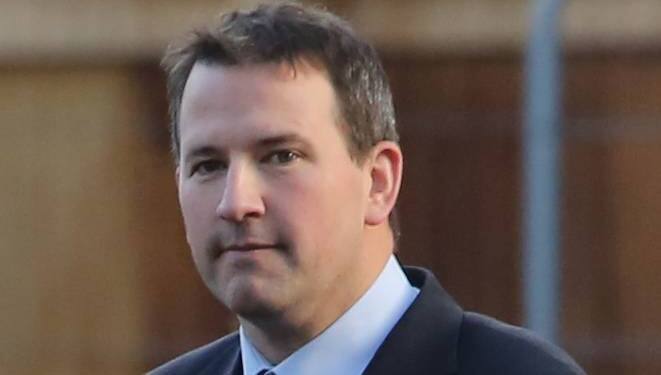
Graham Dwyer is serving a life sentence after he was convicted at the Central Criminal Court in 2015 of the murder of Elaine O’Hara. File picture
Almost from the moment he was sent to Midlands Prison in 2015 for the horrific murder of Elaine O’Hara, one of Ireland’s most notorious killers had been working diligently to overturn that conviction.
The decision on Wednesday by the Supreme Court to deny 51-year-old architect Graham Dwyer’s final appeal against that conviction saw a truly dangerous man finally run out of road, and belatedly brought closure to a crime that shocked the nation.
The conviction of Dwyer for the 2012 murder of the 36-year-old childcare worker was far from a surprise.
He had conducted a secretive, sadistic relationship with the woman who had a history of self-esteem and mental health issues for at least five years, and had initially denied that relationship when first arrested.
A mountain of text message evidence had shown in graphic detail his desire to kill, and his callous use of a vulnerable, damaged woman to that end.
The discovery of a multitude of evidence at Vartry Reservoir in 2013, mere days before Elaine O’Hara’s body itself was found in the Dublin Mountains, eventually led to a mobile phone found at the site being linked to Dwyer himself via painstaking forensic work involving mobile phone mast pings and the passage of Dwyer’s car through Ireland’s toll booths.

In reality, the sole merit of his appeal hinged on a technicality — that being whether or not the phone data used to convict him of a near-three-year-old crime should have been admissible, given the statute of limitations for the retention of such data under European law, which has primacy over the law of individual EU states, had long passed by the time of Dwyer’s trial.
The fact that, legally, Dwyer had a point highlights how the law can often be a double-edged sword.
The killer’s objections to his conviction hinged on the proven fact that Ireland’s then law governing the indefinite retention of phone data — the same legislation used to access Dwyer’s phone metadata by the gardaí — had been ruled as out of step with European law by the Court of Justice of the European Union (CJEU) in 2014 in a landmark case taken by privacy advocacy body Digital Rights Ireland, a ruling which was subsequently reaffirmed by the European court on multiple occasions.
In terms of proving that Dwyer committed the murder of Elaine O’Hara, no physical evidence existed. The crime was particularly nefarious given the victim’s history of mental illness — for a year following her disappearance and before the discovery of her body on Killakee Mountain, the general supposition had been that she had taken her own life.
Dwyer’s civil appeal process in the High Court regarding the validity of the phone data evidence was eventually referred to the CJEU for guidance. In April 2022 that court ruled, as expected, in Dwyer’s favour and stated that Ireland’s 2011 data retention legislation was indeed incompatible with European law.
Immediately following that judgement Ireland’s Department of Justice began the process of belatedly updating the data retention law, eight years after first being told that what was then in place was invalid.
Regardless, both the Court of Appeal in March 2023 and the Supreme Court on Wednesday gave short shrift to the killer’s complaints that the data used to convict him was invalid.
Indeed, the Supreme Court’s decision had been pre-empted as recently as last month when it dismissed the similar appeal of Caolan Smyth over his conviction — on the basis of phone traffic and location data — in 2021 at the Special Criminal Court for the attempted murder of James ‘Mago’ Gately.
In Dwyer’s case, the State’s highest court ruled unanimously that, leaving aside the disputed phone data evidence, “overwhelming and unanswerable” alternate evidence — including graphic videos recovered from laptops underlining the violent nature of his relationship with Elaine O’Hara — existed to support his conviction.
With that, the last hope of a man who thoroughly deserves to spend the rest of his life in prison was extinguished. Ireland is a safer country for it.
CONNECT WITH US TODAY



Be the first to know the latest news and updates