‘Godfather of AI’ warns humanity could be ‘toast’ if artificial intelligence cannot be controlled
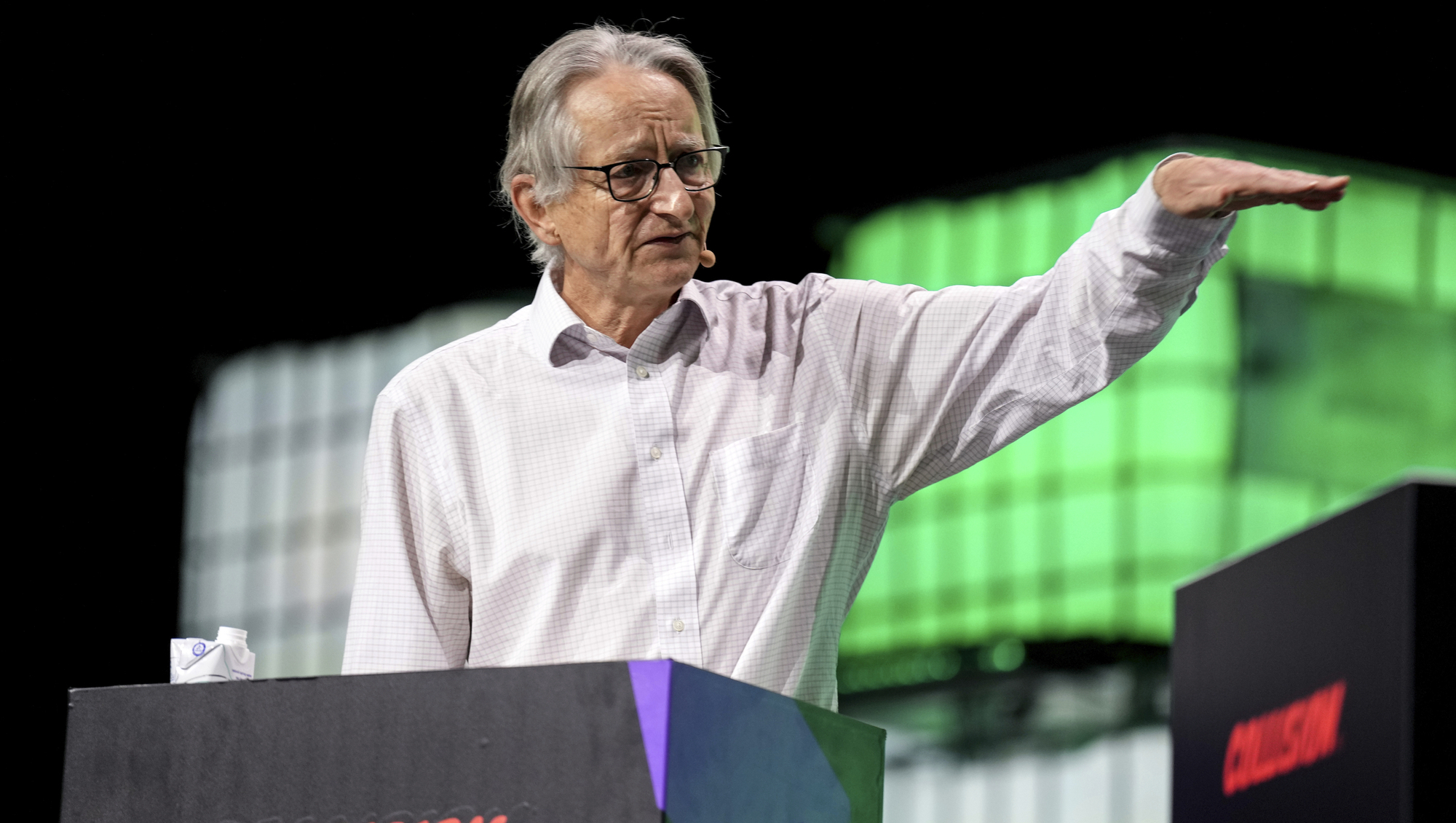
Nobel laureate Professor Geoffrey Hinton in 2024. Prof Hinton concluded that if AI 'did take control, we wouldn't be able to take control back'. File picture: Chris Young/The Canadian Press/AP
Humanity is "toast" if artificial intelligence keeps evolving and cannot be turned off, the 'Godfather of AI' has warned as European leaders gathered in Dublin.
In a series of stark warnings, Nobel laureate Professor Geoffrey Hinton said earlier this week he was going to warn leaders that AI could wipe out humankind in three years.
Prof Hinton concluded that if AI “did take control, we wouldn't be able to take control back”.
As 24 of the EU's 27 leaders gathered in Dublin for an informal meeting of the European Council, AI dominated discussion, with Mistral AI co-founder and CEO Arthur Mensch and Mr Hinton among the key speakers.
European Commission president Ursula von der Leyen acknowledged the scale of technological shift, saying every generation "faces a technological turning point that shapes the decades ahead".
“For ours, it is artificial intelligence,” she said, explaining that Prof Hinton “described very clearly the enormous risks” of AI.
Ms von der Leyen said that Prof Hinton “described very clearly the enormous risks he sees in AI, specifically runaway AI”.
Read More
She noted that Europe was previously criticised for regulating AI yet is now being praised for doing so.
Mr Hinton told RTÉ's that “chatbots have less regulation on them than a ham sandwich”.
Despite this, Ms von der Leyen also said that the EU wants to “accelerate the use of AI” and is “focusing on five sectors where AI can have the biggest value and the biggest impact”.
Taoiseach Michael Martin said leaders were “reminded that AI is developing at extraordinary speed and will shape our economics, societies, and democracies irrevocably”.
He said there was a “very strong sense around the table that we also need to mitigate” the “considerable” risks posed by AI.
“AI must remain under human direction, oversight, and control, and it must be developed and used in line with international law,” he said.
Mr Martin said: “We need to maximise the opportunities offered by AI, and we need to control all the risks of AI.”
Mr Martin also discussed AI later, following a meeting of EU leaders.
“There are benefits and risks. AI is a reality in the modern era, but I think [Prof Hinton's] warnings have to be taken seriously given his expertise,” Mr Martin told the .
“What I took from his presentation to the council today was the need to, at the earlier stage of the design of AI, make sure that we have clear principles that underpin the design of AI.
“That it is to be designed to better humankind, not to undermine it.”
Mr Martin said he believed there is a need to build up expertise.
“We have to ensure that the models are ones that are under the control of humans,” he said.
On regulation, the Taoiseach said he believed there is “growing momentum” behind a movement for global governance of AI, while pointing to the backlash in the US with the midterm elections.
“As the Congress changes, there may be a renewed focus on the need to be conscious of the risks and to have a stronger regulatory framework.
“So one has to start developing the concept of a global governance framework. That is now underway.” He cited the work of both Finland and Norway, who called for a global governance structure at a recent meeting of the United Nations.
EU leaders also discussed Russia's invasion of Ukraine, with Latvian prime minister Andris Kulbergs declaring that Europe needed to be more assertive towards Russia.
“We, as Europe, have to grow some bigger balls because we are bigger in size,” he said.
Mr Martin said the EU has been strong in its response to the Russian invasion. "I won’t repeat the phrase, but I think sometimes Europe can be overly self-critical,” he said.
It was confirmed that Europe will be represented at peace talks between Ukraine and Russia by the E5, made up of EU institutions as well as France, Germany, Italy, Poland, and the UK.
Friday's informal meeting of the European Council followed Thursday's European Political Community summit, with the two gatherings among the major events of Ireland's six-month presidency of the Council of the EU.
- Louise Burne is Political Correspondent.
CONNECT WITH US TODAY



Be the first to know the latest news and updates