Metrolink to cost €17.5bn at most and start operating within next 12 years, project boss says
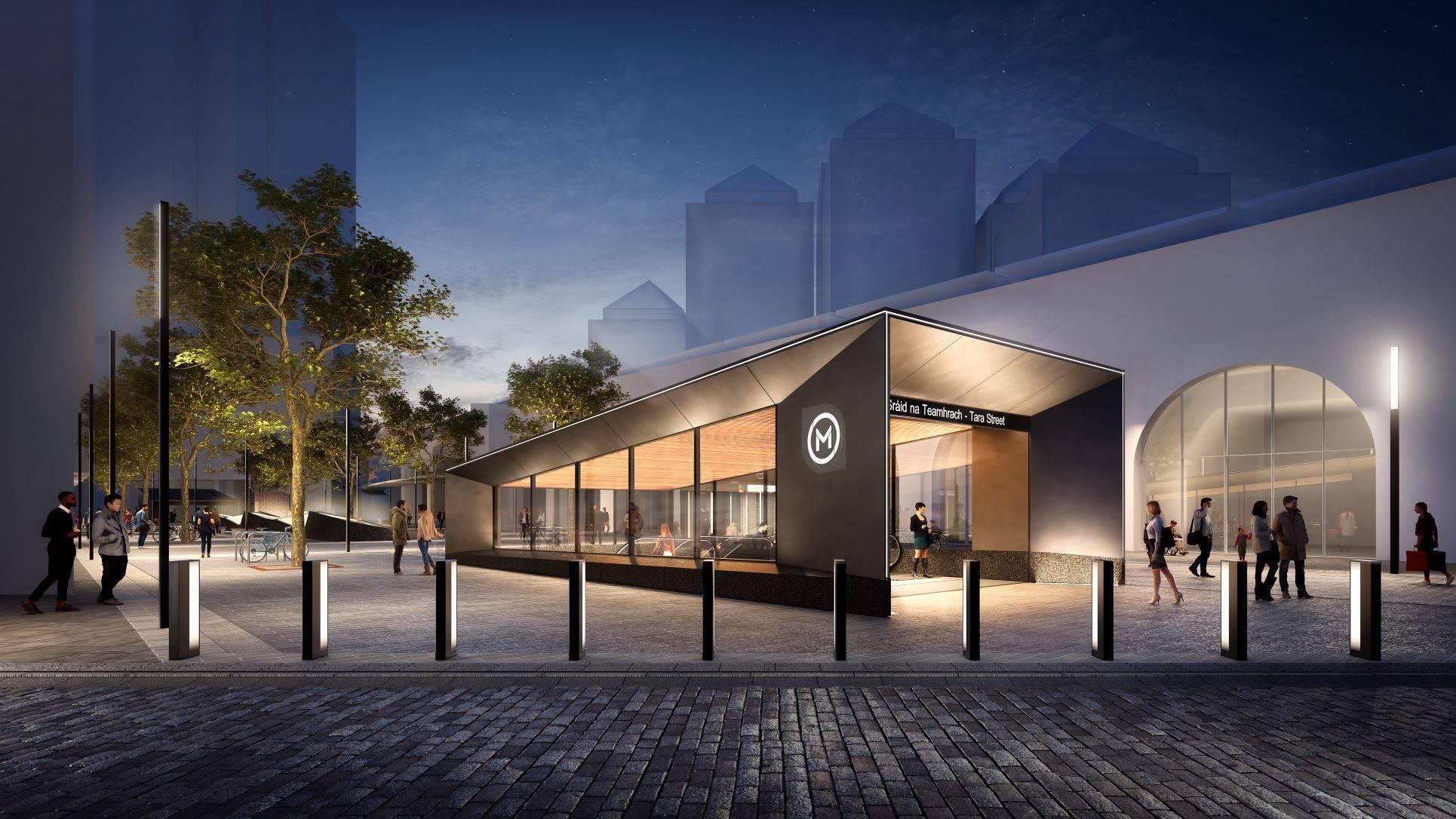
An artist's impression of the MetroLink rail project's Tara Street entrance. The final 19km, 16-stop line will stretch from Estuary north of Dublin Airport, via the airport itself, though Dublin city centre and on to Charlemont on the city's southside. File picture
Metrolink, the largest infrastructure project in the history of the State, is set to carry its first passengers between 2036 and 2038, and will cost a maximum of €17.5bn.
Transport Infrastructure Ireland and the National Transport Authority say that when completed the giant underground project will see between €1.13 and €1.95 returned to the taxpayer for every €1 invested, with there being no scenario where the rail link will cost more than it creates.
Interim programme director of Metrolink itself, Michael Flynn, said the project — should it gain final Government approval next year — will allow for the construction of 77,000 additional homes, while 20,000 people will use the driverless service each hour in both directions, with the link to be powered entirely via renewable energy.
The final 19km, 16-stop line will stretch from Estuary north of Dublin Airport, via the airport itself, though Dublin city centre and on to Charlemont on the city's southside.
A park-and-ride facility is to be constructed at Estuary to accommodate 3,000 cars, Mr Flynn said, with interchange capability at Dublin Airport, Glasnevin, O'Connell Street and St Stephen's Green and Charlemont for trains, the Luas, and DART services.
Assuming there are no issues with inflation or risk, the baseline cost of bringing Metrolink to operational status would be €10.1bn, Mr Flynn said.
The worst case scenario in terms of costings would see the project cost €17.49bn, he said, with that situation assuming that 80% of the project’s deliverables “don’t go to plan”. The best case scenario meanwhile would see Metrolink cost €14.4bn.
Should the project manifest in the best-case scenario, then Metrolink could carry its first passengers in 2036, with 2038 the likely go-live date should things not go according to plan.
Mr Flynn was speaking at a media briefing for the project to mark its having reached Approval Gate 2 of the State's public procurement process for the delivery of large-scale infrastructure — the publication of a detailed business case — with that milestone seeing Metrolink proceeding to tender for its construction.
That process will take an additional year, with a final Government decision as to whether or not to proceed with Metrolink to be taken towards the end of 2027, with the project to break ground the following year should approval be given.
The executives acknowledged that Metrolink is being proposed at a time of heightened geopolitical and economic uncertainty, while a previous iteration of the proposed link, dating from 2000, was scrapped in 2011 on foot of the 2008 global financial crisis.
"I think it's a fair point," Lorcan O'Connor, chief executive of TII, said when asked if it's "now or never" for Metrolink given the amount of work that has gone in to getting the project to its current state. "I think obviously the financial crisis of 15 years ago was a particular set of circumstances," he said.
"The entire country was insolvent. But what we have now is a well-developed programme. The next step allows us to actually go to the market and get a final price. But we have everything in place to actually commence this project at this stage," he added.
Mr Flynn did acknowledge however that despite the "robust" costings of the detailed business case for Metrolink, it will be the tenderers that "will ultimately establish the true market price".
"It's the market that will ultimately deliver the contracts and ultimately deliver the project," he said.

CONNECT WITH US TODAY



Be the first to know the latest news and updates