Skyclarys funding approved by HSE after emotional campaign from Friedreich’s ataxia families
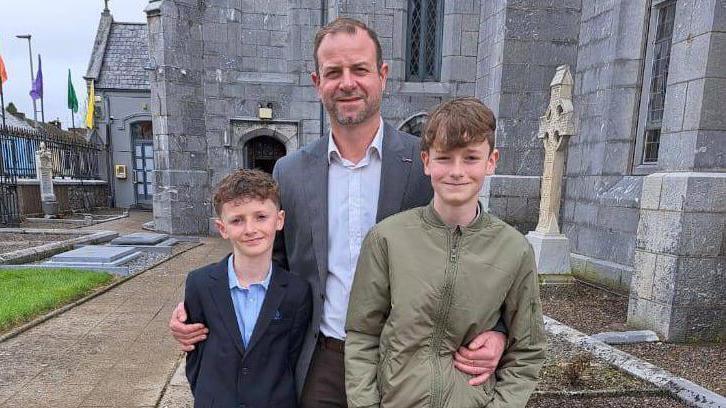
Craig Coady and his sons Paudie and Rory.
Cork father Craig Coady, whose son Paudie has Friedreich’s ataxia and who lost his other son Rory to the same illness last September, said the HSE’s decision to fund Skyclarys was “like a ton weight had been lifted”.
The HSE has approved funding for the treatment for patients with Friedreich’s ataxia following a long campaign by patients and their families.
Mr Coady said he had not been hopeful in recent weeks that the HSE’s senior management team would overturn the recommendation of its Drugs Group, which had advised against funding Skyclarys earlier this month.
“I wasn't hopeful over the last two weeks because it's so rare that the HSE management goes against the advice of the Drugs Group.
“That final push was something I had to do. The last 7-10 days, people got behind it and we gave it the best push we could. I wasn't hopeful because it's not often it's done, but I felt hope yesterday when Rare Disease Ireland came out.
“I feel exhausted now. Hopefully it won't be too long to get the drugs into our hands.
“For Paudie, he can still use his hands and walk and talk some bit. This drug will slow down the disease and that's the main thing.” The HSE said its decision followed a “substantially improved financial offer” from pharmaceutical company Biogen.
Its senior management team met on Tuesday morning to consider the benefits of the drug for patients against the terms of the new offer.
“The SMT took account of a substantially improved financial offer made in recent days by the company Biogen to the HSE arising from intensive discussions,” a spokeswoman said.
“Biogen has moved substantially from its previous position, and the HSE wants to express its appreciation of the flexible and constructive approach shown by the company.” Following the change in the terms, the HSE said it was faced with “a very different commercial offering” to that previously considered by its Drugs Group.
Read More
The HSE spokeswoman said: “On balance the senior management team decided to approve reimbursement for Skyclarys based on the new commercial offering.
“It concluded that had it been asked to consider the same terms the HSE Drugs Group considered, it would have come to the same position as the Drugs Group and would not have proposed reimbursement.” The senior management team also considered the limited effectiveness shown for the drug and noted that a high cost remains despite the improved offer.
“It considered some of the potential weaknesses in the clinical evidence and other relevant matters the Drugs Group considered under the Health (Pricing and Supply of Medical Goods) Act 2013,” she said.
However, it also took account of the “substantial unmet need of patients suffering from what is a devastating disease and the absence of any other medicines to treat it”, she added.
Work is now under way between the HSE and Biogen to finalise how the treatment will be rolled out to patients and the administrative systems required.
“The HSE will progress these engagements quickly, and understands that Biogen is also committed to finalising details at an early stage,” she said.
Around 200 people in Ireland are affected by Friedreich’s ataxia.

Health minister Jennifer Carroll MacNeill has asked the HSE and Biogen to begin work immediately on rolling out Skyclarys.
“It is an important day in a world where their disease brings far too much uncertainty,” she said on Tuesday.
“Though I know the statutory process through which these decisions are made is complex, it is important that politics and politicians allow the space for science to be the decision maker.”
Referring to the public campaign for reimbursement, she said: “I am grateful to the patients who have so carefully articulated their lived experiences. I am also grateful to the many clinicians who provided the HSE’s Senior Management Team with their expertise and advice to make their decision today.”
She also said: “At a time when there is too much uncertainty in the world, Ireland will continue to stick to science and to the rule of law. Simply put, these processes must be independent and led by experts.”
The minister thanked the HSE and Biogen for their “intensive engagement”, particularly noting the pharmaceutical company’s work in recent days.
Ms Carroll MacNeill expects the HSE and Biogen will now work together to ensure that patients can get swift access to the drug.
“I have asked that this work commence immediately,” she said.
Taoiseach Michael Martin welcomed the decision by the HSE to recommend the use of the drug, Skyclarys.
“I wish to pay tribute to all those living with Friedreich’s Ataxia, and their families, who have endured so much. I thank them for their engagement and their advocacy,” Mr Martin said in a statement.
“I understand fully their concerns and anxieties in relation to gaining access to this drug, the first treatment of its kind for this condition.
“It has been a very challenging period for the families, and I wish to acknowledge that.
“We appreciate the fact that this decision came on the back of substantive engagement between the HSE and the company Biogen over the past number of days and weeks.
“The outcome will result in strong engagement with Biogen over the coming years in respect of the treatment of Friedreich’s Ataxia. It was important that the statutory process for approving the drug was brought to its conclusion, and we welcome this decision, first and foremost for those who need access to Skyclarys.
“The Minister for Health and the Government will now work to support implementation of the HSE’s recommendation as quickly as possible.”
This is an “absolutely life-changing” decision for patients, according to Maureen Sweeney, head of operations at the Ataxia Foundation Ireland.
“Everybody is just so relieved and delighted,” she said on Tuesday.
“I don’t know whether to laugh or cry here. It is just so emotional and it is just such a relief for everyone.”
She understands the drug is being licensed here under European Medicines Agency approvals, meaning it will be available to all patients aged over 16.
Skyclarys is not a cure, but it does slow the physical deterioration associated with the condition. This includes the impact on vocal cords and speech.
“In reality some people will not progress an awful lot more with the condition, so it’s life-changing for them. It’s absolutely life-changing,” Ms Sweeney said.
“And one of the big things is this drug has been proven to help with the voice so that will keep them being able to communicate.”
She stressed that this is “a massive, massive thing” for everyone affected.
The Ataxia Foundation Ireland will mark its 10th anniversary next month, and she said there will now be something for everyone to celebrate together.


CONNECT WITH US TODAY



Be the first to know the latest news and updates