Jess Casey: Covid still in play as record 70,400 Leaving Cert students get their results
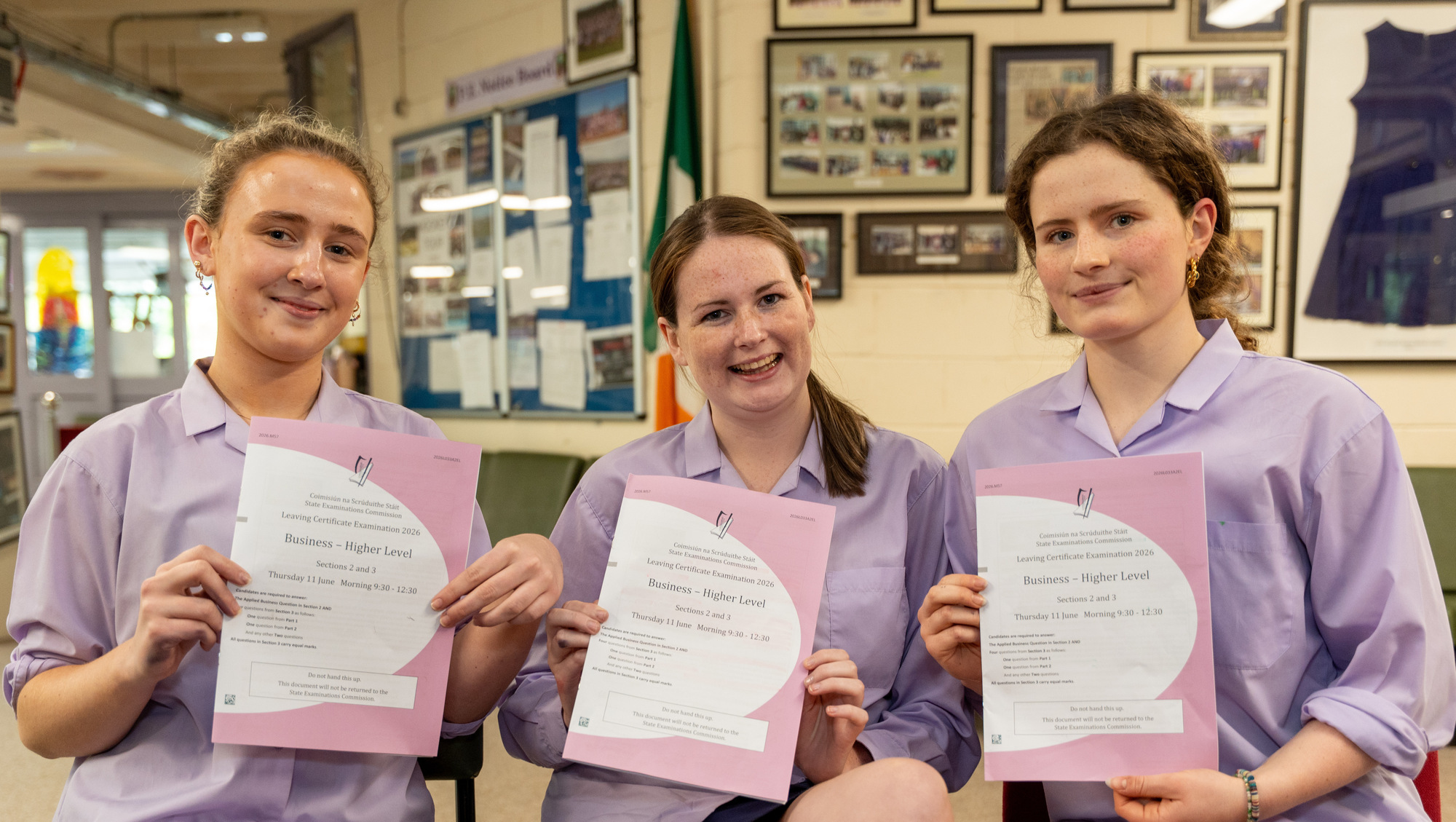
Claire McCarthy, Casey Cahill, and Andrea Lehane after sitting the Business paper at Regina Mundi College in Cork last week. Most students receiving their LC results today started secondary at the height of covid. Picture: Noel Sweeney
A record number of students will receive their Leaving Cert results today — more than 70,400 students, an increase of 15% when compared to 2024.
Most of them began their studies at the height of the covid pandemic, starting first year in September 2020, wearing face masks and following social distancing, having left their primary schools unexpectedly in March that year.
The impact of that chapter of recent history is remarkably still evident on the outcomes of the State exams.
The Class of 2026 is the second group now to face more modest grades than their peers who received their results in the more immediate aftermath of the pandemic.
Exam authorities continued this year with tentative steps to address grade inflation, which soared following chops and changes to the traditional Leaving Cert format and marking system due to covid-era disruption.
Read More
Pandemic upheaval to the Leaving Cert included the cancellation of traditional June exams, which were replaced with the teacher-led calculated grades in 2020, followed by both exams and accredited grades in 2021.
As the exam cycle re-adjusted in 2022, 2023, and 2024, grades were kept at an inflated level, before the first steps to bring them back to pre-pandemic levels began in 2025.
Prior to any statistical interventions, the marks in 2026 were mostly in line with those of 2025, if not slightly stronger.
The marking outcomes were then put through one round of statistical adjustment by the State Examination Commission (SEC). This brought them closer to 2020 levels, on the aggregate.
Grades were artificially boosted upwards in 2025, too. However, in 2025, grades were adjusted to bring them midway between 2020 and 2021 levels, which were higher.
The post-marking adjustment (PMA) applies more to lower marks than it does to higher marks. It applies on a linear scale, equally across all subjects.
The PMA applied does not remove marks, or bring a student’s grades lower. More marks are applied to lower results, gradually declining towards the higher results.
This ranged from 2.3 at the top of the scale, and 7 at the lower end. The average adjustment was 4. This compares to 3.1 at the highest end in 2025, and 10.3 at the
bottom of the scale, and an overall average of 5.8.
The PMA applied to all 470,000 grades in the 2026 Leaving Cert; as a result, 35.5% (166,868) increased a grade, and 303,409 are unchanged. While its still an adjustment upwards, this is far less dramatic than in recent years. More than 71% of grades were adjusted upwards in 2023; 68% in 2024; and 52.4% in 2025.

The SEC post-marking adjustment looks set to stay at least another year to avoid a cliff-edge style drop-off, as seen in other jurisdictions.
Moves to bring grades closer in line with the pre-pandemic norm have been slower here, as exam bosses and education authorities were keen to avoid this scenario.
This is in part because of how closely linked Leaving Cert results remain with the college application process.
Approximately 20,000 applicants to this year’s CAO are presenting results from previous years, the majority of which are likely to have benefitted from grade inflation to a stronger extent than the Class of 2026.
A record number of students sat exams in June, and there are also significant increases in individual subjects. This includes history, up 10%; PE, up 25%; construction studies, up 11%; Spanish, up 10%; Polish, up 23%; Ukrainian, up 18%; and Mandarin Chinese, up 47%.
In 2026, there are more students than ever, and more are opting to take subjects at a higher level; 330,787 grades this year have been awarded at higher level, compared to 110,431 at ordinary level.
Students are also receiving stronger marks now than before the pandemic. Close to 70% of all higher-level grades this year were awarded a H4 grade or higher, worth a minimum of 66 CAO points in every subject, bar maths, where it is worth 91 points.
In 2019, 62.9% of higher-level grades were H4 or higher. Last year, this stood at 74.2%, and at the peak of grade inflation in 2023, it stood at 77.2%.
More students are also continuing to achieve the very top marks in a subject, although not as high, proportionately, as in previous years. While the number of H1s awarded in many subjects stays well above pre-pandemic norms, they are proportionately less than the numbers awarded last year.
In 2019, almost 6% of all higher-level grades were H1s. In 2026, this stands at 10.1%, before appeals.
In Irish, 10% of the grades awarded at higher level in 2026 achieved a H1. This compares to 11% in 2025 before the appeals process, and 14.1% in 2024. In 2019, this
figure was 6.9%.

Of the higher level grades awarded in English, 4.3% this year received a H1. This compares to 5% in 2025, 6.9% in 2024, and 3% in 2019 pre-pandemic.
In maths, 8.1% of the grades awarded at higher level this year were H1s.
In 2025, this was 11%, and 12.6% in 2024. Pre-pandemic, in 2019, this figure stood at 6.4%.
How this year’s attempts to address grade inflation will impact on the first round of CAO offers next week remains to be seen. In recent years, there has been increased random selection, whereby a lottery is used to determine entry to popular courses. It has seen high-achieving students miss out on their number one choice.
Predicting the way CAO points will change is not an exact science.
A lot of factors impact cut-off points, as they are determined by supply and demand. Points fall and rise based on the popularity of courses, and whether or not more college places have been created.
This year, guidance counsellors also report that accommodation has become a major factor in where students wish to study. Many are opting for courses close to home or within a commutable distance.
- Jess Casey Education Correspondent


CONNECT WITH US TODAY



Be the first to know the latest news and updates