Murdered man's mother calls out 'victim-blaming' in Irish justice system
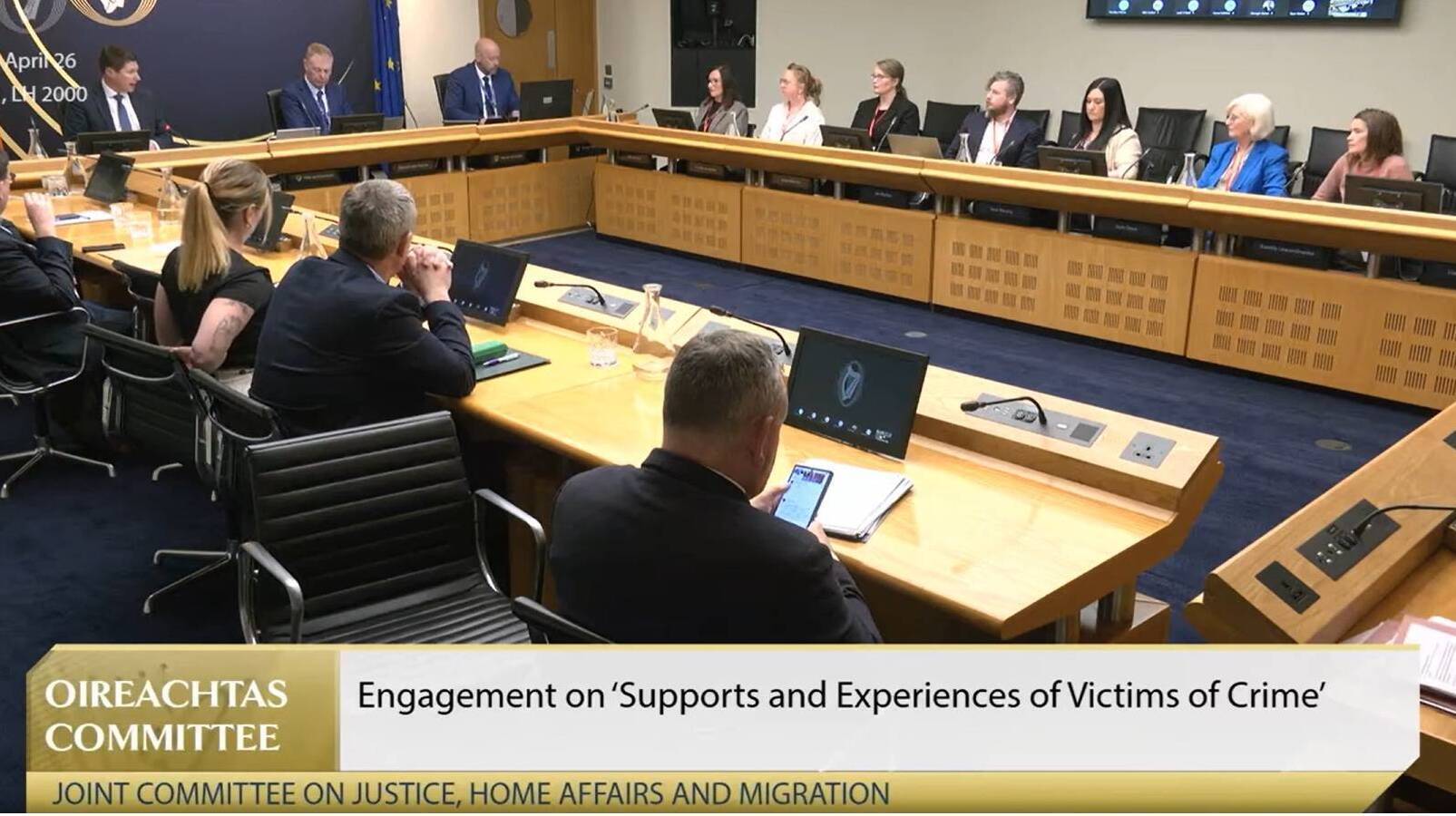
Niamh McGuinness, whose son was murdered, and assault survivor Ruth Maxwell were among those who addressed the joint Oireachtas justice committee today. Picture: Oireachtas TV
The mother of a man murdered in a Dublin hostel has told a Dáil committee that Ireland’s systems are “built on subtle victim-blaming”.
Niamh McGuinness’s 23-year-old son James Kavanagh was murdered by Robert Murphy in April 2023.
The mother was one of a number of people who addressed the Joint Committee on Justice, Home Affairs and Migration during a session on supports and experiences of victims of crime.
She described her son as “kind, empathetic, loved animals and music and is adored and missed unbelievably by his family", adding: “He is now part of a devastating statistic: 85% of homicide victims in Ireland are male.”
She said that while great progress has been made in “creating appropriate outrage regarding violence against women, there is a pervasive assumption that men ‘invite’ violence through their lifestyle or choices".
“This cultural bias leads to a massive disparity in empathy and, consequently a massive disparity in funding for interventions and supports.”
She added: “If appropriate interventions and supports were available for those most at risk of perpetrating violence, the number of victims could be significantly reduced.”
She said that the cost of imprisoning one person for 25 years is approximately €2.5m, but that early trauma intervention costs a fraction of that.
Meanwhile, victims representative Ruth Maxwell told the committee: “Ten years after the crime, I remain on a waiting list in relation to my injuries.
"I only received full psychological support last year, nine years after the offence.
"As my physical injuries worsen, there is still no long-term support framework in place.”

She sustained severed tendons in her hand as she fought off her attacker, Slawomir Gierlowski, in Dublin in 2016. She damaged her hand when pulling his knife away from her throat. After a DNA profile was made after that attack, Gierlowski was linked to and convicted of previous attacks on women.
Read More
Ms Maxwell now works as a consultant to support others in their dealings with the Criminal Injuries Compensation Tribunal.
She says the current compensation scheme is not workable.
“There is no dedicated organisation specifically supporting victims of violent or knife crime. As a result, recovery is prolonged and isolating, and in many cases harder than it needs to be.
"The compensation process is a central part of the problem. It is not accessible in practice.
"The burden of making the system work is placed on the victim.
This is not an isolated experience. It is something I see consistently across victims of violent crime, including those affected by domestic and sexual violence.”
Last month, the Law Reform Commission recommended that a new State body be set up to oversee compensation for victims of violent crime, with the commission saying the current payments system is not fit for purpose.
Crime Victims Helpline chief executive Michele Puckhaber told the committee that the helpline has submitted a proposal to the Department of Justice to pilot “a comprehensive support model for victims of general crime for those who currently fall outside existing services”.
She said however that the helpline does not have a “mandate or the resources to meet this need”.
She added: “Support for victims of crime must not remain piecemeal. It must be planned, be resourced and be available to all victims.”